


#Short Answer
Covers understanding generative ai: a comprehensive guide, including core concepts, practical examples, benefits, limitations, and risks in Generative AI.
#Infobox
#Overview
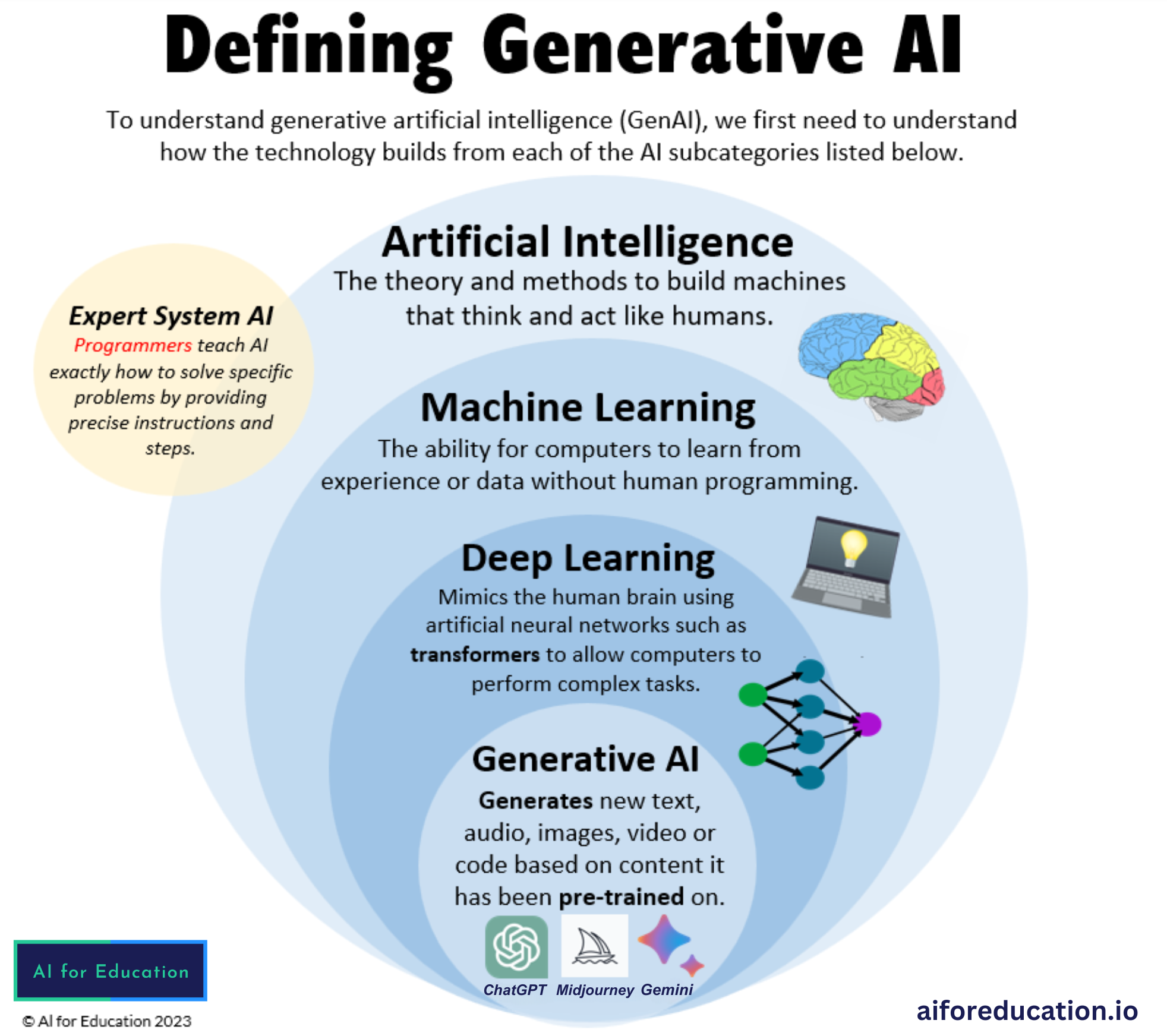
Generative AI represents a transformative branch of artificial intelligence focused on creating novel data instances that resemble real-world examples. Unlike discriminative models, which classify or predict outcomes from given inputs, generative models learn the underlying distribution of training data to synthesize new, plausible content. This capability has revolutionized industries by automating creative processes, accelerating research, and enabling human-AI collaboration. The technology underpins tools like text generators (e.g., large language models), image synthesizers (e.g., diffusion models), and music composers, all of which operate by identifying statistical patterns in vast datasets. Generative AI’s versatility stems from its ability to generalize beyond training data, producing outputs that are contextually coherent yet distinct from original examples.
#History / Background
#Early Foundations (1950s–2010s)
The conceptual roots of generative AI trace back to the 1950s with early experiments in neural networks and probabilistic models. However, practical advancements were limited by computational constraints and theoretical gaps. Key milestones include:
- 1957: The Perceptron, an early neural network model, laid groundwork for learning algorithms.
- 1986: Backpropagation, introduced by Geoffrey Hinton, enabled training of multi-layer networks.
- 2006: Geoffrey Hinton’s work on deep belief networks demonstrated generative capabilities by learning hierarchical representations.
#Breakthroughs (2010s–Present)
The 2010s marked a renaissance for generative AI, driven by:
- 2014: Ian Goodfellow’s introduction of Generative Adversarial Networks (GANs), which pit two neural networks (a generator and discriminator) against each other to improve output realism.
- 2017: The Transformer architecture, introduced in the paper "Attention Is All You Need", revolutionized sequence modeling, enabling models like BERT and later GPT to generate coherent text.
- 2020s: Scaling laws and computational advancements led to large language models (LLMs) such as GPT-3 (2020) and GPT-4 (2023), capable of generating human-like text, code, and even creative narratives.
#Commercialization and Public Adoption The late 2010s and early 2020s saw generative AI transition from research labs to mainstream applications:
- 2018: OpenAI released GPT-1, followed by iterative improvements (GPT-2 in 2019, GPT-3 in 2020).
- 2021: DALL·E and Stable Diffusion popularized AI-generated images, democratizing creative tools.
- 2022–2023: Tools like MidJourney, GitHub Copilot, and Jasper integrated generative AI into workflows for writing, coding, and design.
#How It Works
#Core Principles Generative AI relies on probabilistic modeling to learn data distributions and sample from them. The process involves:
- Training on Large Datasets: Models ingest vast amounts of labeled or unlabeled data (e.g., text corpora, image repositories).
- Learning Patterns: Neural networks identify statistical correlations (e.g., word sequences in text or pixel relationships in images).
- Sampling: The trained model generates new data by sampling from the learned distribution.
#Key Architectures
- Generative Adversarial Networks (GANs)
- Components: A generator creates synthetic data, while a discriminator evaluates its authenticity.
- Process: The generator improves by fooling the discriminator, leading to increasingly realistic outputs.
- Applications: Image synthesis, video generation, and data augmentation.
- Variational Autoencoders (VAEs)
- Components: An encoder compresses input data into a latent space, and a decoder reconstructs it.
- Process: VAEs learn a probabilistic mapping, enabling controlled generation by sampling from the latent space.
- Applications: Anomaly detection, drug discovery, and image editing.
- Transformer-Based Models (e.g., LLMs)
- Components: Self-attention mechanisms allow the model to weigh input tokens dynamically.
- Process: Models predict the next token in a sequence (e.g., words in text) based on context.
- Applications: Text generation, translation, summarization, and code completion.
- Diffusion Models
- Components: A forward process gradually adds noise to data, while a reverse process learns to denoise it.
- Process: The model generates data by iteratively refining noisy inputs.
- Applications: High-resolution image synthesis (e.g., Stable Diffusion, DALL·E 3).
#Training and Optimization
- Loss Functions: Models minimize discrepancies between generated and real data (e.g., cross-entropy loss for text, adversarial loss for GANs).
- Fine-Tuning: Pre-trained models are adapted to specific tasks using smaller, task-specific datasets.
- Reinforcement Learning: Some models (e.g., RLHF in LLMs) use human feedback to align outputs with desired behaviors.
#Important Facts
- Data Dependency: Generative AI’s performance hinges on the quality, diversity, and scale of training data. Biases in datasets can lead to biased outputs.
- Computational Cost: Training large models (e.g., LLMs) requires significant GPU/TPU resources, often exceeding millions of dollars in cloud costs.
- Ethical Concerns: Issues include deepfakes, misinformation, plagiarism, and job displacement in creative fields.
- Open vs. Closed Models: Open-source models (e.g., Stable Diffusion) promote accessibility, while proprietary models (e.g., GPT-4) offer higher performance but restrict usage.
- Multimodal Capabilities: Modern generative AI integrates multiple data types (e.g., text-to-image, image-to-text) for richer applications.
- Regulation: Governments and organizations are developing frameworks (e.g., EU AI Act, U.S. Executive Order on AI) to address risks like misuse and transparency.
#Timeline
- Foundational ideas
Core concepts and early methods shape Understanding Generative AI: a Comprehensive Guide.
- Practical use
Tools, examples, and real-world deployments make the topic easier to evaluate.
- Responsible implementation
Current work focuses on reliability, governance, performance, and measurable impact.
#Related Terms
#FAQ
What does Understanding Generative AI: a Comprehensive Guide cover?
Covers understanding generative ai: a comprehensive guide, including core concepts, practical examples, benefits, limitations, and risks in Generative AI.
Why is Understanding Generative AI: a Comprehensive Guide important?
It helps readers understand key concepts, compare practical use cases, and evaluate how Generative AI decisions affect outcomes, risks, and implementation choices.
What should readers verify before applying this topic?
Readers should compare benefits, limitations, data requirements, and related themes such as Understanding, Generative, AI before using the ideas in real projects.
#References
- Understanding Generative AI: a Comprehensive Guide terminology and background research
- Understanding Generative AI: a Comprehensive Guide use cases, implementation examples, and limitations
- Generative AI best practices, standards, and risk guidance
- Understanding case studies, benchmarks, and current industry analysis


.png)
Comments
No comments yet. Start the discussion with a useful note.