


#Short Answer
Covers generative ai: everything you need to know, including core concepts, practical examples, benefits, limitations, and risks in Generative AI.
#Infobox
#Overview
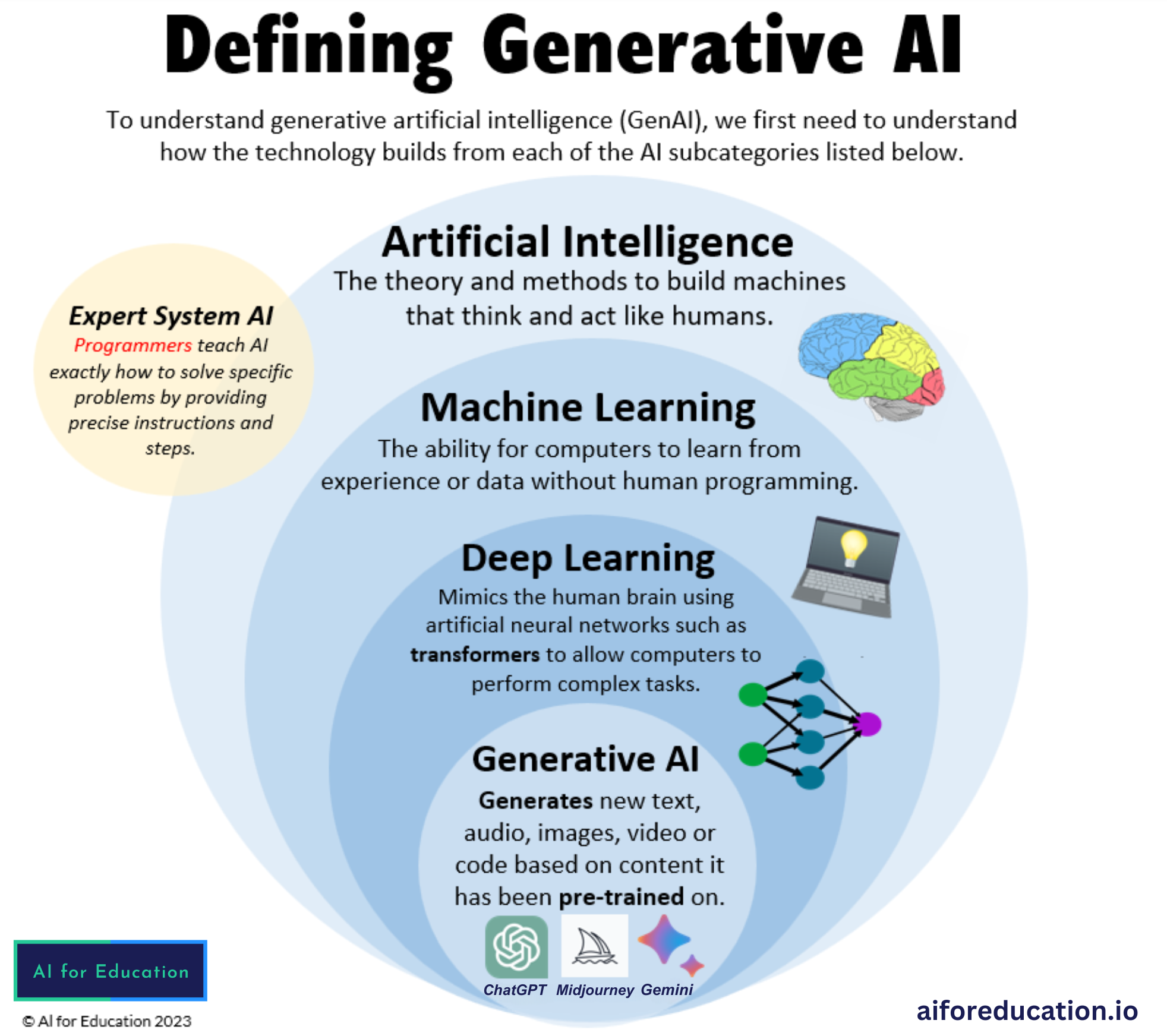
Generative AI represents a transformative branch of artificial intelligence focused on producing novel, coherent, and contextually relevant outputs. Unlike traditional AI, which analyzes or classifies existing data, generative models synthesize new data instances that mimic real-world patterns. This capability is driven by advanced machine learning architectures, particularly neural networks trained on massive datasets. The field encompasses multiple modalities, including:
- Text Generation: Creating human-like prose, summaries, or conversational responses.
- Image Synthesis: Generating photorealistic or artistic images from textual prompts.
- Audio Generation: Producing music, speech, or sound effects.
- Code Generation: Automating software development tasks.
- 3D Modeling: Creating virtual objects or environments. Generative AI systems leverage probabilistic modeling to predict and construct outputs, often employing techniques like autoregressive modeling, variational autoencoders (VAEs), and reinforcement learning from human feedback (RLHF). The integration of these models into workflows has democratized creativity, enabling non-experts to generate professional-grade content with minimal effort.
#History / Background
#Early Foundations (1950s–2010s)
The conceptual roots of generative AI trace back to early AI research, including:
- 1950s–1960s: Early experiments with rule-based systems and Markov chains for text generation.
- 1980s–1990s: Introduction of neural networks, though limited by computational constraints.
- 2006: Geoffrey Hinton’s work on deep belief networks revived interest in neural generative models.
- 2014: Ian Goodfellow’s introduction of Generative Adversarial Networks (GANs) revolutionized image synthesis by enabling realistic output generation through adversarial training.
#The Transformer Era (2017–Present)
The breakthrough came with the Transformer architecture, introduced in the 2017 paper "Attention Is All You Need" by Vaswani et al. Transformers, with their self-attention mechanisms, enabled efficient training on vast datasets and became the backbone of modern generative models. Key milestones include:
- 2018: OpenAI’s GPT (Generative Pre-trained Transformer) series debuted, demonstrating text generation capabilities.
- 2020: GPT-3 expanded model size to 175 billion parameters, showcasing few-shot learning and coherent long-form text generation.
- 2021: DALL·E (OpenAI) and Stable Diffusion (Stability AI) popularized text-to-image generation, making AI art accessible to the public.
- 2022–2023: The release of ChatGPT (GPT-3.5/4) and Midjourney v5 marked a shift toward conversational and creative AI tools, integrating into mainstream applications.
- 2024: Advances in multimodal models (e.g., combining text, image, and audio) and open-source alternatives (e.g., Llama 3) expanded accessibility and customization.
#Commercialization and Public Adoption The proliferation of generative AI tools coincided with the rise of cloud computing and big data, enabling scalable training and deployment. Companies like Microsoft, Google, and NVIDIA invested heavily in AI infrastructure, while startups focused on niche applications (e.g., legal document generation, medical imaging). Public awareness surged with the launch of user-friendly interfaces, such as chatbots and AI art platforms, though concerns about misuse (e.g., deepfakes) prompted regulatory discussions.
#How It Works
#Core Architectures Generative AI relies on several foundational architectures, each suited to specific tasks:
- Autoregressive Models (e.g., GPT, LLaMA)
- Mechanism: Predict the next token (word, pixel, or data point) in a sequence based on prior inputs.
- Training: Uses large text corpora (e.g., Common Crawl, Wikipedia) to learn statistical patterns.
- Output: Generates text by iteratively sampling from a probability distribution over possible next tokens.
- Example: ChatGPT generates responses by predicting the most likely continuation of a prompt.
- Generative Adversarial Networks (GANs) (e.g., StyleGAN, CycleGAN)
- Mechanism: Two neural networks—a generator (creates data) and a discriminator (evaluates authenticity)—compete in a zero-sum game.
- Training: The generator improves by fooling the discriminator, while the discriminator learns to distinguish real from fake data.
- Output: High-fidelity images, videos, or audio (e.g., deepfake videos).
- Challenge: Mode collapse (generator produces limited variations) and training instability.
- Variational Autoencoders (VAEs)
- Mechanism: Encodes input data into a latent space (compressed representation) and decodes it to reconstruct or generate new data.
- Training: Optimizes for both reconstruction accuracy and latent space regularity.
- Output: Smooth interpolations between data points (e.g., morphing images).
- Use Case: Drug discovery, anomaly detection.
- Diffusion Models (e.g., Stable Diffusion, DALL·E 2)
- Mechanism: Gradually adds noise to data (forward process) and then reverses it (reverse process) to generate new samples.
- Training: Learns to denoise corrupted data, enabling high-quality synthesis.
- Advantages: Superior image quality, stability compared to GANs.
- Example: Stable Diffusion generates images from text prompts by iteratively refining a noisy input.
- Transformer-Based Models (e.g., PaLM, Mistral)
- Mechanism: Uses self-attention to weigh the importance of each input token relative to others, enabling parallel processing of sequences.
- Scalability: Models with trillions of parameters (e.g., Google’s PaLM 2) achieve state-of-the-art performance in language tasks.
- Fine-Tuning: Adapts pre-trained models to specific domains (e.g., medical or legal text).
#Training Process
Generative models undergo two primary phases:
- Pre-Training: The model learns from a vast, unlabeled dataset (e.g., books, images) to capture general patterns.
- Fine-Tuning: The model is refined on smaller, labeled datasets for specific tasks (e.g., summarization, translation).
#Key Techniques
- Reinforcement Learning from Human Feedback (RLHF): Aligns model outputs with human preferences (used in ChatGPT).
- Prompt Engineering: Crafting input queries to guide model behavior (e.g., "Write a poem in the style of Shakespeare").
- Few-Shot Learning: Generating coherent outputs from minimal examples (e.g., GPT-3’s 175B parameters enable few-shot tasks).
- Multimodality: Combining text, image, and audio inputs/outputs (e.g., Google’s Gemini).
#Important Facts
- Scalability: Modern models like GPT-4 and PaLM 2 contain over 1 trillion parameters, requiring thousands of GPUs/TPUs for training.
- Energy Consumption: Training large models has a significant carbon footprint (e.g., GPT-3’s training emitted ~552 metric tons of CO₂).
- Bias and Fairness: Models inherit biases from training data, leading to skewed outputs (e.g., gender or racial stereotypes in text/images).
- Hallucinations: Generative models may produce plausible but factually incorrect information (a critical issue in healthcare or legal applications).
- Copyright Issues: Training on copyrighted material (e.g., books, art) has sparked lawsuits (e.g., The New York Times v. OpenAI).
- Accessibility: Open-source models (e.g., Stable Diffusion, Llama) democratize AI, while proprietary models (e.g., DALL·E 3) offer polished but restricted features.
- Regulation: Governments are exploring frameworks like the EU AI Act to classify generative AI as "high-risk" systems, mandating transparency and risk assessments.
#Timeline
- Foundational ideas
Core concepts and early methods shape Generative AI: Everything You Need to Know.
- Practical use
Tools, examples, and real-world deployments make the topic easier to evaluate.
- Responsible implementation
Current work focuses on reliability, governance, performance, and measurable impact.
#Related Terms
#FAQ
What does Generative AI: Everything You Need to Know cover?
Covers generative ai: everything you need to know, including core concepts, practical examples, benefits, limitations, and risks in Generative AI.
Why is Generative AI: Everything You Need to Know important?
It helps readers understand key concepts, compare practical use cases, and evaluate how Generative AI decisions affect outcomes, risks, and implementation choices.
What should readers verify before applying this topic?
Readers should compare benefits, limitations, data requirements, and related themes such as Generative, AI, Machine Learning before using the ideas in real projects.
#References
- Generative AI: Everything You Need to Know terminology and background research
- Generative AI: Everything You Need to Know use cases, implementation examples, and limitations
- Generative AI best practices, standards, and risk guidance
- Generative case studies, benchmarks, and current industry analysis
.png)


Comments
No comments yet. Start the discussion with a useful note.