


#Short Answer
Covers generative ai for dummies: a beginner’s overview, including core concepts, practical examples, benefits, limitations, and risks in Generative AI.
#Infobox
#Overview
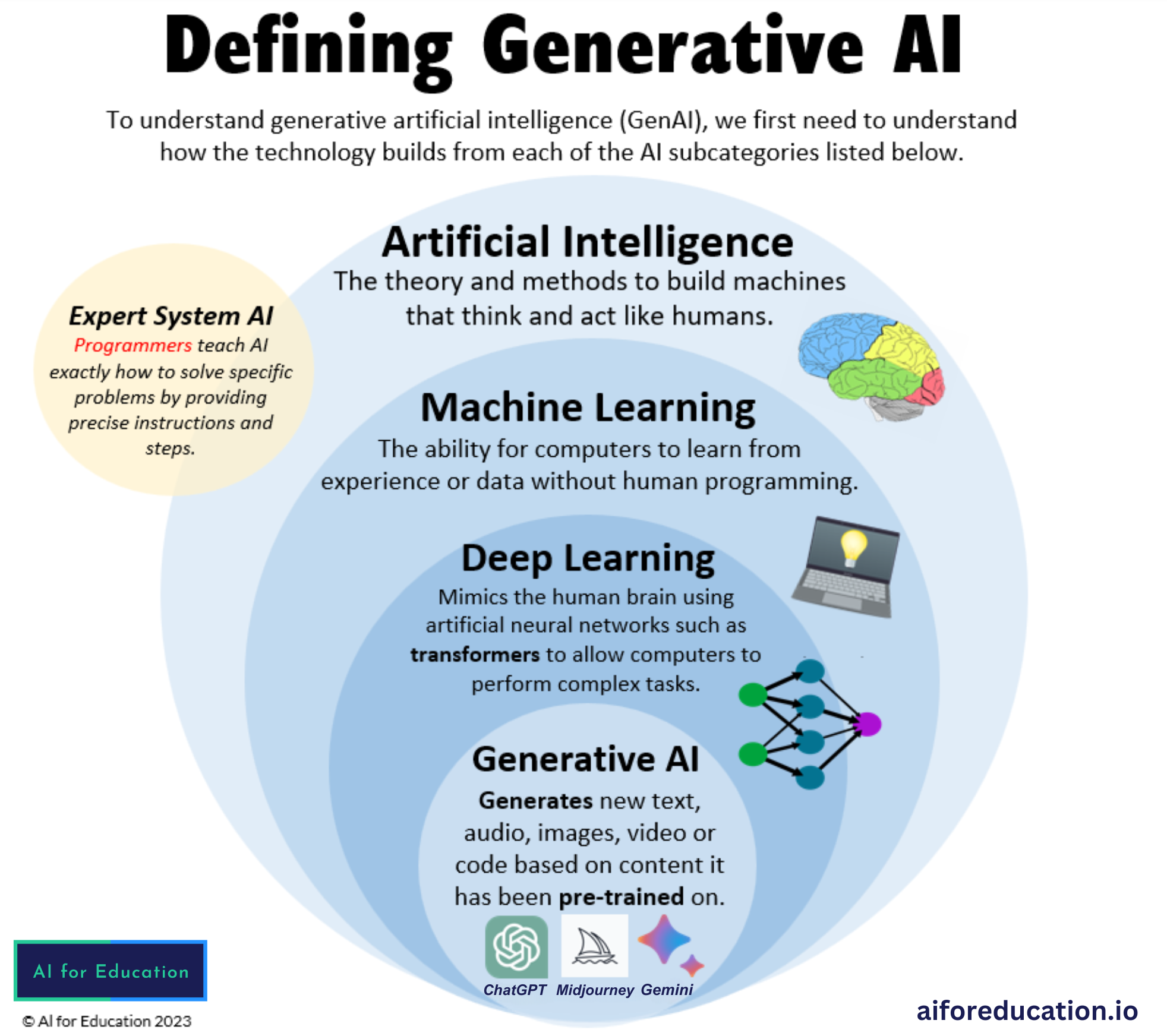
Generative AI for Dummies serves as an accessible introduction to generative artificial intelligence, a subset of AI focused on creating new content—such as text, images, music, and code—based on patterns learned from existing data. The book demystifies complex AI concepts, making them approachable for readers with little to no technical background. It covers foundational principles, real-world applications, and ethical considerations, positioning itself as a practical resource for those looking to understand or leverage generative AI in personal, academic, or professional contexts. The book emphasizes hands-on learning, featuring step-by-step explanations, case studies, and examples of popular generative AI tools like large language models (LLMs), diffusion models, and neural networks. By breaking down technical jargon into digestible segments, it equips readers with the knowledge to navigate the rapidly evolving landscape of AI-driven content creation.
#History / Background
#Origins of Generative AI Generative AI traces its roots to the mid-20th century, with early advancements in machine learning and neural networks. The concept of generative models emerged from research in probabilistic graphical models and statistical learning, where algorithms were designed to generate new data points that resembled training data. Key milestones include:
- 1950s–1960s: Early experiments with neural networks, such as the perceptron, laid the groundwork for AI-driven generation.
- 1980s–1990s: The development of hidden Markov models (HMMs) and Gaussian mixture models (GMMs) enabled probabilistic generation of sequences, such as speech or text.
- 2000s: The rise of deep learning, particularly convolutional neural networks (CNNs) and recurrent neural networks (RNNs), revolutionized generative capabilities, leading to breakthroughs in image and text synthesis.
#Evolution of Generative AI The modern era of generative AI began with the introduction of generative adversarial networks (GANs) in 2014 by Ian Goodfellow and colleagues. GANs introduced a novel framework where two neural networks—a generator and a discriminator—compete in a zero-sum game to improve the quality of generated outputs. This innovation spurred rapid progress in image generation, with tools like StyleGAN and DALL·E achieving photorealistic results. Subsequent advancements included:
- 2017: The introduction of transformer models, such as the original Transformer architecture, which enabled more efficient handling of sequential data, paving the way for large language models (LLMs).
- 2020: The release of GPT-3 by OpenAI demonstrated the potential of LLMs to generate coherent, contextually relevant text, sparking widespread interest in generative AI.
- 2022–2023: The launch of DALL·E 2, MidJourney, and Stable Diffusion popularized text-to-image generation, making generative AI accessible to non-technical users.
#The Role of "Generative AI for Dummies" Published in 2023, Generative AI for Dummies reflects the growing demand for educational resources on generative AI amid its mainstream adoption. The book addresses the gap between rapid technological advancements and public understanding, providing a structured pathway for beginners to grasp both the theoretical and practical aspects of generative AI.
#How It Works
#Core Principles of Generative AI Generative AI operates on the principle of learning patterns from data and using those patterns to create new, original content. The process typically involves:
- Data Collection: Gathering large datasets (e.g., text corpora, images, audio) to train the model.
- Model Training: Using machine learning algorithms to identify statistical relationships within the data.
- Generation: Applying the trained model to produce new outputs that mimic the training data.
#Key Techniques
- Generative Adversarial Networks (GANs)
- Generator: Creates synthetic data (e.g., images, text).
- Discriminator: Evaluates the realism of the generated data, providing feedback to improve the generator.
- Outcome: High-quality, realistic outputs (e.g., deepfake videos, art).
- Variational Autoencoders (VAEs) - Encodes input data into a compressed latent space and decodes it to generate new variations. - Useful for tasks like image reconstruction and anomaly detection.
- Transformer Models - Utilizes self-attention mechanisms to process sequential data (e.g., text, time series). - Powers LLMs like GPT-4 and BERT, enabling text generation, translation, and summarization.
- Diffusion Models - Gradually adds noise to data and then reverses the process to generate new samples. - Used in tools like Stable Diffusion for high-fidelity image synthesis.
#Practical Applications Generative AI is applied across diverse fields:
- Content Creation: Automated writing (e.g., marketing copy, news articles), art generation.
- Healthcare: Drug discovery, medical imaging, synthetic patient data.
- Entertainment: Video game asset generation, music composition.
- Software Development: Code generation, bug fixing.
- Education: Personalized learning materials, interactive simulations.
#Important Facts
- Generative AI vs. Discriminative AI: Unlike discriminative models (which classify data), generative models create new data instances.
- Training Data Bias: Generative AI models inherit biases present in their training data, which can lead to skewed or inappropriate outputs.
- Computational Requirements: Training large generative models (e.g., LLMs) demands significant computational power, often requiring GPUs or TPUs.
- Ethical Concerns: Issues include deepfakes, misinformation, and intellectual property disputes over AI-generated content.
- Accessibility: Tools like DALL·E Mini, Craiyon, and GitHub Copilot have democratized generative AI, making it available to non-experts.
- Future Trends: Advances in multimodal models (e.g., combining text, image, and audio) and few-shot learning (generating outputs from minimal input) are shaping the next generation of generative AI.
#Timeline
- Foundational ideas
Core concepts and early methods shape Generative AI for Dummies: a Beginner’s Overview.
- Practical use
Tools, examples, and real-world deployments make the topic easier to evaluate.
- Responsible implementation
Current work focuses on reliability, governance, performance, and measurable impact.
#Related Terms
#FAQ
What does Generative AI for Dummies: a Beginner’s Overview cover?
Covers generative ai for dummies: a beginner’s overview, including core concepts, practical examples, benefits, limitations, and risks in Generative AI.
Why is Generative AI for Dummies: a Beginner’s Overview important?
It helps readers understand key concepts, compare practical use cases, and evaluate how Generative AI decisions affect outcomes, risks, and implementation choices.
What should readers verify before applying this topic?
Readers should compare benefits, limitations, data requirements, and related themes such as Generative, AI, Beginner before using the ideas in real projects.
#References
- Generative AI for Dummies: a Beginner’s Overview terminology and background research
- Generative AI for Dummies: a Beginner’s Overview use cases, implementation examples, and limitations
- Generative AI best practices, standards, and risk guidance
- Generative case studies, benchmarks, and current industry analysis


.png)
Comments
No comments yet. Start the discussion with a useful note.