

#Short Answer
Covers the ultimate guide to ai models, including core concepts, practical examples, benefits, limitations, and risks in Machine Learning.
#Infobox
#Overview
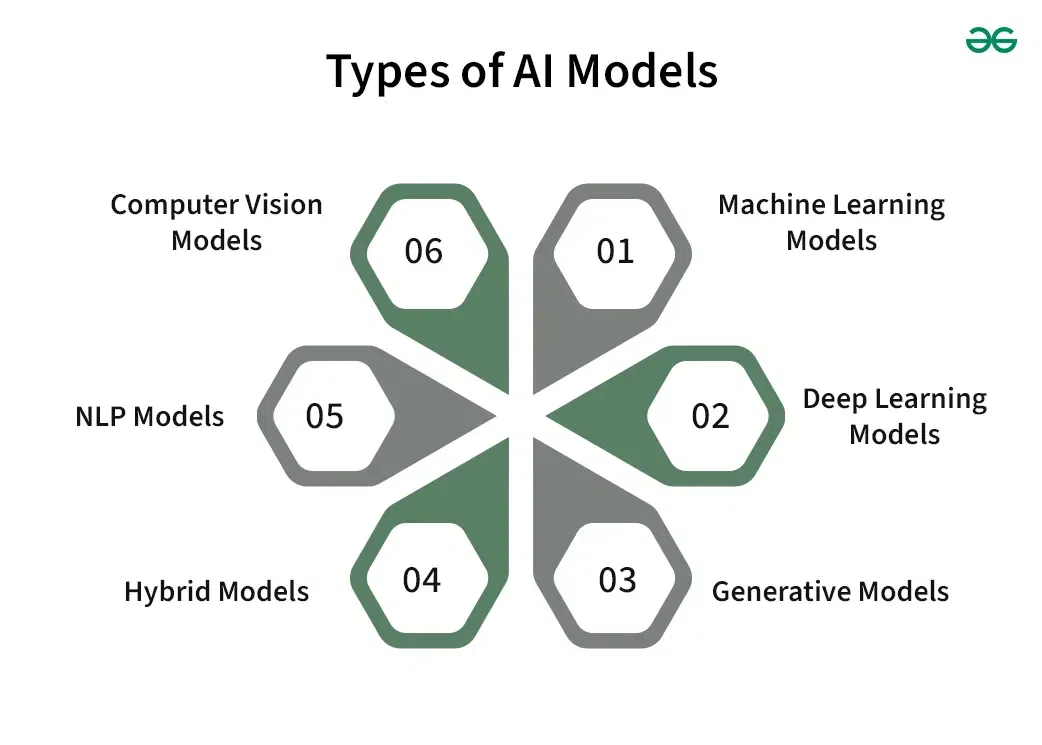
An AI model is a computational framework designed to simulate human-like intelligence by learning from data. Unlike traditional software, which follows explicit instructions, AI models adapt and improve their performance through exposure to training data. They are the foundation of modern AI systems, enabling machines to recognize speech, translate languages, diagnose diseases, and automate complex decision-making processes. AI models can be broadly categorized into supervised learning models, which learn from labeled data, unsupervised learning models, which identify patterns in unlabeled data, and reinforcement learning models, which learn through trial and error by interacting with an environment. The choice of model depends on the specific task, data availability, and desired outcome. The development of AI models has revolutionized industries by automating repetitive tasks, enhancing accuracy in predictions, and enabling new capabilities such as autonomous driving and personalized medicine. As AI continues to evolve, models are becoming more sophisticated, with advancements in deep learning and neural networks pushing the boundaries of what machines can achieve.
#History / Background
The concept of AI models traces back to the mid-20th century, with early theoretical foundations laid by pioneers such as Alan Turing, who proposed the idea of a machine that could simulate human intelligence, and John McCarthy, who coined the term "artificial intelligence" in 1956. The first AI models were rule-based systems, which relied on predefined logical rules to perform tasks. However, these systems lacked adaptability and scalability. The 1980s and 1990s saw the rise of machine learning, a paradigm shift that enabled models to learn from data rather than rely solely on explicit programming. Key milestones during this period included the development of decision trees, support vector machines (SVMs), and neural networks. The introduction of backpropagation, a method for training neural networks, was particularly significant, as it allowed models to adjust their internal parameters to minimize errors. The 2000s marked a turning point with the advent of deep learning, a subset of machine learning that utilizes multi-layered neural networks to process vast amounts of data. Breakthroughs such as convolutional neural networks (CNNs) for image recognition and recurrent neural networks (RNNs) for sequential data analysis propelled AI models into mainstream applications. The availability of large datasets and advances in computational power further accelerated progress. In the 2010s and 2020s, AI models became increasingly sophisticated, with transformer models like BERT and GPT revolutionizing natural language processing. These models leverage self-attention mechanisms to understand context and generate human-like text. Concurrently, reinforcement learning achieved notable successes, such as AlphaGo, which defeated world champions in the complex board game Go. Today, AI models are integral to a wide range of applications, from virtual assistants and autonomous vehicles to medical diagnostics and financial forecasting. The field continues to advance rapidly, with ongoing research focused on improving model efficiency, interpretability, and generalization.
#How It Works
AI models operate through a structured process that involves data ingestion, training, validation, and deployment. The workflow typically begins with the collection and preprocessing of data, which may include cleaning, normalization, and augmentation to ensure consistency and relevance.
#Training Phase During training, the model learns to recognize patterns in the data by adjusting its internal parameters. This process is guided by a loss function, which measures the difference between the model's predictions and the actual outcomes. Optimization algorithms, such as gradient descent, are used to minimize the loss function by iteratively updating the model's parameters. For supervised learning, the model is trained on labeled data, where each input is paired with the correct output. For example, in a classification task, the model learns to associate specific features of the input data with predefined categories. In unsupervised learning, the model identifies patterns in unlabeled data, such as clustering similar data points together. Reinforcement learning involves training the model through interactions with an environment, where it receives rewards or penalties based on its actions.
#Model Architecture The architecture of an AI model defines how it processes and transforms data. Common architectures include:
- Neural Networks: Composed of interconnected layers of nodes (neurons), neural networks are the backbone of deep learning. Convolutional neural networks (CNNs) are specialized for image and video processing, while recurrent neural networks (RNNs) and transformers are used for sequential data, such as text or time series.
- Decision Trees and Random Forests: These models use a tree-like structure to make decisions based on input features. Random forests, an ensemble method, combine multiple decision trees to improve accuracy and reduce overfitting.
- Support Vector Machines (SVMs): SVMs are effective for classification and regression tasks by finding the optimal hyperplane that separates data points into different classes.
- Generative Models: Models like Generative Adversarial Networks (GANs) and Variational Autoencoders (VAEs) are used to generate new data samples that resemble the training data.
#Evaluation and Deployment After training, the model is evaluated using a separate dataset to assess its performance. Metrics such as accuracy, precision, recall, F1-score, and mean squared error are used to measure the model's effectiveness. Hyperparameter tuning, which involves adjusting parameters like learning rate and batch size, is often performed to optimize performance. Once validated, the model is deployed into production, where it processes real-world data to make predictions or decisions. Continuous monitoring and retraining are essential to ensure the model remains accurate and relevant as new data becomes available.
#Important Facts
- Data Dependency: AI models are only as good as the data they are trained on. Biased or incomplete data can lead to inaccurate or unfair outcomes.
- Computational Requirements: Training advanced AI models, particularly deep learning models, requires significant computational resources, often necessitating specialized hardware like GPUs or TPUs.
- Overfitting and Underfitting: Overfitting occurs when a model learns the training data too well, including noise, and fails to generalize to new data. Underfitting happens when a model is too simple to capture the underlying patterns in the data.
- Explainability: Many AI models, especially deep learning models, are often referred to as "black boxes" because their decision-making processes are not easily interpretable. Efforts are ongoing to develop explainable AI (XAI) techniques to improve transparency.
- Ethical Considerations: AI models can inadvertently perpetuate biases present in their training data, leading to ethical concerns. Addressing these issues requires careful data selection, bias mitigation techniques, and ethical guidelines.
- Transfer Learning: This technique involves using a pre-trained model on a new but related task, significantly reducing the amount of data and computational resources required for training.
- Edge AI: Deploying AI models on edge devices, such as smartphones or IoT devices, enables real-time processing without relying on cloud infrastructure, enhancing privacy and reducing latency.
#Timeline
- Foundational ideas
Core concepts and early methods shape The Ultimate Guide to AI Models.
- Practical use
Tools, examples, and real-world deployments make the topic easier to evaluate.
- Responsible implementation
Current work focuses on reliability, governance, performance, and measurable impact.
#Related Terms
#FAQ
What does The Ultimate Guide to AI Models cover?
Covers the ultimate guide to ai models, including core concepts, practical examples, benefits, limitations, and risks in Machine Learning.
Why is The Ultimate Guide to AI Models important?
It helps readers understand key concepts, compare practical use cases, and evaluate how Machine Learning decisions affect outcomes, risks, and implementation choices.
What should readers verify before applying this topic?
Readers should compare benefits, limitations, data requirements, and related themes such as Ultimate, AI, Models before using the ideas in real projects.
#References
- The Ultimate Guide to AI Models terminology and background research
- The Ultimate Guide to AI Models use cases, implementation examples, and limitations
- Machine Learning best practices, standards, and risk guidance
- Ultimate case studies, benchmarks, and current industry analysis


Comments
No comments yet. Start the discussion with a useful note.