


#Short Answer
Explains What Is Deep Learning, including the core definition, how it works, practical examples, and limitations.
#Infobox
#Overview
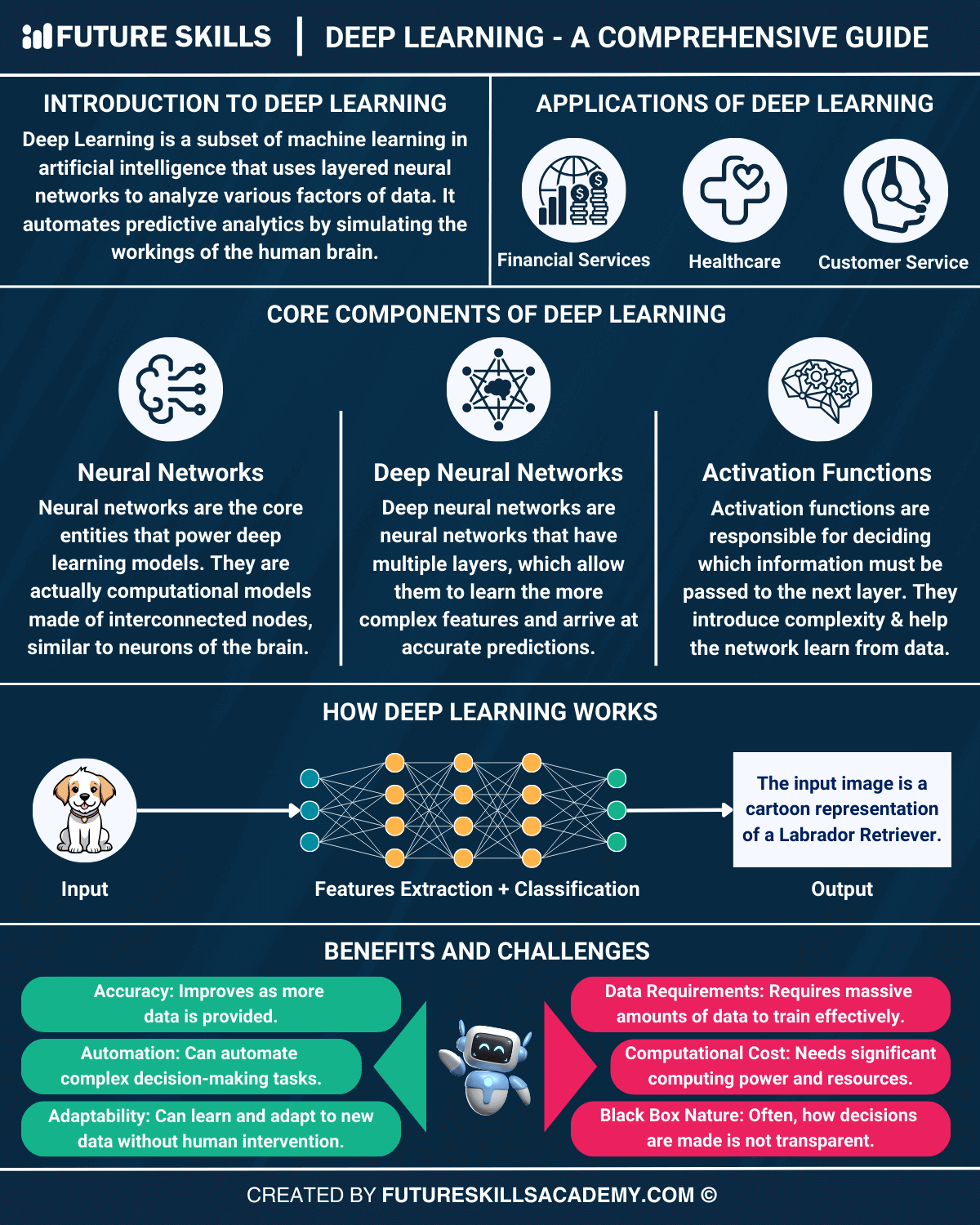
Deep learning is a transformative approach within artificial intelligence (AI) that leverages artificial neural networks to process and analyze vast amounts of data. Unlike traditional machine learning methods, which rely on handcrafted features, deep learning models automatically extract relevant features from raw data through multiple layers of abstraction. This capability has led to breakthroughs in fields such as computer vision, natural language processing (NLP), and reinforcement learning, making deep learning a cornerstone of modern AI systems. The core idea behind deep learning is inspired by the structure and function of the human brain, particularly the interconnected neurons that process and transmit information. In deep learning models, these neurons are represented as artificial nodes (or units) organized into layers. Each layer transforms the input data into a more abstract and composite representation, enabling the model to learn hierarchical patterns. For example, in image recognition, early layers might detect edges, while deeper layers identify shapes, objects, and ultimately entire scenes.
#History / Background
#Early Foundations (1940s–1980s)
The conceptual roots of deep learning trace back to the 1940s with the introduction of the perceptron by Frank Rosenblatt in 1958, a simple neural network model inspired by biological neurons. However, early neural networks were limited by computational constraints and lacked efficient training methods. The field stagnated during the "AI winter" of the 1970s and 1980s, when funding and interest in AI declined due to unmet expectations.
#Revival and Breakthroughs (1980s–2000s)
The resurgence of neural networks began in the 1980s with the development of the backpropagation algorithm, which enabled efficient training of multi-layer networks. In 1989, Yann LeCun demonstrated the first practical application of backpropagation in training a convolutional neural network (CNN) for handwritten digit recognition. However, computational limitations and the lack of large datasets hindered progress.
#The Deep Learning Revolution (2000s–Present)
The modern deep learning era took off in the mid-2000s, driven by three key factors:
- Increased Computational Power: The rise of graphics processing units (GPUs) accelerated training times for neural networks.
- Big Data: The availability of large, labeled datasets (e.g., ImageNet) allowed models to learn complex patterns.
- Algorithmic Advances: Innovations such as rectified linear units (ReLU), dropout, and batch normalization improved training efficiency and model performance. Landmark achievements include:
- 2012: AlexNet, a deep CNN developed by Alex Krizhevsky, won the ImageNet Large Scale Visual Recognition Challenge (ILSVRC), achieving a top-5 error rate of 15.3%, a significant improvement over traditional methods.
- 2016: AlphaGo, a deep learning-based AI developed by DeepMind, defeated the world champion Go player, Lee Sedol, showcasing the potential of deep reinforcement learning.
- 2020s: Deep learning models like GPT-3 and DALL-E demonstrated unprecedented capabilities in generating human-like text and images, respectively.
#How It Works
#Artificial Neural Networks (ANNs)
Deep learning models are built on artificial neural networks, which consist of interconnected layers of nodes (neurons). The three primary types of layers are:
- Input Layer: Receives the raw data (e.g., pixels in an image, words in a sentence).
- Hidden Layers: Perform computations and transformations on the input data. Deep networks have multiple hidden layers, each refining the data representation.
- Output Layer: Produces the final prediction or classification (e.g., identifying an object in an image).
#Key Components
- Weights and Biases: Each connection between neurons has an associated weight, which determines the strength of the signal. Biases allow the model to shift the activation function.
- Activation Functions: Non-linear functions (e.g., ReLU, sigmoid, tanh) introduce non-linearity, enabling the network to learn complex patterns.
- Loss Function: Measures the difference between the predicted output and the actual label (e.g., mean squared error for regression, cross-entropy for classification).
- Optimization Algorithms: Adjust the weights and biases to minimize the loss function. Common algorithms include Stochastic Gradient Descent (SGD), Adam, and RMSprop.
#Training Process
- Forward Propagation: Input data is passed through the network, layer by layer, to generate a prediction.
- Loss Calculation: The prediction is compared to the true label using the loss function.
- Backpropagation: The gradient of the loss function is computed with respect to each weight, and the weights are updated to reduce the loss.
- Iteration: The process repeats for multiple epochs (passes through the dataset) until the model converges to an optimal solution.
#Types of Deep Learning Models
- Convolutional Neural Networks (CNNs): Specialized for grid-like data (e.g., images), using convolutional layers to detect local patterns.
- Recurrent Neural Networks (RNNs): Designed for sequential data (e.g., time series, text), with loops that allow information to persist.
- Long Short-Term Memory (LSTM) Networks: A type of RNN that mitigates the vanishing gradient problem, enabling long-term dependencies.
- Transformers: Introduced in the 2017 paper "Attention Is All You Need", transformers use self-attention mechanisms to process sequential data efficiently, powering models like BERT and GPT.
- Generative Adversarial Networks (GANs): Consist of two networks—a generator that creates data and a discriminator that evaluates it—used for generating realistic images, music, and text.
#Important Facts
- Hierarchical Feature Learning: Deep learning models automatically learn hierarchical representations of data, eliminating the need for manual feature engineering.
- Data Hunger: Deep learning models require large datasets to generalize well. Small datasets often lead to overfitting.
- Computational Intensity: Training deep models demands significant computational resources, often requiring GPUs or TPUs (Tensor Processing Units).
- Transfer Learning: Pre-trained models (e.g., ResNet, BERT) can be fine-tuned for specific tasks, reducing the need for extensive training data.
- Explainability Challenges: Deep learning models are often "black boxes," making it difficult to interpret their decision-making processes.
- Ethical Concerns: Issues such as bias in training data, privacy violations, and the potential for misuse (e.g., deepfake technology) are significant challenges.
- Hardware Advancements: The development of specialized hardware (e.g., NVIDIA GPUs, Google TPUs) has accelerated the training and deployment of deep learning models.
- Interdisciplinary Impact: Deep learning has applications across industries, including healthcare (medical imaging, drug discovery), finance (fraud detection, algorithmic trading), and entertainment (recommendation systems, game AI).
#Timeline
- Foundational ideas
Core concepts and early methods shape What Is Deep Learning?.
- Practical use
Tools, examples, and real-world deployments make the topic easier to evaluate.
- Responsible implementation
Current work focuses on reliability, governance, performance, and measurable impact.
#Related Terms
#FAQ
What does What Is Deep Learning? cover?
Explains What Is Deep Learning, including the core definition, how it works, practical examples, and limitations.
Why is What Is Deep Learning? important?
It helps readers understand key concepts, compare practical use cases, and evaluate how Machine Learning decisions affect outcomes, risks, and implementation choices.
What should readers verify before applying this topic?
Readers should compare benefits, limitations, data requirements, and related themes such as Deep, Learning, AI before using the ideas in real projects.
#References
- What Is Deep Learning? terminology and background research
- What Is Deep Learning? use cases, implementation examples, and limitations
- Machine Learning best practices, standards, and risk guidance
- Deep case studies, benchmarks, and current industry analysis

Comments
No comments yet. Start the discussion with a useful note.