

#Short Answer
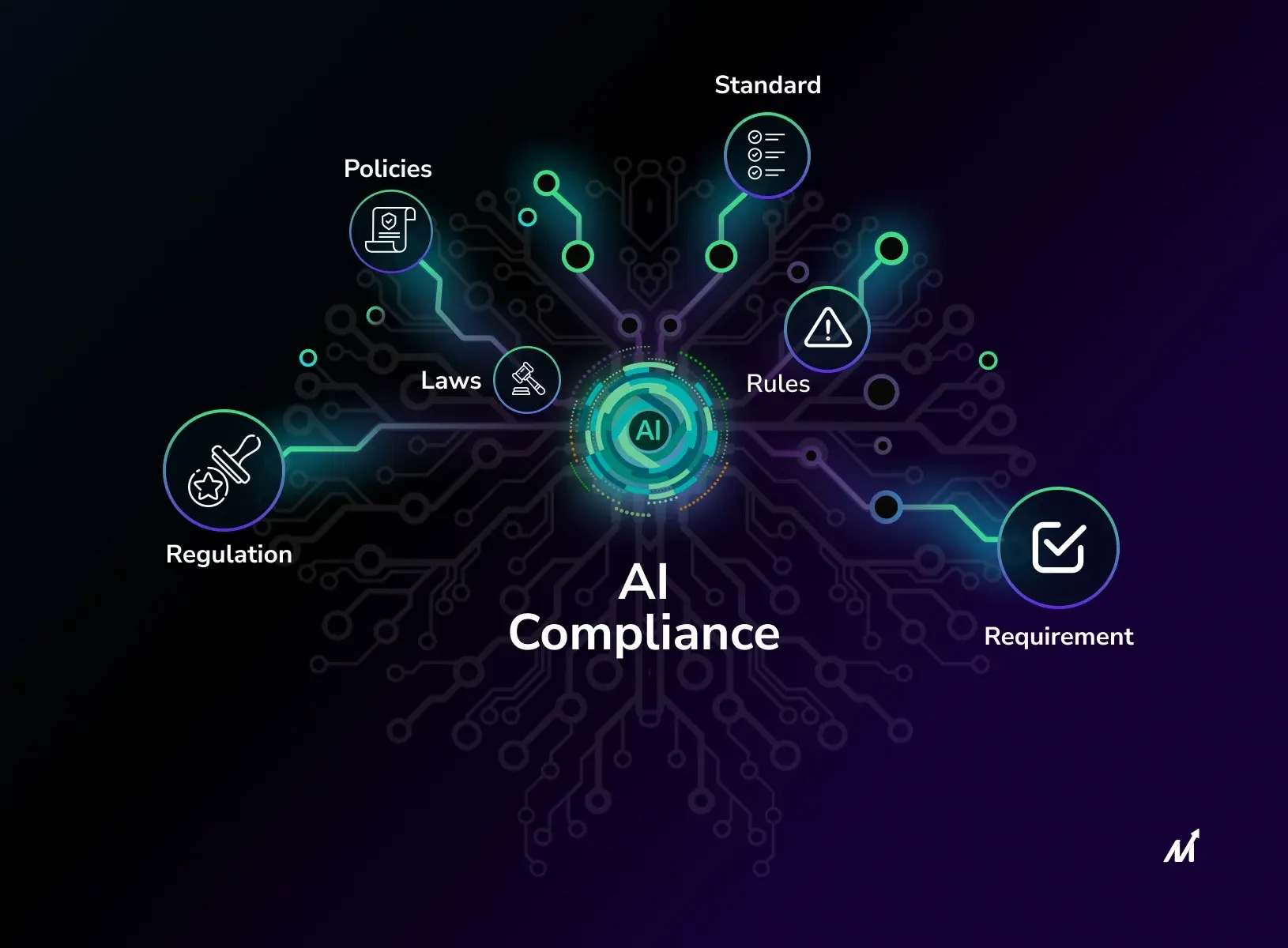
AI in compliance refers to the use of artificial intelligence technologies to automate, enhance, and streamline regulatory compliance processes, ensuring organizations meet legal, financial, and operational requirements efficiently.
#Infobox
#Overview
AI and compliance represent a transformative intersection where artificial intelligence (AI) technologies are leveraged to ensure organizations adhere to regulatory requirements efficiently and accurately. This integration addresses the growing complexity of global regulations, the volume of data that must be monitored, and the need for real-time compliance reporting. AI-driven compliance solutions utilize advanced algorithms, including machine learning (ML) and natural language processing (NLP), to automate routine tasks such as transaction monitoring, risk assessment, and regulatory reporting.
In industries like finance, healthcare, and data privacy, AI compliance tools help organizations mitigate risks, avoid costly penalties, and maintain operational integrity. The adoption of AI in compliance is part of a broader trend known as RegTech (Regulatory Technology), which focuses on using technology to simplify and enhance regulatory processes. By automating manual processes and providing predictive insights, AI enables businesses to proactively manage compliance rather than reactively addressing violations.
#History / Background
The evolution of AI in compliance can be traced back to the early 2000s, when financial institutions began adopting rule-based systems for anti-money laundering (AML) and fraud detection. These early systems relied on predefined algorithms to flag suspicious transactions, but they were limited by their inability to adapt to new patterns of financial crime.
The breakthrough came with the integration of machine learning in the 2010s. Financial institutions and regulatory bodies started using ML models to analyze vast datasets, identify anomalies, and predict potential compliance risks. The rise of big data and cloud computing further accelerated this trend, enabling real-time data processing and analysis.
A pivotal moment occurred in 2018 with the implementation of the European Union’s General Data Protection Regulation (GDPR), which imposed strict data privacy requirements on organizations handling EU citizens' data. This regulation spurred the development of AI-powered tools for data governance, consent management, and breach detection. Similarly, the increasing complexity of financial regulations such as the Dodd-Frank Act in the U.S. and Basel III globally created a demand for AI-driven compliance solutions.
Today, AI compliance tools are widely adopted across industries, from healthcare (where they ensure adherence to HIPAA) to supply chain management (where they monitor labor and environmental regulations). The ongoing advancements in AI, particularly in explainable AI (XAI) and ethical AI, continue to shape the future of compliance automation.
#How It Works
#Key Technologies
AI compliance systems rely on several core technologies to function effectively:
- Machine Learning (ML): ML models are trained on historical compliance data to identify patterns, predict risks, and detect anomalies. Supervised learning is commonly used for classification tasks, such as flagging transactions that deviate from normal behavior, while unsupervised learning helps uncover hidden patterns in unlabeled data.
- Natural Language Processing (NLP): NLP enables systems to analyze unstructured data, such as legal documents, regulatory texts, and internal communications. It can extract relevant compliance requirements, classify documents, and even generate automated reports based on regulatory changes.
- Predictive Analytics: By analyzing historical and real-time data, predictive models forecast potential compliance risks, such as future regulatory changes or emerging threats like cybersecurity breaches.
- Robotic Process Automation (RPA): RPA automates repetitive compliance tasks, such as data entry, form filling, and report generation, reducing human error and improving efficiency.
- Computer Vision: In industries like healthcare and manufacturing, computer vision is used to monitor compliance with physical safety standards, such as equipment inspections or workplace safety protocols.
#Implementation Process
The deployment of AI in compliance typically follows a structured process:
- Data Collection and Integration: Organizations gather relevant data from various sources, including transaction records, employee communications, and external regulatory databases. This data is then integrated into a centralized compliance platform.
- Model Training and Calibration: AI models are trained using historical compliance data to recognize patterns associated with violations or risks. The models are calibrated to minimize false positives and negatives, ensuring accuracy.
- Real-Time Monitoring: Once deployed, the AI system continuously monitors transactions, communications, and operational activities in real time. It flags potential compliance issues, such as unusual transaction patterns or unauthorized data access.
- Alerts and Reporting: When a potential violation is detected, the system generates alerts for compliance teams. Automated reports are generated for regulatory bodies, summarizing the organization’s compliance status.
- Continuous Learning and Adaptation: AI models are regularly updated to adapt to new regulations, emerging risks, and changes in the operational environment. This ensures the system remains effective over time.
#Important Facts
- Efficiency Gains: AI can process and analyze data up to 100 times faster than traditional manual methods, significantly reducing the time and cost associated with compliance.
- Accuracy Improvement: AI systems reduce human error in compliance tasks, such as data entry and risk assessment, leading to fewer false positives and missed violations.
- Regulatory Adaptability: AI models can be quickly updated to reflect changes in regulations, such as new AML laws or GDPR amendments, ensuring organizations stay compliant without extensive manual revisions.
- Cost Reduction: By automating routine compliance tasks, organizations can reduce labor costs and allocate resources more effectively to high-value activities.
- Scalability: AI compliance solutions can scale to handle large volumes of data and transactions, making them suitable for multinational corporations and industries with complex regulatory requirements.
- Ethical Considerations: The use of AI in compliance raises ethical concerns, such as algorithmic bias and data privacy. Organizations must ensure their AI systems are transparent, explainable, and compliant with ethical guidelines.
#Timeline
- The broader field of technology solutions designed to help businesses comply with regulations efficiently.
- Regulations and tools designed to prevent the illegal generation of income through concealment.
- Processes and technologies used to verify the identity of clients and assess their risk profiles.
- A legal framework in the EU that sets guidelines for the collection and processing of personal data.
- A U.S. regulation that provides data privacy and security provisions for safeguarding medical information.
- A U.S. law that mandates certain practices in financial record
keeping and reporting for corporations.
- AI systems designed to provide clear, interpretable explanations for their decisions, crucial for compliance and regulatory scrutiny.
- The use of AI to forecast potential compliance risks and regulatory changes before they occur.
#Related Terms
#FAQ
What does AI And Compliance: Meeting Regulations cover?
Explores how artificial intelligence shapes compliance and meeting regulations, covering practical use cases, benefits, limitations, and risks.
Why is AI And Compliance: Meeting Regulations important?
It helps readers understand key concepts, compare practical use cases, and evaluate how AI Ethics decisions affect outcomes, risks, and implementation choices.
What should readers verify before applying this topic?
Readers should compare the benefits, limitations, data requirements, and related themes such as Compliance, Meeting, Regulation before using the ideas in real projects.
#References
- AI And Compliance: Meeting Regulations terminology and background research
- AI And Compliance: Meeting Regulations use cases, implementation examples, and limitations
- AI Ethics best practices, standards, and risk guidance
- Compliance case studies, benchmarks, and current industry analysis


Comments
No comments yet. Start the discussion with a useful note.