

#Short Answer
Explores how artificial intelligence shapes regulation and current laws, covering practical use cases, benefits, limitations, and risks.
#Infobox
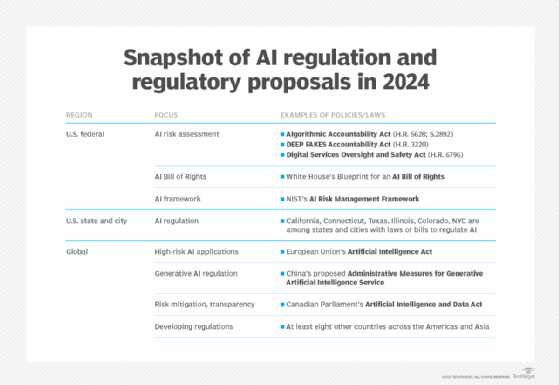
Overview of artificial intelligence regulation, including current laws, compliance requirements, and global policy trends shaping AI governance in 2024.
Artificial Intelligence Regulation Field Artificial intelligence Focus Ethics, safety, transparency, accountability Key Laws GDPR, Algorithmic Accountability Act, EU AI Act Jurisdictions European Union, United States, China, Canada, Singapore Enforcement Bodies Data Protection Authorities, National AI Boards, Sectoral Regulators First Major Regulation 2016 (GDPR draft proposals) Latest Major Regulation 2024 (EU AI Act implementation phases)
#Overview
Artificial intelligence regulation refers to the legal frameworks, policies, and guidelines designed to govern the development, deployment, and use of artificial intelligence systems. As AI technologies advance—spanning machine learning, natural language processing, computer vision, and autonomous systems—the need for regulatory oversight has intensified to address ethical concerns, mitigate risks, and ensure public trust.
Regulation in this domain typically focuses on several core objectives: protecting individual privacy, preventing algorithmic bias, ensuring transparency in automated decision-making, and safeguarding against misuse such as deepfakes or autonomous weapons. Governments and international bodies are increasingly adopting a risk-based approach, categorizing AI applications by their potential impact and applying proportionate regulatory requirements.
#Scope of Regulation
AI regulation encompasses a wide range of domains including:
- Data Privacy: Rules governing the collection, storage, and processing of personal data used in AI training.
- Algorithmic Transparency: Requirements for explainability and interpretability of AI decision-making processes.
- Bias and Fairness: Prohibitions or restrictions on discriminatory outcomes in AI systems.
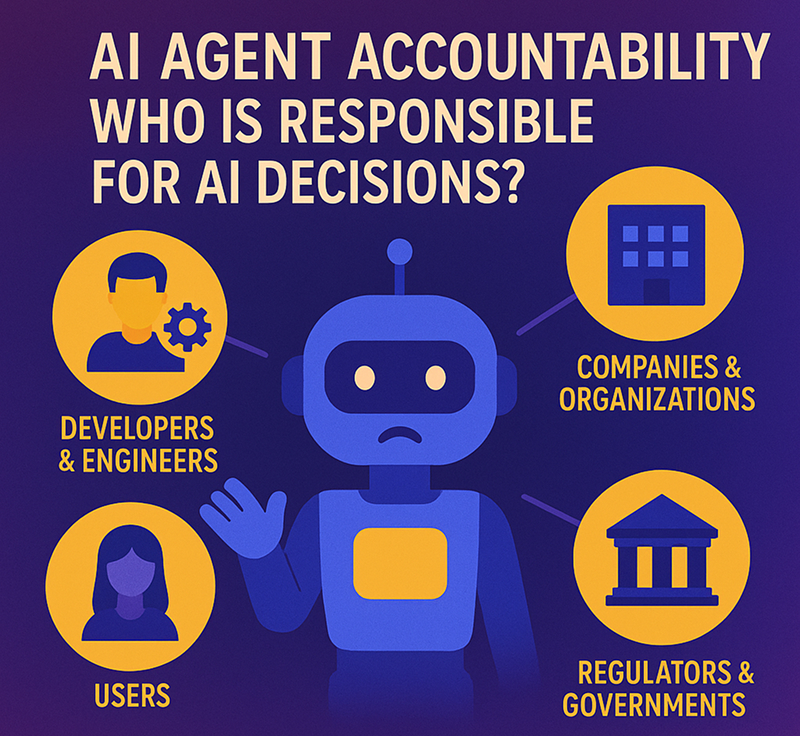
- Accountability: Legal frameworks assigning responsibility for AI system behavior and outcomes.
- Safety and Security: Standards for robust, reliable, and secure AI systems, particularly in high-risk applications.
- Content Moderation: Regulation of AI used in social media, misinformation detection, and automated content generation.
#History / Background
#Early Initiatives
The concept of regulating AI emerged alongside early debates about automation and its societal impact. In the 1950s and 1960s, as AI research began to take shape, scholars and policymakers raised concerns about machine autonomy and ethical use. However, formal regulation remained limited due to the technology's early developmental stage.
#2010s: Rise of Data Privacy and Ethics
The proliferation of big data and machine learning in the 2010s accelerated regulatory attention. The General Data Protection Regulation (GDPR), adopted by the European Union in 2016 and enforced in 2018, became a landmark regulation by introducing principles such as data minimization, consent, and the right to explanation for automated decisions.
Other jurisdictions followed with ethical guidelines. In 2019, the OECD adopted the OECD AI Principles, promoting human-centered, trustworthy AI. The United States saw the introduction of the Algorithmic Accountability Act in 2019, though it did not pass into law.
#2020s: Global Race to Regulate
The 2020s marked a turning point with concrete legislative proposals and binding laws. The European Union's EU Artificial Intelligence Act, proposed in 2021 and finalized in 2024, became the first comprehensive AI regulation, categorizing AI systems into unacceptable, high-risk, limited-risk, and minimal-risk tiers. High-risk systems face stringent requirements including risk assessments, transparency obligations, and human oversight.
Other major developments include China's Interim Measures for Generative AI (2023), which requires AI models to reflect socialist values and avoid generating harmful content. In the United States, the Executive Order on Safe, Secure, and Trustworthy AI (2023) directed federal agencies to develop AI safety standards and guidelines.
#How It Works
#Risk-Based Regulatory Framework
Most modern AI regulations employ a risk-based approach, classifying AI systems based on their potential harm and applying corresponding regulatory requirements:
- Unacceptable Risk: Systems considered a clear threat to safety, livelihoods, or rights are banned. Examples include social scoring systems and certain types of predictive policing.
- High Risk: AI used in critical infrastructure, healthcare diagnostics, employment screening, or law enforcement requires conformity assessments, risk management systems, and human oversight. Examples include medical imaging AI and autonomous vehicles.
- Limited Risk: Systems with transparency obligations, such as chatbots or deepfake generators, must disclose their AI nature and allow user control.
- Minimal Risk: Low-risk applications like spam filters or AI-enabled video games face minimal or no regulation.
#Core Regulatory Requirements
Across jurisdictions, several key requirements are commonly mandated:
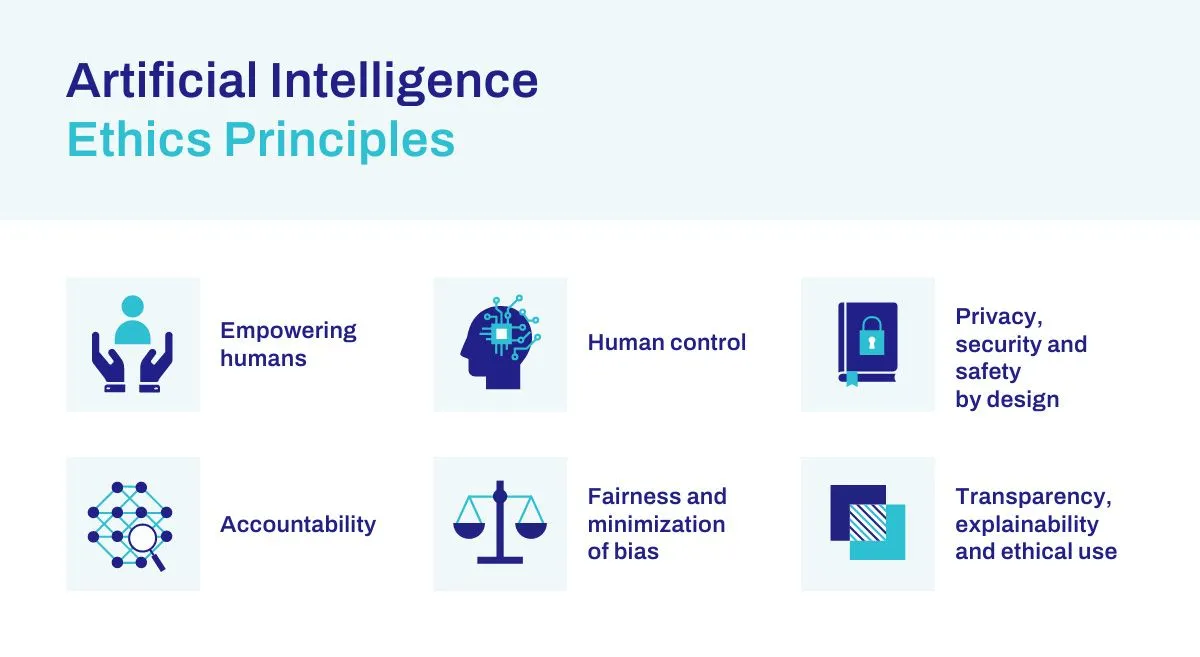
- Transparency: AI systems must be explainable, with documentation on data sources, model architecture, and decision logic available to regulators and, in some cases, end users.
- Data Governance: Organizations must ensure data used to train AI models is lawfully obtained, accurate, and representative to prevent bias and discrimination.
- Human Oversight: High-risk AI systems must include mechanisms for human intervention, especially in life-critical decisions.
- Accountability: Clear assignment of responsibility for AI outcomes, including liability frameworks for harm caused by AI systems.
- Safety and Robustness: AI systems must undergo rigorous testing for vulnerabilities, adversarial attacks, and unintended consequences.
- Privacy by Design: Integration of privacy protections into AI system development, including data minimization and encryption.
#Important Facts
- The EU AI Act is the first comprehensive binding AI law globally, affecting over 450 million people.
- Under GDPR, individuals have the "right to explanation," allowing them to request information about automated decisions affecting them.
- China's AI regulations require generative AI services to undergo security assessments and align with "core socialist values."
- The United States lacks a unified federal AI law but relies on sector-specific regulations and executive orders.
- Canada's Pan-Canadian AI Strategy focuses on research funding and ethical guidelines rather than binding rules.
- Singapore's Model AI Governance Framework is voluntary but widely adopted by businesses.
- AI regulation is increasingly influencing global trade, with compliance becoming a prerequisite for market access in many regions.
#Timeline
Year Event 2016 European Union publishes draft GDPR, including provisions on automated decision-making. 2017 Asilomar AI Principles published by the Future of Life Institute, outlining ethical guidelines for AI development. 2018 GDPR enters into force in the European Union. 2019 OECD adopts AI Principles; U.S. Algorithmic Accountability Act introduced. 2020 European Commission publishes White Paper on AI and draft proposal for AI regulation. 2021 European Commission formally proposes the EU AI Act. 2022 China releases draft measures for generative AI services. 2023 EU AI Act negotiations conclude; U.S. issues Executive Order on AI safety; China implements interim generative AI rules. 2024 EU AI Act enters into force with phased implementation; first compliance deadlines for high-risk AI systems.
#Related Terms
#FAQ
What does AI And Regulation: Current Laws cover?
Explores how artificial intelligence shapes regulation and current laws, covering practical use cases, benefits, limitations, and risks.
Why is AI And Regulation: Current Laws important?
It helps readers understand key concepts, compare practical use cases, and evaluate how AI Ethics decisions affect outcomes, risks, and implementation choices.
What should readers verify before applying this topic?
Readers should compare the benefits, limitations, data requirements, and related themes such as Regulation, Laws, Responsible AI before using the ideas in real projects.
#References
- AI And Regulation: Current Laws terminology and background research
- AI And Regulation: Current Laws use cases, implementation examples, and limitations
- AI Ethics best practices, standards, and risk guidance
- Regulation case studies, benchmarks, and current industry analysis

Comments
No comments yet. Start the discussion with a useful note.