


#Short Answer
Artificial intelligence regulation encompasses the legal and ethical frameworks designed to manage the risks and opportunities presented by AI systems. As AI technologies become increasingly integrated into critical sectors such as healthcare, finance, transportation, and law enforcement, the need for comprehensive regulation has grown. These regulations seek to balance innovation with public safety, ensuring that AI systems operate transparently, fairly, and without causing harm.
#Infobox
#Overview
Artificial intelligence regulation encompasses the legal and ethical frameworks designed to manage the risks and opportunities presented by AI systems. As AI technologies become increasingly integrated into critical sectors such as healthcare, finance, transportation, and law enforcement, the need for comprehensive regulation has grown. These regulations seek to balance innovation with public safety, ensuring that AI systems operate transparently, fairly, and without causing harm.
Key objectives of AI regulation include preventing algorithmic discrimination, protecting personal data, ensuring accountability in automated decision-making, and fostering trust among users and stakeholders. Governments worldwide are adopting varied approaches—ranging from voluntary guidelines to enforceable legislation—to address these concerns while supporting technological advancement.
#History / Background
#Early Developments
The concept of regulating AI emerged alongside the technology itself. Early discussions in the 1950s and 1960s focused on the ethical implications of machine intelligence, but formal regulation was not yet a priority. By the 1980s and 1990s, as AI applications expanded into fields like finance and healthcare, concerns about bias, privacy, and accountability began to surface.
One of the first major regulatory milestones was the General Data Protection Regulation (GDPR), adopted by the European Union in 2016 and enforced in 2018. GDPR introduced strict rules on data collection, processing, and user consent, indirectly influencing AI systems that rely on large datasets.
#Rise of AI Ethics Guidelines
In the 2010s, as AI capabilities grew—particularly with advances in machine learning and deep learning—governments and international organizations began developing AI ethics guidelines. Notable examples include:
- OECD AI Principles (2019): A set of voluntary guidelines promoting trustworthy AI.
- UNESCO Recommendation on the Ethics of AI (2021): The first global standard on AI ethics.
- European Commission's Ethics Guidelines for Trustworthy AI (2019): Emphasizing human oversight and fairness.
#Legislative Turn
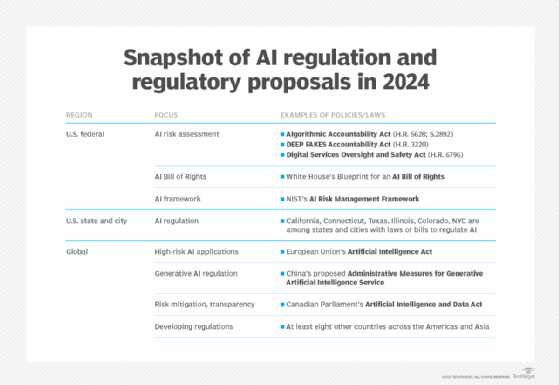
By the mid-2020s, several jurisdictions moved from guidelines to binding legislation. The EU Artificial Intelligence Act, proposed in 2021 and finalized in 2024, became the first comprehensive AI law, classifying AI systems by risk level and imposing strict obligations on high-risk applications such as facial recognition and predictive policing.
In the United States, the Algorithmic Accountability Act and state-level laws like the California Consumer Privacy Act (CCPA) began addressing algorithmic transparency and data privacy. Meanwhile, China introduced its Interim Measures for Generative AI Services in 2023, regulating content generated by AI models.
#How It Works
#Risk-Based Regulation
Modern AI regulation often employs a risk-based approach, categorizing AI systems according to their potential impact on individuals and society. Common risk levels include:
- Minimal Risk: AI tools like spam filters or recommendation systems with limited societal impact.
- Limited Risk: Systems requiring transparency, such as chatbots or virtual assistants.
- High Risk: Applications in critical domains like healthcare diagnostics, autonomous vehicles, or law enforcement, subject to stringent requirements including risk assessments, data governance, and human oversight.
- Unacceptable Risk: AI systems deemed too dangerous, such as social scoring systems or autonomous weapons, which are typically banned.
#Core Regulatory Mechanisms
Regulatory frameworks often include the following components:
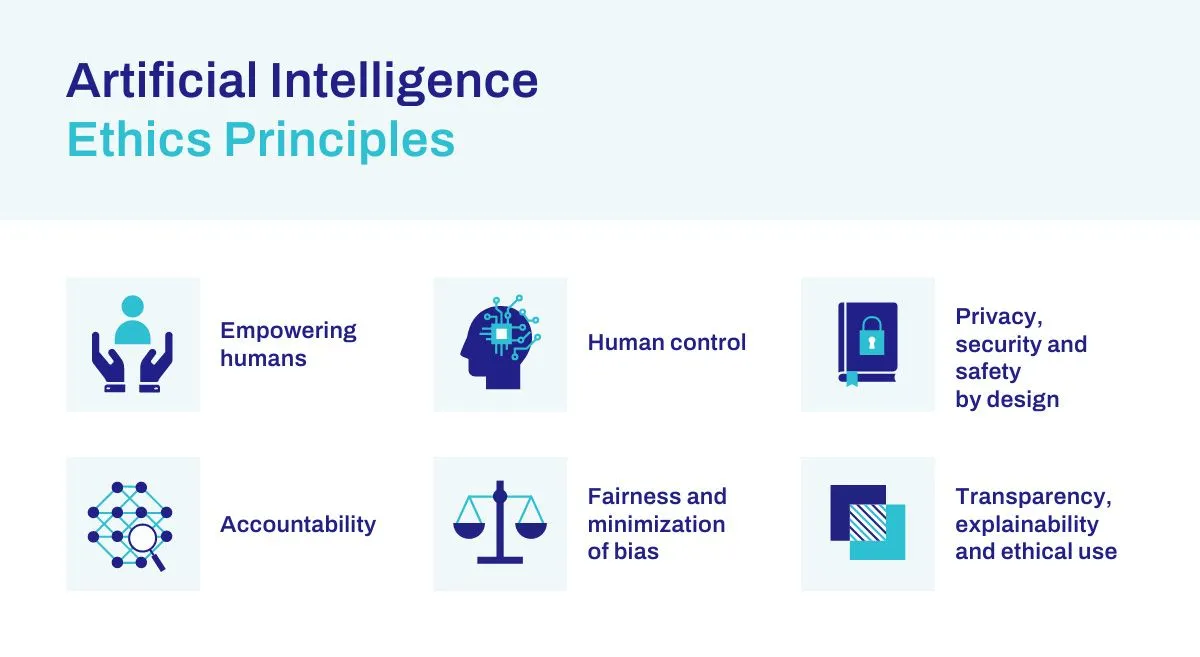
- Transparency Requirements: Mandating disclosure of AI decision-making processes, especially in high-risk applications.
- Data Governance: Ensuring datasets used in AI training are unbiased, representative, and legally obtained.
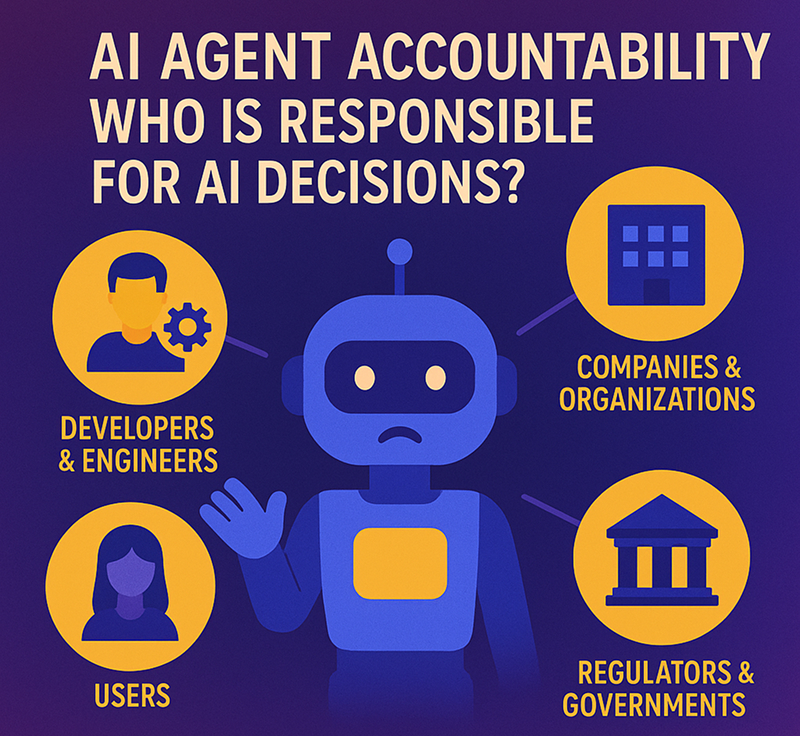
- Accountability Measures: Holding developers and deployers responsible for AI outcomes, including liability for harm caused by AI systems.
- Explainability Standards: Requiring AI systems to provide understandable explanations for their decisions, particularly in sectors like finance and healthcare.
- Human Oversight: Ensuring that humans retain control over AI systems in critical decision-making processes.
#Important Facts
- The EU AI Act is the first comprehensive binding AI law globally, covering over 400 pages of detailed provisions.
- GDPR’s right to explanation allows individuals to request explanations for automated decisions affecting them.
- Bias in AI systems often stems from biased training data, leading to discriminatory outcomes in hiring, lending, and law enforcement.
- Generative AI models, such as large language models, are increasingly regulated due to concerns over misinformation, deepfakes, and copyright infringement.
- The Algorithmic Accountability Act (proposed in the U.S.) would require companies to assess AI systems for bias and privacy risks before deployment.
- China’s AI regulations focus on content moderation, requiring generative AI services to align with state values and prevent the spread of "illegal" information.
- Canada’s Directive on Automated Decision-Making mandates impact assessments for AI used in government services.
#Timeline
- Alan Turing proposes the
Alan Turing proposes the [Turing test](# 'Turing test'), sparking early discussions on machine intelligence.
- U.S. Fair Information Practice
U.S. Fair Information Practice Principles (FIPPs) introduced, influencing later data protection laws.
- European Union adopts GDPR
European Union adopts [GDPR](# 'General Data Protection Regulation'), setting global standards for data privacy.
- Canada releases the Pan-Canadi
Canada releases the [Pan-Canadian AI Strategy](# 'Pan-Canadian Artificial Intelligence Strategy'), promoting ethical AI development.
- OECD publishes AI Principles
OECD publishes [AI Principles](# 'OECD AI Principles'), endorsed by 42 countries.
- U.S. state of Illinois
U.S. state of Illinois enacts the [Artificial Intelligence Video Interview Act](# 'Illinois Artificial Intelligence Video Interview Act'), regulating AI in hiring.
- UNESCO adopts the Recommendati
UNESCO adopts the [Recommendation on the Ethics of AI](# 'UNESCO Recommendation on the Ethics of AI').
- European Commission proposes t
European Commission proposes the [EU AI Act](# 'EU Artificial Intelligence Act').
- China implements Interim Measu
China implements [Interim Measures for Generative AI Services](# 'Interim Measures for the Management of Generative AI Services').
- EU AI Act enters
EU AI Act enters into force, marking the first comprehensive AI legislation.
#Related Terms
#FAQ
What does AI Regulation: Current Landscape cover?
AI regulation: current landscape covers practical examples, benefits, limitations, and important considerations for readers.
Why is AI Regulation: Current Landscape important?
It helps readers understand key concepts, compare practical use cases, and evaluate how AI Ethics decisions affect outcomes, risks, and implementation choices.
What should readers verify before applying this topic?
Readers should compare the benefits, limitations, data requirements, and related themes such as Regulation, Landscape, Responsible AI before using the ideas in real projects.
#References
- AI Regulation: Current Landscape terminology and background research
- AI Regulation: Current Landscape use cases, implementation examples, and limitations
- AI Ethics best practices, standards, and risk guidance
- Regulation case studies, benchmarks, and current industry analysis
Comments
No comments yet. Start the discussion with a useful note.