

#Short Answer
Explains What Is Reinforcement Learning, including the core definition, how it works, practical examples, and limitations.
#Infobox
#Overview
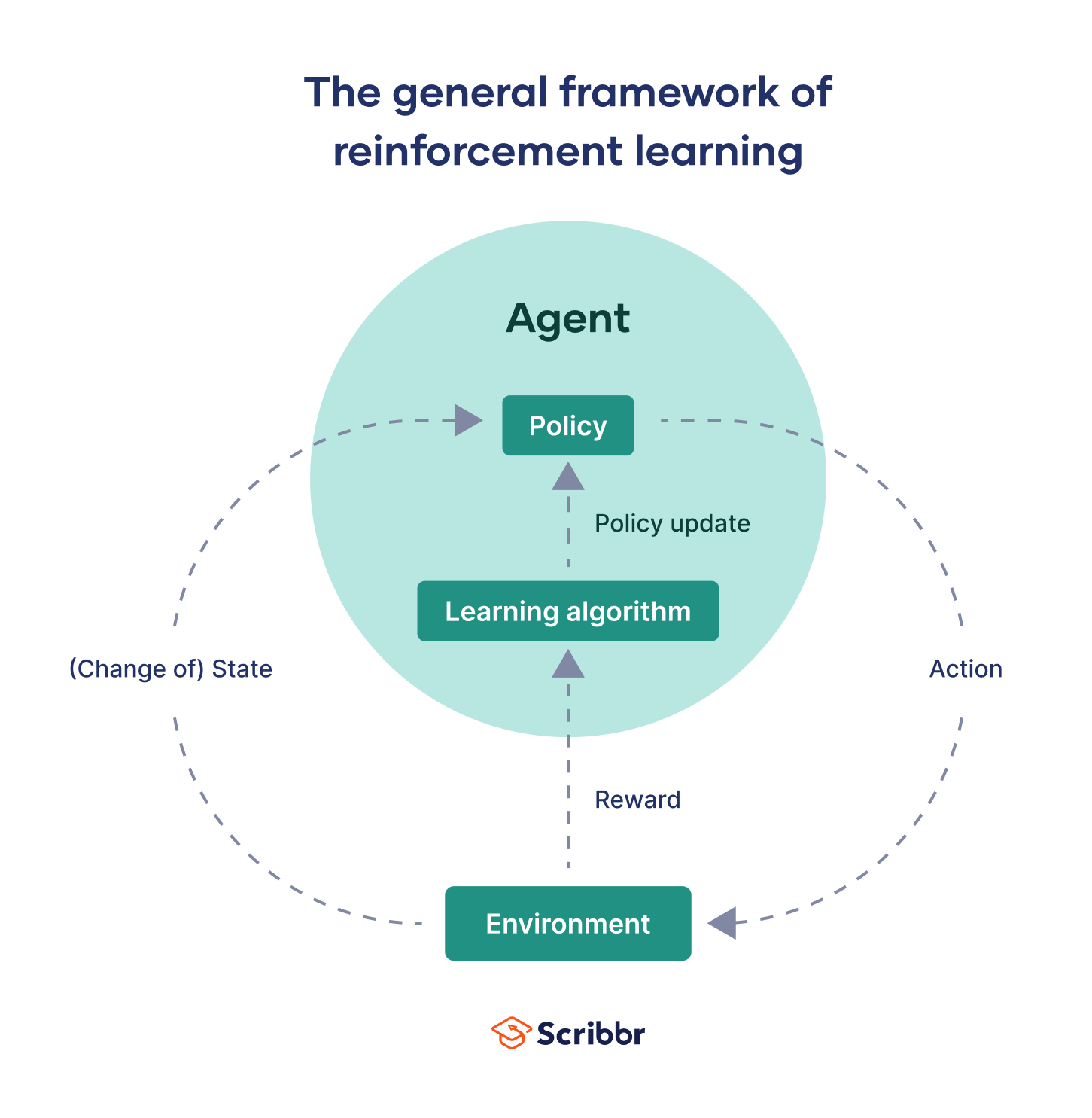
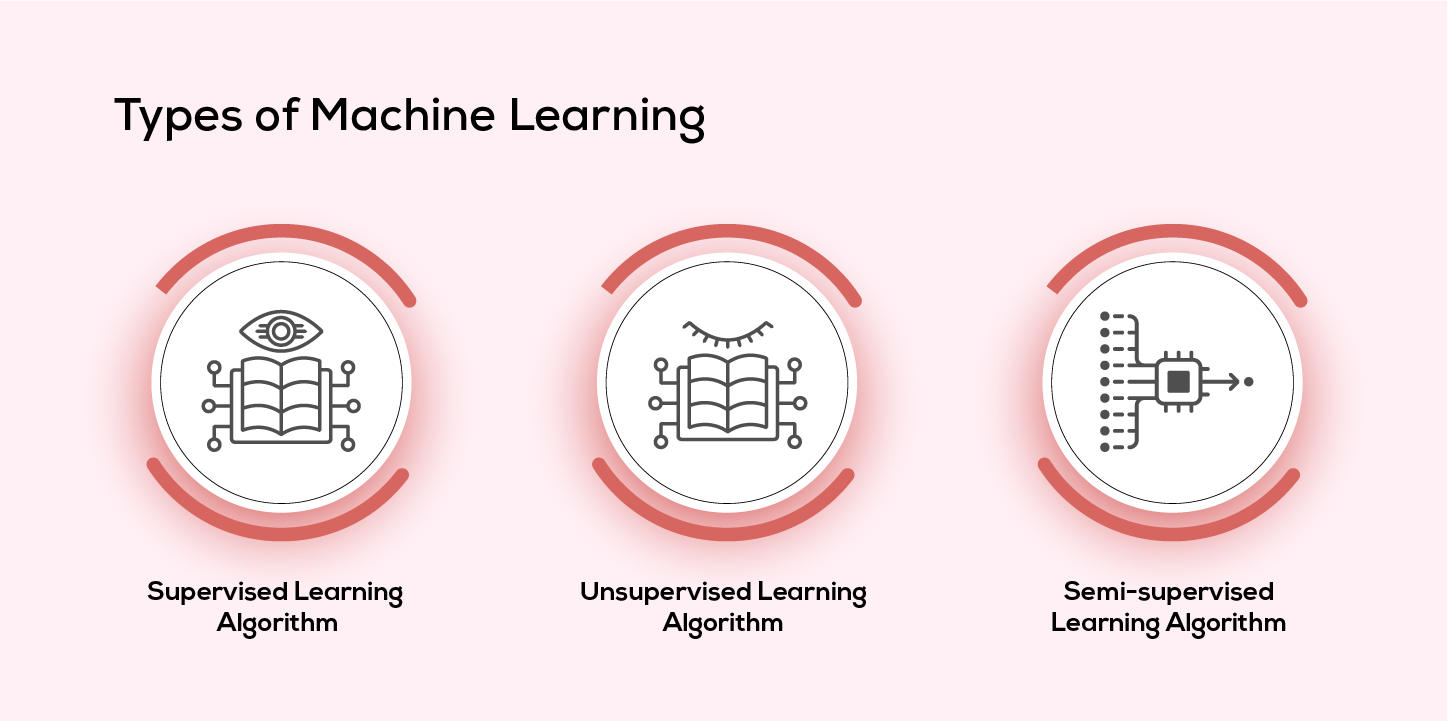
Reinforcement learning (RL) is a goal-oriented approach to machine learning where an agent learns optimal actions through experience rather than explicit instructions. The agent interacts with an environment, receiving rewards or penalties based on its actions. Over time, the agent develops a policy—a strategy for selecting actions that maximize long-term rewards. RL is distinct from supervised learning (which uses labeled data) and unsupervised learning (which finds patterns in unlabeled data). Instead, RL operates in a feedback-driven paradigm, making it ideal for problems where the optimal solution is not immediately apparent.
#Core Components of RL
- Agent: The decision-maker that learns from interactions.
- Environment: The system with which the agent interacts, providing feedback (rewards/punishments).
- Action (A): The decision or move the agent takes.
- State (S): The current situation or context the agent observes.
- Reward (R): The immediate feedback from the environment based on the agent’s action.
- Policy (π): The strategy the agent uses to determine actions from states.
- Value Function (V): Estimates the expected cumulative reward from a given state.
- Model: (Optional) A representation of the environment’s dynamics, used for planning.
#History / Background
The foundations of reinforcement learning trace back to behavioral psychology and optimal control theory in the mid-20th century.
#Early Developments
- 1950s–1960s: Richard Bellman introduced dynamic programming, laying the groundwork for solving sequential decision problems.
- 1960s–1970s: Ronald Howard and others formalized Markov Decision Processes (MDPs), a mathematical framework for RL.
- 1980s: Christopher Watkins developed Q-learning, a model-free RL algorithm that learns optimal action-selection policies.
#Modern Advancements
- 1990s–2000s: RL gained traction in robotics and game AI, with applications like TD-Gammon (a backgammon-playing program by Gerald Tesauro).
- 2010s: Deep reinforcement learning emerged, combining RL with deep neural networks. Key milestones include:
- DeepMind’s DQN (2015): Demonstrated RL’s ability to master Atari games from raw pixels.
- AlphaGo (2016): Defeated world champion Go player Lee Sedol, showcasing RL’s power in complex strategy games.
- AlphaZero (2017): Extended RL to master chess, shogi, and Go without human knowledge.
- 2020s: RL is applied in autonomous systems, supply chain optimization, personalized healthcare, and financial trading.
#How It Works
Reinforcement learning operates through a trial-and-error process where the agent learns from experience rather than pre-labeled data. The learning process can be broken down into the following steps:
#
- Environment Interaction The agent observes the current state (S) of the environment and selects an action (A) based on its policy (π). The environment then transitions to a new state (S') and provides a reward (R).
#
- Reward Signal The reward is a scalar feedback that indicates the immediate desirability of the action. Positive rewards reinforce good actions, while negative rewards (or penalties) discourage poor decisions.
#
- Policy Learning The agent updates its policy to maximize the expected cumulative reward (also called the return). This involves:
- Exploration vs. Exploitation: Balancing between trying new actions (exploration) and leveraging known good actions (exploitation).
- Value Estimation: Calculating the value function (V), which predicts the long-term reward from a given state.
#
- Model-Based vs. Model-Free RL
- Model-Free RL: The agent learns directly from interactions without modeling the environment (e.g., Q-learning, Policy Gradients).
- Model-Based RL: The agent builds a model of the environment to predict future states and rewards (e.g., Dyna-Q, Monte Carlo Tree Search).
#
- Key Algorithms | Algorithm | Type | Description | |------------------------|-------------------|---------------------------------------------------------------------------------| | Q-Learning | Model-Free | Learns the optimal action-value function (Q-function) independently of the policy. | | SARSA | Model-Free | On-policy variant of Q-learning that updates Q-values based on the next action. | | Deep Q-Networks (DQN) | Model-Free (Deep) | Uses deep neural networks to approximate Q-values for high-dimensional states. | | Policy Gradients | Model-Free | Directly optimizes the policy by gradient ascent. | | Proximal Policy Optimization (PPO) | Model-Free | A stable policy gradient method that limits policy updates to avoid large deviations. | | Monte Carlo Tree Search (MCTS) | Model-Based | Used in AlphaGo to simulate future game states and select optimal moves. |
#
- Challenges in RL
- Credit Assignment Problem: Determining which actions contributed to a reward, especially in delayed feedback.
- Exploration vs. Exploitation Trade-off: Balancing between discovering new strategies and exploiting known ones.
- Curse of Dimensionality: High-dimensional state spaces (e.g., raw pixels in games) require efficient representations.
- Sample Inefficiency: RL often requires millions of interactions to learn effectively.
#Important Facts
#Advantages of Reinforcement Learning ✅ No Need for Labeled Data: Unlike supervised learning, RL learns from interactions. ✅ Adaptability: Can handle dynamic and uncertain environments. ✅ Generalization: Policies can be transferred to similar tasks with fine-tuning. ✅ Autonomous Decision-Making: Ideal for systems requiring real-time adjustments (e.g., robotics, trading).
#Limitations of Reinforcement Learning ❌ Computationally Expensive: Requires significant computational resources for training. ❌ Safety Concerns: Poorly trained agents may take harmful actions (e.g., autonomous vehicles). ❌ Hyperparameter Sensitivity: Performance heavily depends on tuning (e.g., learning rate, discount factor). ❌ Real-World Deployment Challenges: Sim-to-real transfer remains a major hurdle.
#Real-World Applications 🔹 Robotics: Teaching robots to walk, grasp objects, or navigate obstacles. 🔹 Gaming: AI agents that master complex games (e.g., StarCraft, Dota 2). 🔹 Finance: Algorithmic trading, portfolio optimization, and fraud detection. 🔹 Healthcare: Personalized treatment strategies, drug discovery, and robotic surgery. 🔹 Autonomous Vehicles: Self-driving cars making real-time decisions. 🔹 Recommendation Systems: Dynamic personalization in streaming and e-commerce.
#Timeline
- Foundational ideas
Core concepts and early methods shape What Is Reinforcement Learning?.
- Practical use
Tools, examples, and real-world deployments make the topic easier to evaluate.
- Responsible implementation
Current work focuses on reliability, governance, performance, and measurable impact.
#Related Terms
#FAQ
What does What Is Reinforcement Learning? cover?
Explains What Is Reinforcement Learning, including the core definition, how it works, practical examples, and limitations.
Why is What Is Reinforcement Learning? important?
It helps readers understand key concepts, compare practical use cases, and evaluate how Machine Learning decisions affect outcomes, risks, and implementation choices.
What should readers verify before applying this topic?
Readers should compare benefits, limitations, data requirements, and related themes such as Reinforcement, Learning, AI before using the ideas in real projects.
#References
- What Is Reinforcement Learning? terminology and background research
- What Is Reinforcement Learning? use cases, implementation examples, and limitations
- Machine Learning best practices, standards, and risk guidance
- Reinforcement case studies, benchmarks, and current industry analysis


Comments
No comments yet. Start the discussion with a useful note.