

#Short Answer
Explains What Is Natural Language Processing (nlp), including the core definition, how it works, practical examples, and limitations.
#Infobox
#Overview
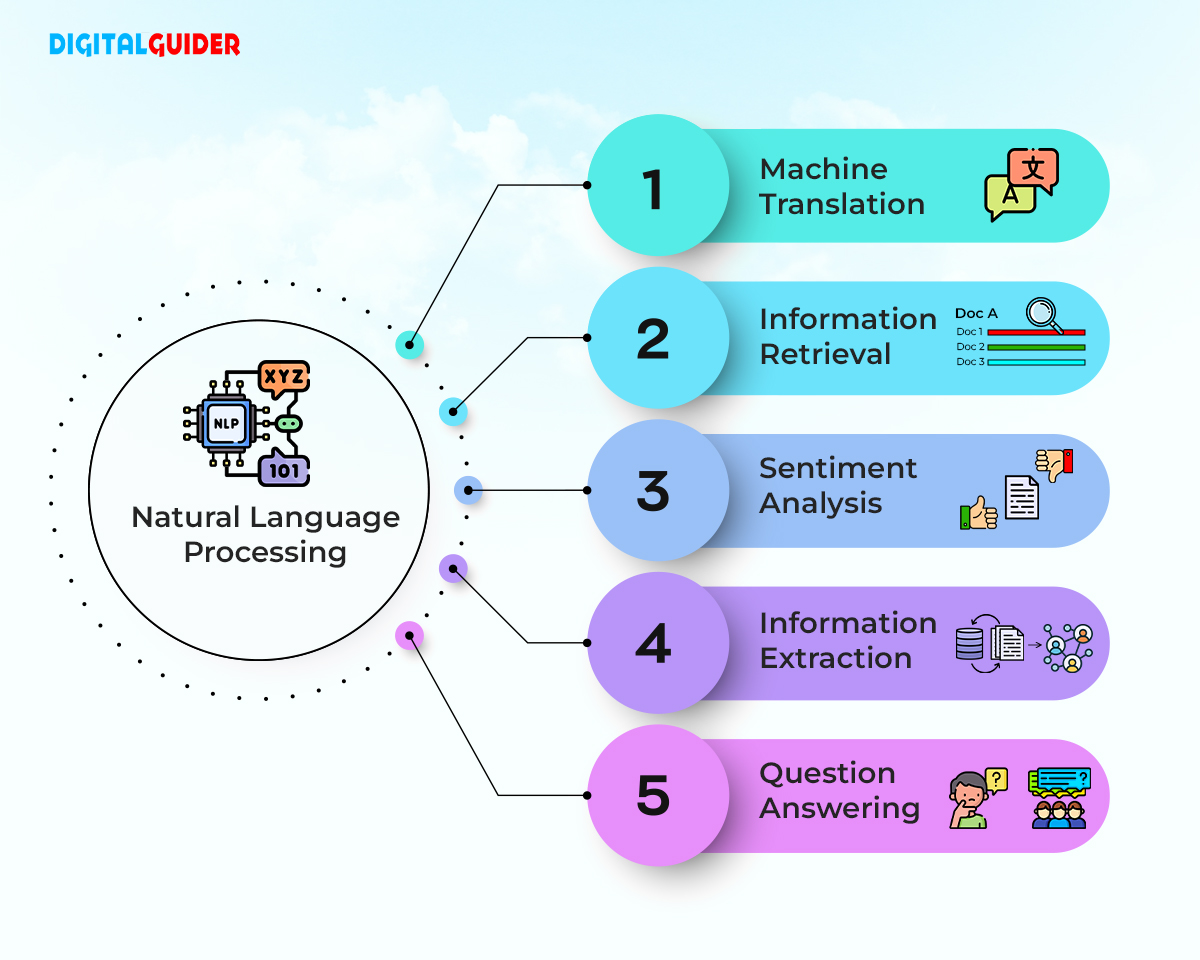
Natural Language Processing (NLP) is a multidisciplinary field that combines computer science, artificial intelligence, and linguistics to enable machines to process and analyze large amounts of natural language data. Unlike traditional programming, which relies on structured data, NLP deals with unstructured text and speech, making it one of the most challenging yet rewarding areas of AI. At its core, NLP aims to bridge the communication gap between humans and machines by allowing computers to:
- Understand the meaning of text or speech.
- Generate human-like responses or content.
- Extract relevant information from large datasets.
- Translate between languages accurately.
- Classify text based on sentiment, intent, or topic. NLP is divided into two main branches:
- Natural Language Understanding (NLU) – Focuses on interpreting human language (e.g., parsing sentences, extracting meaning).
- Natural Language Generation (NLG) – Focuses on producing human-like text (e.g., generating reports, chatbot responses).
#History / Background
#Early Foundations (Pre-1950s)
The conceptual roots of NLP trace back to ancient linguistic theories, including Panini’s grammar rules (4th century BCE) and René Descartes’ early ideas on language and thought. However, the formal study of computational linguistics began in the mid-20th century.
#The Birth of NLP (1950s–1960s)
- 1950: Alan Turing published "Computing Machinery and Intelligence", introducing the Turing Test, which evaluates a machine’s ability to exhibit intelligent behavior indistinguishable from a human.
- 1954: The Georgetown-IBM experiment demonstrated the first machine translation system, translating Russian sentences into English.
- 1957: Noam Chomsky introduced transformational grammar, a foundational theory in linguistics that influenced early NLP models.
- 1966: ELIZA, an early chatbot created by Joseph Weizenbaum, simulated human conversation by using pattern matching and substitution techniques.
#Rule-Based Systems (1970s–1980s)
During this period, NLP relied heavily on handcrafted linguistic rules and expert systems. Key developments included:
- SHRDLU (1970): A program that understood and responded to natural language commands in a block-world environment.
- MARGIE (1975): A system that performed semantic analysis and inference on English sentences.
- PROLOG (1972): A logic programming language widely used in early NLP research.
#Statistical NLP (1990s–2000s)
The rise of machine learning and statistical methods revolutionized NLP by enabling systems to learn from data rather than rely solely on predefined rules.
- 1990s: Introduction of corpus-based approaches, such as the Brown Corpus and Penn Treebank, which provided annotated text datasets for training.
- 1997: IBM’s statistical machine translation system outperformed earlier rule-based methods.
- 2000s: Part-of-speech tagging, named entity recognition (NER), and syntactic parsing became standard techniques.
#Deep Learning Era (2010s–Present)
The advent of deep learning and neural networks transformed NLP, leading to breakthroughs in language modeling, translation, and sentiment analysis.
- 2013: Word2Vec (Google) introduced distributed word representations, enabling better semantic understanding.
- 2015: Sequence-to-sequence (Seq2Seq) models improved machine translation (e.g., Google’s Neural Machine Translation).
- 2017: Transformer architecture (Vaswani et al.) introduced self-attention mechanisms, powering models like BERT, GPT, and T5.
- 2020s: Large Language Models (LLMs) such as ChatGPT, PaLM, and Llama demonstrated near-human-level language generation and comprehension.
#How It Works
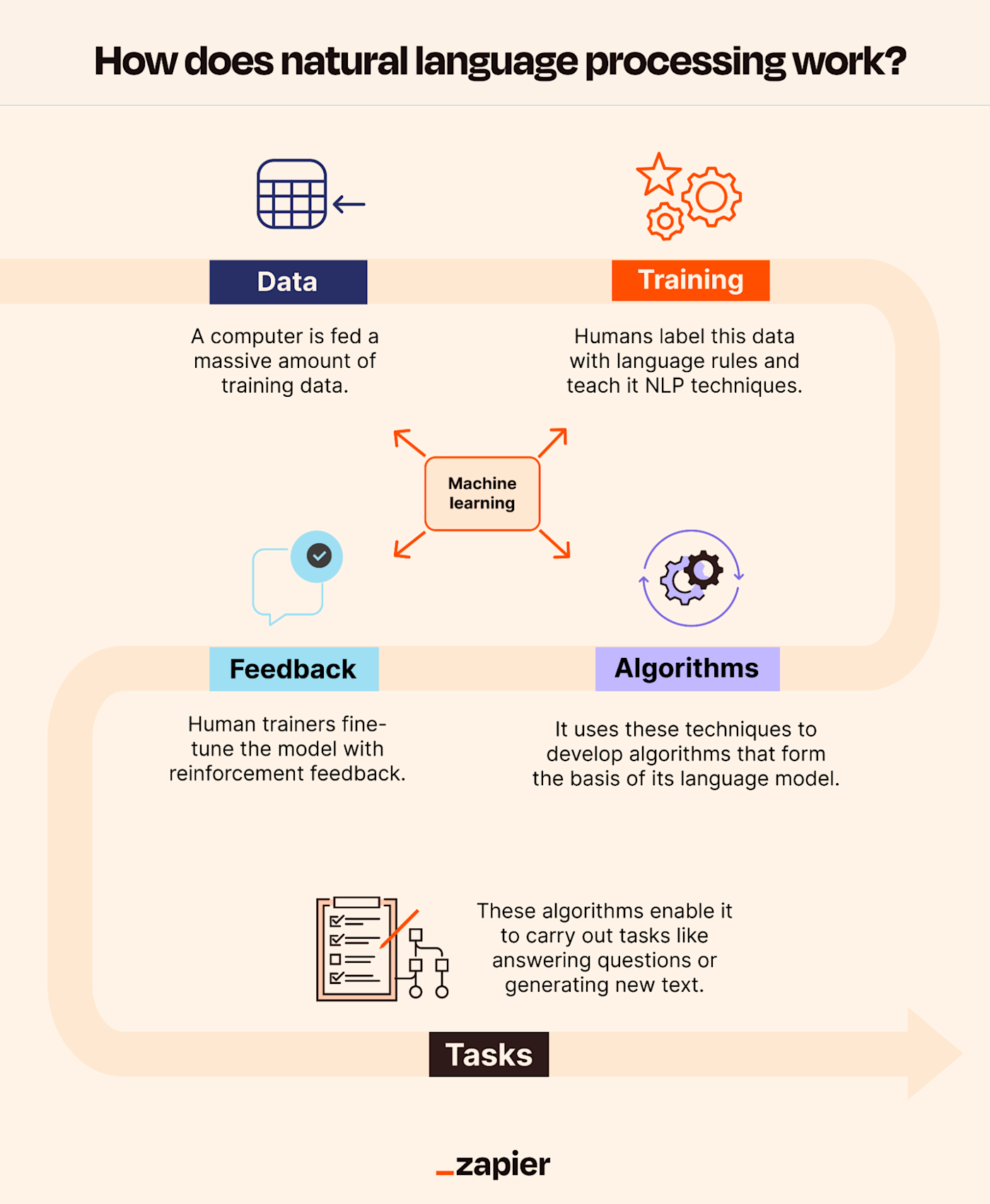
NLP systems process language through a multi-stage pipeline, combining linguistic rules, statistical models, and deep learning techniques. The process can be broken down into the following key steps:
#1. Text Preprocessing Before analysis, raw text undergoes several preprocessing steps to improve accuracy:
- Tokenization: Splitting text into words, phrases, or sentences (e.g., "I love NLP" → ["I", "love", "NLP"]).
- Normalization: Converting text to a standard format (e.g., lowercase conversion, removing punctuation, expanding contractions).
- Stopword Removal: Filtering out common words (e.g., "the", "is", "and") that add little meaning.
- Stemming & Lemmatization: Reducing words to their base or root form (e.g., "running" → "run", "better" → "good").
- Part-of-Speech (POS) Tagging: Assigning grammatical labels to words (e.g., noun, verb, adjective).
#2. Syntactic Analysis This step examines the grammatical structure of sentences to understand relationships between words.
- Parsing: Building a parse tree to represent sentence structure (e.g., subject-verb-object relationships).
- Dependency Parsing: Identifying word dependencies (e.g., "The cat sat on the mat" → "sat" depends on "cat").
#3. Semantic Analysis Semantic analysis focuses on meaning extraction from text.
- Word Sense Disambiguation (WSD): Determining the correct meaning of ambiguous words (e.g., "bank" as a financial institution vs. a riverbank).
- Named Entity Recognition (NER): Identifying entities such as people, organizations, locations (e.g., "Apple Inc." → Organization).
- Coreference Resolution: Linking pronouns to their referents (e.g., "She" → "Mary").
#4. Discourse & Pragmatic Analysis This level examines context, tone, and intent beyond individual sentences.
- Discourse Analysis: Understanding coherence and cohesion in multi-sentence text.
- Sentiment Analysis: Detecting emotional tone (positive, negative, neutral).
- Intent Recognition: Identifying user goals in conversational AI (e.g., "Book a flight" → travel intent).
#5. Language Generation (NLG)
For systems that produce text, NLG involves:
- Template-Based Generation: Filling predefined templates with extracted data.
- Neural Generation: Using sequence-to-sequence models (e.g., Transformers) to generate fluent, context-aware responses.
#6. Machine Learning & Deep Learning Models Modern NLP relies on advanced models to process language:
- Traditional Models:
- Naive Bayes, SVM, Hidden Markov Models (HMMs) for classification and tagging.
- Neural Models:
- Recurrent Neural Networks (RNNs), Long Short-Term Memory (LSTM) for sequence modeling.
- Transformer Models (BERT, GPT, T5) for contextual understanding.
- Pre-trained Language Models (PLMs): - Models like BERT (Bidirectional Encoder Representations from Transformers) and RoBERTa are pre-trained on vast text corpora and fine-tuned for specific tasks.
#Important Facts
- NLP is Everywhere: From Google Search to Siri and Alexa, NLP powers many everyday technologies.
- Multilingual NLP: Systems like Google Translate support over 100 languages, though accuracy varies.
- Bias in NLP: Models can inherit biases from training data, leading to unfair or discriminatory outputs.
- Computational Cost: Training large models (e.g., GPT-3) requires thousands of GPUs and significant energy.
- Ethical Concerns: NLP raises issues like privacy (voice assistants), deepfakes, and misinformation spread.
- Human-Like Performance: Some models (e.g., GPT-4) achieve near-human scores on language benchmarks like GLUE and SuperGLUE.
- Applications in Healthcare: NLP extracts insights from medical records, aiding in disease diagnosis and drug discovery.
- Real-Time Processing: NLP enables live transcription, chatbots, and sentiment analysis in customer service.
#Timeline
- Foundational ideas
Core concepts and early methods shape What Is Natural Language Processing (nlp)?.
- Practical use
Tools, examples, and real-world deployments make the topic easier to evaluate.
- Responsible implementation
Current work focuses on reliability, governance, performance, and measurable impact.
#Related Terms
#FAQ
What does What Is Natural Language Processing (nlp)? cover?
Explains What Is Natural Language Processing (nlp), including the core definition, how it works, practical examples, and limitations.
Why is What Is Natural Language Processing (nlp)? important?
It helps readers understand key concepts, compare practical use cases, and evaluate how Language AI decisions affect outcomes, risks, and implementation choices.
What should readers verify before applying this topic?
Readers should compare benefits, limitations, data requirements, and related themes such as Natural, Language, Processing before using the ideas in real projects.
#References
- What Is Natural Language Processing (nlp)? terminology and background research
- What Is Natural Language Processing (nlp)? use cases, implementation examples, and limitations
- Language AI best practices, standards, and risk guidance
- Natural case studies, benchmarks, and current industry analysis


Comments
No comments yet. Start the discussion with a useful note.