


#Short Answer
Covers understanding natural language processing: a comprehensive guide, including core concepts, practical examples, benefits, limitations, and risks in Language AI.
#Infobox
#Overview
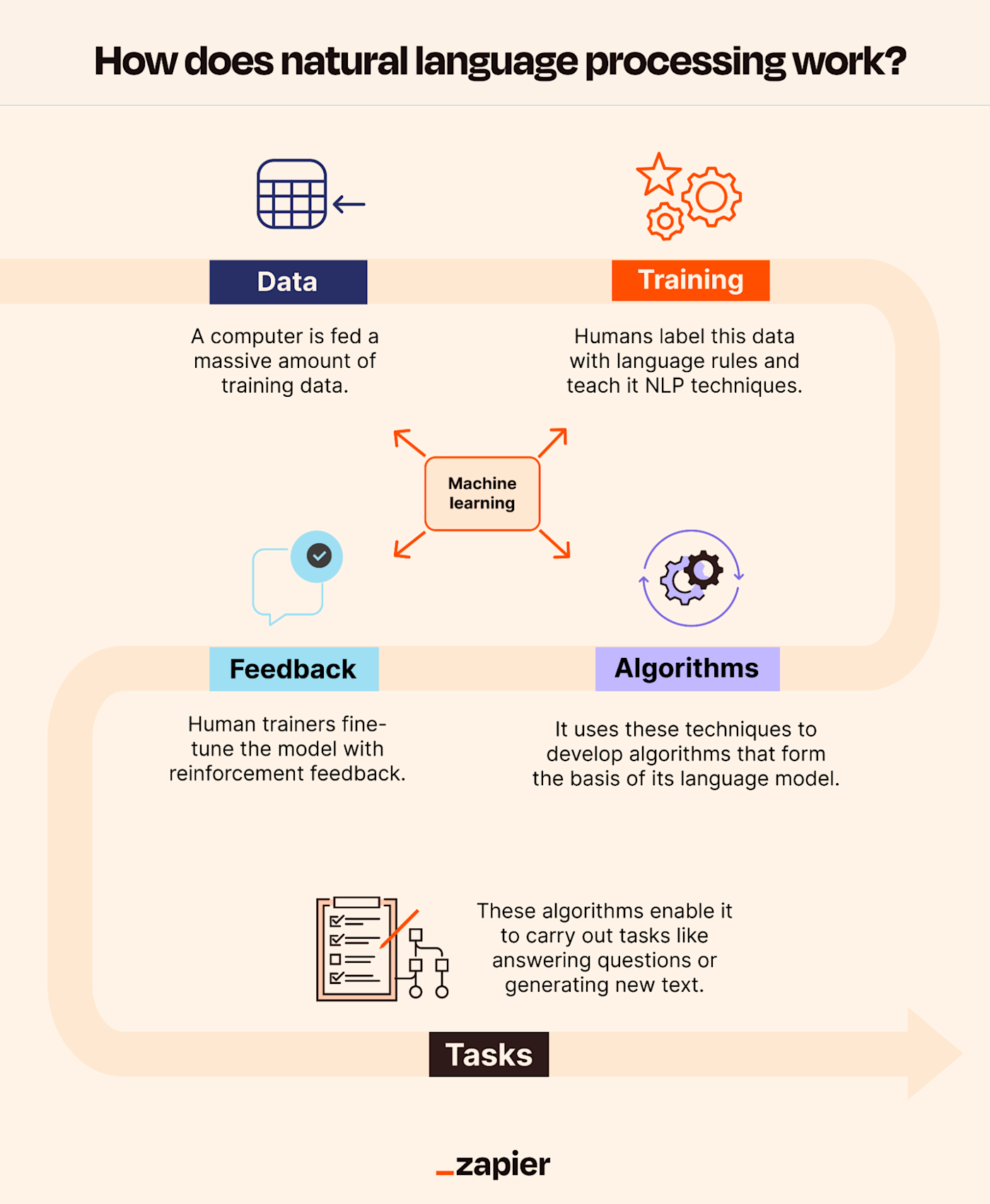
Natural Language Processing (NLP) is a multidisciplinary field that bridges the gap between human communication and machine understanding. By leveraging computational techniques, NLP systems analyze, interpret, and generate human language in both written and spoken forms. This capability is essential for enabling machines to process vast amounts of unstructured text data, extract meaningful insights, and facilitate seamless human-computer interaction. NLP is deeply rooted in linguistics, computer science, and artificial intelligence. It combines statistical, machine learning, and deep learning approaches to model language patterns, semantics, and syntax. The ultimate goal of NLP is to create systems that can understand context, resolve ambiguities, and produce coherent responses—mimicking human-like language comprehension. The applications of NLP are vast and continue to expand across industries. From automating customer service with chatbots to analyzing social media trends, NLP is transforming how businesses and individuals interact with data. Its integration into search engines, virtual assistants, and content generation tools underscores its pivotal role in modern technology.
#History / Background
#Early Foundations (Pre-1950s)
The conceptual origins of NLP trace back to the early 20th century, with the study of formal linguistics and the development of symbolic logic. In 1950, Alan Turing proposed the "Imitation Game" (later known as the Turing Test), which posed a fundamental question: Can machines think? This challenge laid the groundwork for AI and, by extension, NLP.
#The Birth of NLP (1950s–1960s)
The field formally emerged in the 1950s with the advent of early computational linguistics. One of the first notable projects was the Georgetown-IBM experiment in 1954, which demonstrated machine translation from Russian to English using a limited set of rules. This period was dominated by rule-based systems, where linguists manually encoded grammatical rules into programs. Key milestones during this era include:
- 1957: Noam Chomsky's theory of generative grammar revolutionized linguistic theory, influencing early NLP approaches.
- 1966: ELIZA, an early natural language processing program, simulated conversation by using pattern matching and substitution techniques.
#Statistical and Empirical NLP (1970s–1990s)
The 1970s and 1980s saw a shift toward statistical methods, driven by the limitations of rule-based systems. Researchers began using probabilistic models to analyze language patterns, leading to advancements in speech recognition and text processing. Notable developments included:
- Hidden Markov Models (HMMs): Introduced for speech recognition in the 1980s, enabling more accurate transcription of spoken language.
- Corpus Linguistics: The creation of large text corpora (e.g., Brown Corpus) allowed for empirical analysis of language usage.
#The Rise of Machine Learning (2000s–2010s)
The 2000s marked a paradigm shift with the integration of machine learning into NLP. Algorithms like Support Vector Machines (SVMs) and Conditional Random Fields (CRFs) improved tasks such as part-of-speech tagging and named entity recognition. A defining moment came in 2013 with the introduction of Word2Vec by Tomas Mikolov, which used neural networks to represent words as dense vectors, capturing semantic relationships. This innovation paved the way for more sophisticated models.
#Deep Learning and Transformers (2010s–Present)
The advent of deep learning and transformer architectures revolutionized NLP. Introduced in 2017, the Transformer model (Vaswani et al.) enabled parallel processing of sequences, overcoming the limitations of recurrent neural networks (RNNs). Key breakthroughs include:
- BERT (Bidirectional Encoder Representations from Transformers): Developed by Google in 2018, BERT uses bidirectional training to understand context in both directions, achieving state-of-the-art results in various NLP tasks.
- GPT (Generative Pre-trained Transformer): Introduced by OpenAI, GPT models excel in generating human-like text, powering applications like chatbots and content creation.
- T5 (Text-to-Text Transfer Transformer): Google’s T5 reframed NLP tasks as a unified text-to-text problem, simplifying model training and deployment. Today, NLP continues to evolve with advancements in multimodal models, few-shot learning, and explainable AI, addressing challenges like bias, interpretability, and scalability.
#How It Works
#Core Components of NLP NLP systems typically involve several key components, each addressing a specific aspect of language processing:
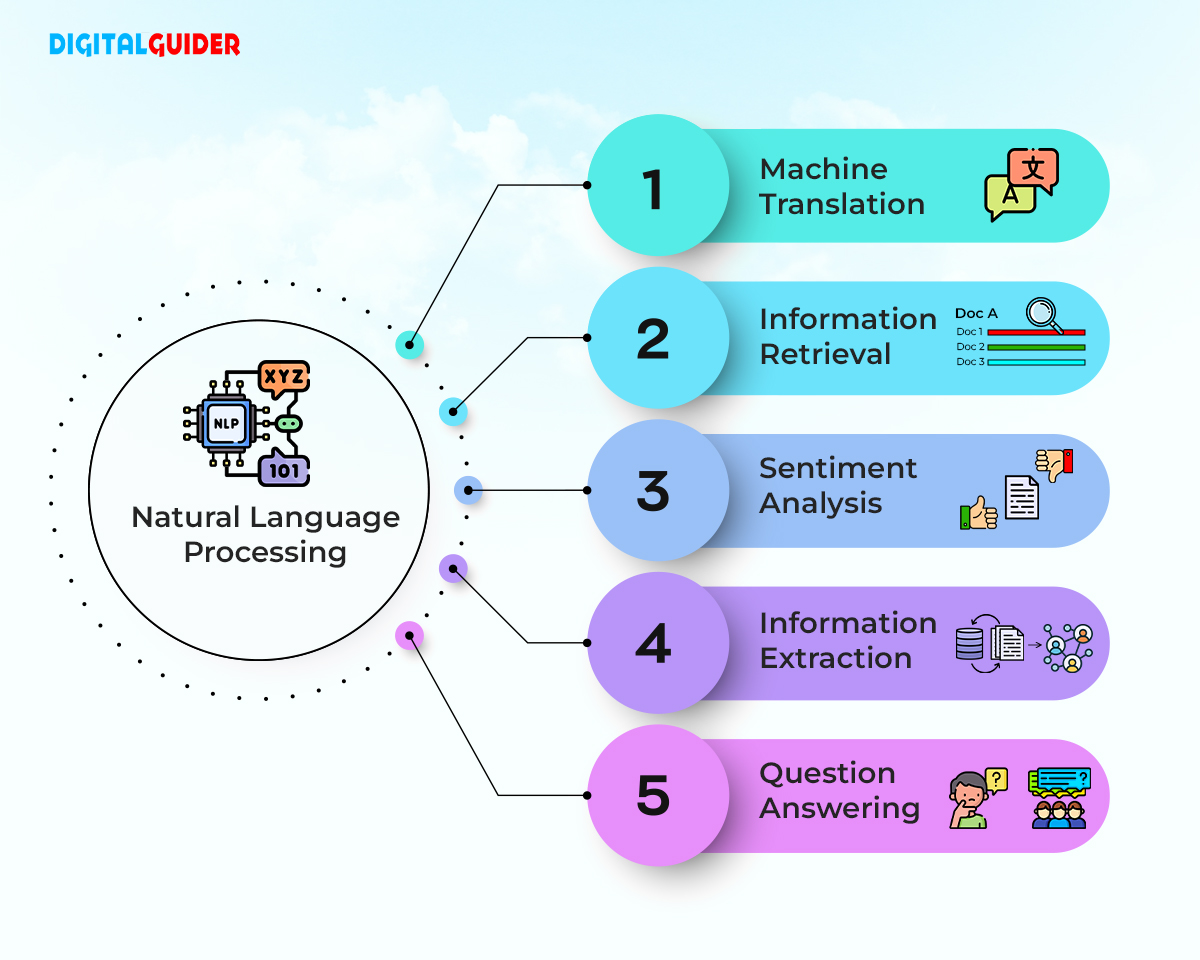
- Tokenization - The process of breaking down text into smaller units (tokens), such as words, phrases, or sentences. - Example: "Natural Language Processing" → ["Natural", "Language", "Processing"]
- Part-of-Speech (POS) Tagging - Assigning grammatical labels (e.g., noun, verb, adjective) to each token. - Example: "She runs fast" → ["She" (pronoun), "runs" (verb), "fast" (adverb)]
- Parsing and Syntax Analysis - Analyzing the grammatical structure of sentences using techniques like constituency parsing or dependency parsing. - Example: Identifying subject-verb-object relationships in a sentence.
- Named Entity Recognition (NER) - Identifying and classifying named entities (e.g., people, organizations, locations) in text. - Example: "Apple Inc. is based in Cupertino." → ["Apple Inc." (organization), "Cupertino" (location)]
- Sentiment Analysis - Determining the emotional tone of a text (positive, negative, neutral). - Example: "I love this product!" → Positive sentiment.
- Machine Translation - Converting text from one language to another using models like sequence-to-sequence (Seq2Seq) or transformers. - Example: "Hello" (English) → "Hola" (Spanish)
- Text Generation - Producing human-like text based on input prompts, often using models like GPT or T5. - Example: Generating a product description from a few keywords.
#Key Techniques
and Models
Rule-Based Systems - Early NLP relied on handcrafted rules and lexicons. - Limitations: Inflexible, labor-intensive, and unable to handle ambiguity.
Statistical NLP - Uses probabilistic models (e.g., n-grams, HMMs) to predict language patterns. - Example: Predicting the next word in a sentence based on previous words.
Machine Learning Approaches
- Supervised Learning: Trains models on labeled datasets (e.g., for sentiment analysis).
- Unsupervised Learning: Identifies patterns without labeled data (e.g., topic modeling).
- Semi-Supervised Learning: Combines labeled and unlabeled data for improved performance.
Deep Learning and Neural Networks
- Recurrent Neural Networks (RNNs): Process sequences sequentially, useful for time-series data like text.
- Convolutional Neural Networks (CNNs): Capture local patterns in text, often used for text classification.
- Transformers: Use self-attention mechanisms to weigh the importance of different words in a sentence, enabling parallel processing and long-range dependencies.
Pre-trained Language Models - Models like BERT, RoBERTa, and GPT are pre-trained on vast amounts of text data and fine-tuned for specific tasks.
- Fine-tuning: Adapting a pre-trained model to a downstream task (e.g., question answering) with a smaller, task-specific dataset.
#Challenges in NLP
- Ambiguity: Language is inherently ambiguous (e.g., "bank" can refer to a financial institution or the side of a river).
- Contextual Understanding: Words can have different meanings based on context (e.g., "crane" as a bird or a machine).
- Bias and Fairness: NLP models can perpetuate biases present in training data (e.g., gender or racial biases).
- Scalability: Processing large volumes of text efficiently requires significant computational resources.
- Multilingualism: Adapting NLP systems to low-resource languages remains a challenge.
#Important Facts
- NLP Powers 90% of Search Queries: Modern search engines like Google use NLP to understand user intent and deliver relevant results.
- Chatbots Handle 69% of Customer Queries: Businesses leverage NLP-powered chatbots to automate customer support, reducing response times.
- BERT Processes 110 Languages: Google’s BERT model supports multilingual applications, enabling cross-lingual understanding.
- GPT-3 Generates Human-Like Text: OpenAI’s GPT-3 can produce coherent essays, code, and even poetry from simple prompts.
- NLP in Healthcare: Systems like IBM Watson analyze medical records to assist in diagnosis and treatment recommendations.
- Sentiment Analysis in Marketing: Brands use NLP to gauge customer sentiment from reviews, social media, and surveys.
- Automatic Speech Recognition (ASR): NLP enables real-time transcription services like Otter.ai and Google’s Live Transcribe.
- Ethical Concerns: NLP models can generate misinformation, deepfake text, or biased outputs, raising ethical dilemmas.
#Timeline
- Foundational ideas
Core concepts and early methods shape Understanding Natural Language Processing: a Comprehensive Guide.
- Practical use
Tools, examples, and real-world deployments make the topic easier to evaluate.
- Responsible implementation
Current work focuses on reliability, governance, performance, and measurable impact.
#Related Terms
#FAQ
What does Understanding Natural Language Processing: a Comprehensive Guide cover?
Covers understanding natural language processing: a comprehensive guide, including core concepts, practical examples, benefits, limitations, and risks in Language AI.
Why is Understanding Natural Language Processing: a Comprehensive Guide important?
It helps readers understand key concepts, compare practical use cases, and evaluate how Language AI decisions affect outcomes, risks, and implementation choices.
What should readers verify before applying this topic?
Readers should compare benefits, limitations, data requirements, and related themes such as Understanding, Natural, Language before using the ideas in real projects.
#References
- Understanding Natural Language Processing: a Comprehensive Guide terminology and background research
- Understanding Natural Language Processing: a Comprehensive Guide use cases, implementation examples, and limitations
- Language AI best practices, standards, and risk guidance
- Understanding case studies, benchmarks, and current industry analysis

Comments
No comments yet. Start the discussion with a useful note.