

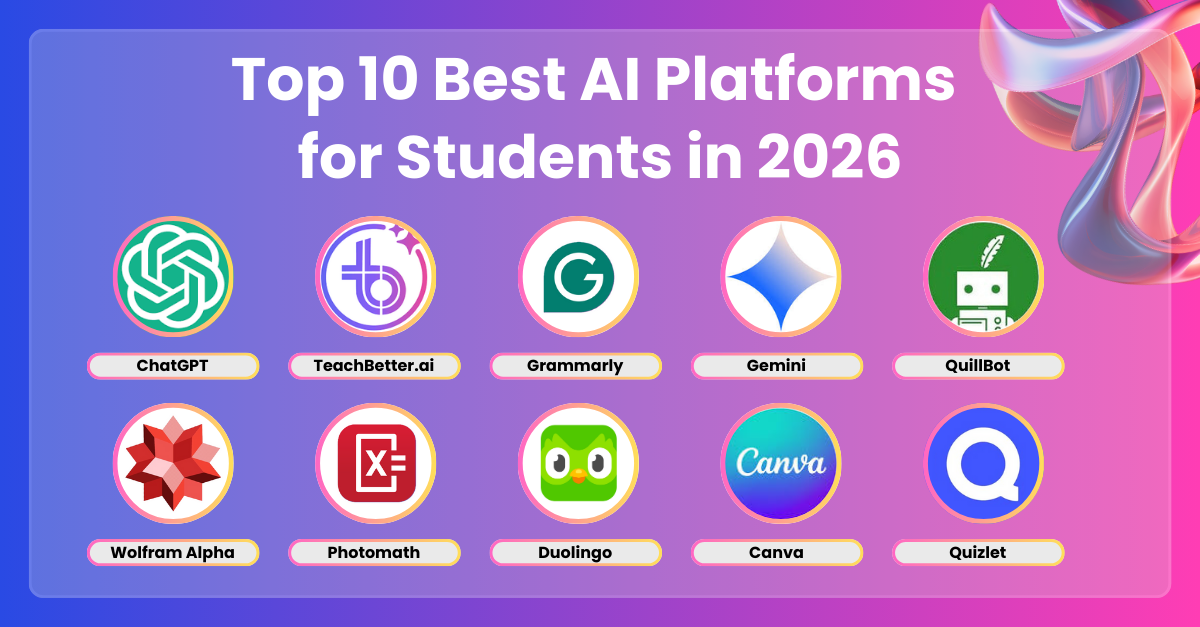
#Short Answer
Reviews top 10 ai platforms in 2026, covering notable options, strengths, limitations, and practical selection factors.
#Infobox
#Overview
By 2026, AI platforms have become indispensable tools in education, reshaping how students learn, teachers instruct, and institutions operate. The proliferation of AI in education is driven by the demand for personalized learning experiences, the need to bridge educational gaps exacerbated by the COVID-19 pandemic, and the rapid advancement of AI technologies. These platforms are designed to cater to individual learning styles, provide instant feedback, and automate administrative tasks, thereby freeing educators to focus on mentorship and critical thinking. The Top 10 AI Platforms for Students in 2026 are distinguished by their ability to integrate seamlessly into existing educational frameworks while offering innovative features such as AI tutors, automated grading, and predictive analytics. They also prioritize inclusivity, ensuring that students with disabilities, non-native English speakers, and those in underserved communities have equitable access to high-quality education. The platforms listed below are not only transforming traditional classrooms but also enabling self-paced learning, micro-credentials, and global collaboration.
#History / Background
The integration of AI into education is not a recent phenomenon but has evolved significantly over the past two decades. Early AI applications in education focused on simple adaptive learning systems and intelligent tutoring systems (ITS) in the 1990s and early 2000s. However, the breakthrough came with the rise of big data, cloud computing, and advancements in machine learning algorithms in the 2010s. By 2020, AI-driven platforms like Duolingo and Khan Academy had already gained traction, but the COVID-19 pandemic accelerated their adoption as schools worldwide transitioned to remote learning. The pandemic highlighted the need for scalable, flexible, and personalized learning solutions, paving the way for the next generation of AI platforms. In 2023, the launch of generative AI tools such as ChatGPT and Google Bard further revolutionized the educational landscape. These tools enabled students to receive instant explanations, generate study materials, and even simulate Socratic dialogues. By 2025, AI platforms began incorporating multimodal learning, combining text, audio, and video to cater to diverse learning preferences. The year 2026 marks a pivotal moment where AI platforms are no longer supplementary tools but core components of the educational ecosystem. Governments and institutions are investing heavily in AI literacy programs, and ethical considerations around data privacy and algorithmic bias are being addressed through regulatory frameworks.
#How It Works
AI platforms for students in 2026 operate on a combination of advanced technologies designed to enhance learning outcomes. The core mechanisms include:
#
- Personalized Learning Engines These engines analyze student performance data, including quiz scores, time spent on tasks, and interaction patterns, to create customized learning paths. Machine learning models identify strengths, weaknesses, and preferred learning styles, adjusting content delivery accordingly.
#
- Natural Language Processing (NLP) NLP enables platforms to understand and generate human-like text, facilitating features such as AI tutors, automated essay grading, and real-time feedback. Tools like Grammarly and Socratic AI use NLP to provide contextual explanations and suggestions.
#
- Adaptive Assessments AI-driven platforms dynamically adjust the difficulty of questions based on student responses. This ensures that assessments are neither too easy nor too challenging, maintaining optimal engagement and learning efficiency.
#
- Gamification and Engagement Gamification elements, such as badges, leaderboards, and interactive challenges, are integrated to boost motivation. Platforms like Duolingo and Quizlet use these techniques to make learning more interactive and enjoyable.
#
- Multimodal Learning Modern AI platforms support multiple formats, including text, audio, video, and interactive simulations. For example, Wolfram Alpha provides step-by-step solutions to mathematical problems, while Photomath offers visual explanations for complex equations.
#
- Predictive Analytics Institutions use predictive analytics to identify at-risk students early, allowing for timely interventions. AI platforms analyze historical data to forecast academic performance and recommend resources to improve outcomes.
#
- Collaborative Learning Features like discussion forums, peer-to-peer tutoring, and group projects are enhanced by AI. Brainly AI, for instance, uses AI to match students with tutors or study groups based on shared interests and academic needs.
#
- Automated Administrative Tasks AI streamlines administrative processes such as grading, attendance tracking, and scheduling. This reduces the burden on educators, allowing them to focus on teaching and mentorship.
#Important Facts
- Accessibility: Over 80% of the top AI platforms in 2026 offer free tiers or subsidized plans for low-income students, ensuring inclusivity.
- Global Reach: These platforms support over 100 languages, with AI-powered translation tools breaking down language barriers.
- Data Privacy: Compliance with regulations like GDPR and COPPA is mandatory, with platforms implementing robust encryption and anonymization techniques.
- Ethical AI: Transparency in AI decision-making is prioritized, with platforms providing explanations for recommendations and assessments.
- Integration: Major platforms like Coursera and Khan Academy integrate with learning management systems (LMS) such as Canvas, Blackboard, and Google Classroom.
- Teacher Tools: AI platforms provide educators with analytics dashboards, automated lesson planning, and plagiarism detection tools.
- Career Readiness: Platforms like Codecademy and Coursera offer AI-driven career path recommendations based on student performance and market trends.
- Sustainability: Many platforms use carbon-neutral data centers and promote digital literacy to reduce the environmental impact of education.
#Timeline
- Foundational ideas
Core concepts and early methods shape Top 10 AI Platforms in 2026.
- Practical use
Tools, examples, and real-world deployments make the topic easier to evaluate.
- Responsible implementation
Current work focuses on reliability, governance, performance, and measurable impact.
#Related Terms
#FAQ
What does Top 10 AI Platforms in 2026 cover?
Reviews top 10 ai platforms in 2026, covering notable options, strengths, limitations, and practical selection factors.
Why is Top 10 AI Platforms in 2026 important?
It helps readers understand key concepts, compare practical use cases, and evaluate how AI Tools decisions affect outcomes, risks, and implementation choices.
What should readers verify before applying this topic?
Readers should compare benefits, limitations, data requirements, and related themes such as Top, 10, AI before using the ideas in real projects.
#References
- Top 10 AI Platforms in 2026 terminology and background research
- Top 10 AI Platforms in 2026 use cases, implementation examples, and limitations
- AI Tools best practices, standards, and risk guidance
- Top case studies, benchmarks, and current industry analysis

Comments
No comments yet. Start the discussion with a useful note.