

#Short Answer
Traces timeline of ai platforms, highlighting major milestones, context, examples, and future implications.
#Infobox
#Overview
The Timeline of AI Platforms documents the progression of artificial intelligence from its theoretical origins to the sophisticated, multimodal systems in use today. This timeline captures the evolution of AI platforms—defined as software or hardware systems designed to perform tasks requiring human-like intelligence—across key phases: early theoretical work, symbolic AI, machine learning, deep learning, and generative AI. AI platforms have transitioned from rule-based systems to self-learning models capable of generating human-like text, images, and even code. The timeline reflects not only technological advancements but also shifts in computational power, data availability, and interdisciplinary collaboration. Understanding this progression is essential for grasping the current state of AI and anticipating future developments.
#History / Background
#Early Foundations (1940s–1950s)
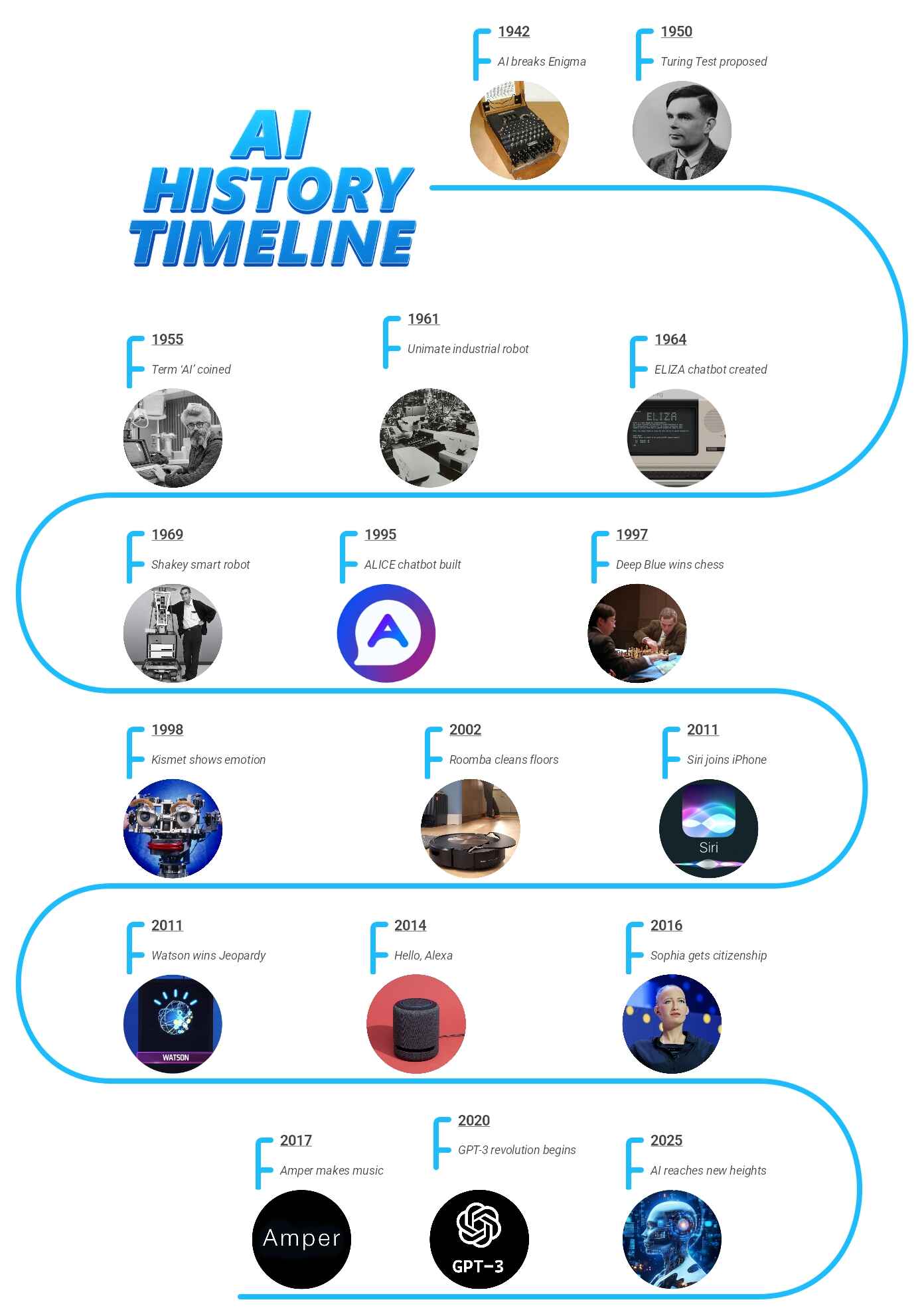
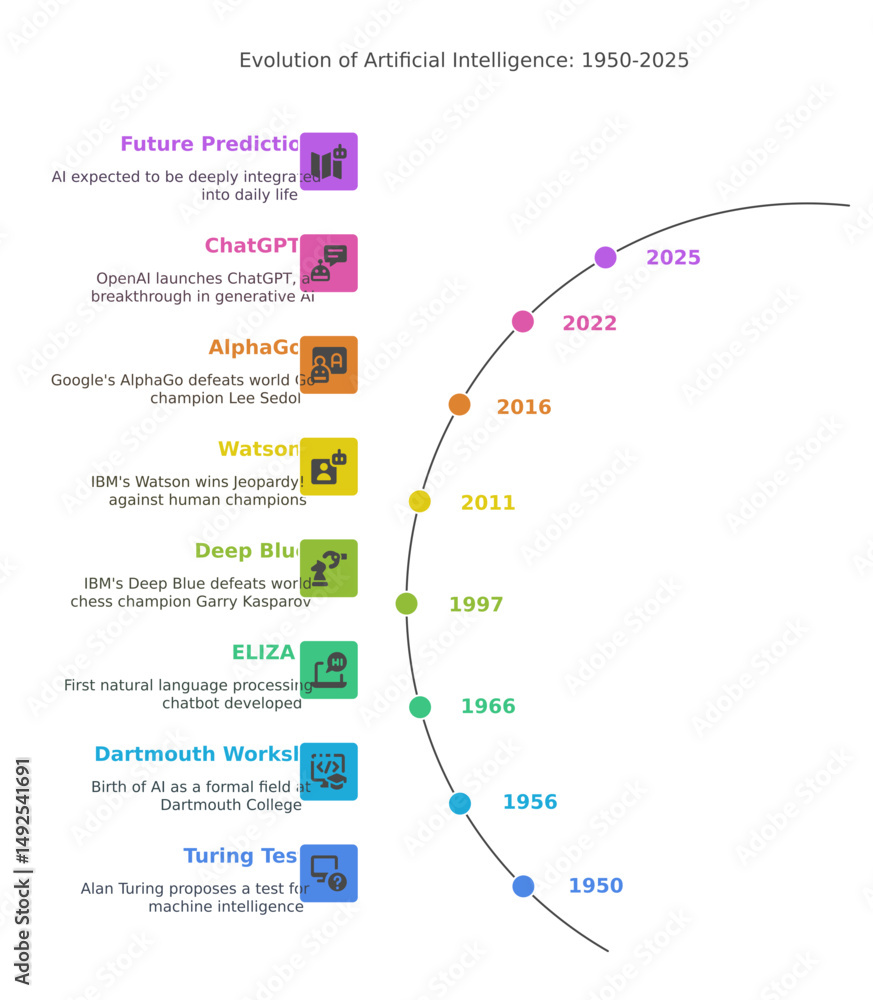
The conceptual roots of AI platforms trace back to the mid-20th century. In 1950, Alan Turing proposed the Turing Test, a criterion for machine intelligence, laying the philosophical groundwork for AI. The term "artificial intelligence" was coined in 1956 during the Dartmouth Conference, where pioneers like John McCarthy and Marvin Minsky envisioned machines capable of simulating human cognition. Early AI platforms were limited by computational constraints and relied on symbolic logic. Programs like Logic Theorist (1956), developed by Allen Newell and Herbert Simon, demonstrated that machines could solve mathematical problems using formal rules.
#The Rise of Expert Systems (1960s–1980s)
The 1960s and 1970s saw the development of expert systems, AI platforms designed to mimic human expertise in specific domains. DENDRAL (1965), created at Stanford, was one of the first expert systems, aiding chemists in molecular structure analysis. MYCIN (1970s) followed, diagnosing bacterial infections with high accuracy. Despite their success, expert systems faced limitations: they required extensive manual rule encoding and struggled with uncertainty. This period also saw the AI Winter (1970s–1980s), a decline in funding and interest due to unmet expectations and technical challenges.
#Machine Learning and Neural Networks (1980s–1990s)
The resurgence of AI in the 1980s was driven by machine learning, particularly neural networks. The backpropagation algorithm, popularized by David Rumelhart and others, enabled networks to learn from data. NETtalk (1987), a neural network that learned to pronounce English text, showcased the potential of connectionist models. However, computational power remained a bottleneck. The field again faced stagnation in the late 1990s, as symbolic AI and neural networks competed for dominance without clear breakthroughs.
#The Deep Learning Revolution (2000s–2010s)
The 2000s marked a turning point with the advent of deep learning, powered by advances in hardware (GPUs) and the availability of large datasets. AlexNet (2012), a convolutional neural network, achieved unprecedented accuracy in image recognition, winning the ImageNet competition and igniting widespread interest in deep learning. During this period, AI platforms evolved from specialized tools to general-purpose systems. IBM Watson (2011) demonstrated the power of AI in natural language processing by defeating human champions on Jeopardy!. AlphaGo (2016), developed by DeepMind, defeated the world champion Go player, showcasing the potential of reinforcement learning.
#The Generative AI Era (2018–Present)
The late 2010s and early 2020s witnessed the rise of generative AI platforms, capable of creating new content—text, images, audio, and video—based on learned patterns. The introduction of transformer models (e.g., BERT, GPT) revolutionized natural language processing by enabling models to understand context and generate coherent responses. ChatGPT (2022), developed by OpenAI, became a cultural phenomenon, demonstrating the accessibility and versatility of generative AI. Platforms like DALL·E (2021) and Midjourney (2022) expanded generative capabilities to visual content, while Stable Diffusion (2022) introduced open-source alternatives for image generation.
#How It Works
#Symbolic AI (Early Platforms)
Early AI platforms relied on symbolic reasoning, where knowledge was represented as rules or logical statements. For example, an expert system like MYCIN used a knowledge base of medical rules to diagnose diseases. These systems were interpretable but inflexible, requiring manual updates for new scenarios.
#Machine Learning (1980s–2000s)
Machine learning platforms used statistical models to learn patterns from data. Neural networks, inspired by biological neurons, consisted of layers of interconnected nodes that adjusted their weights based on input data. Supervised learning, where models were trained on labeled datasets, became a standard approach.
#Deep Learning (2010s–Present)
Deep learning platforms employ artificial neural networks with multiple layers (hence "deep"). Key architectures include:
- Convolutional Neural Networks (CNNs): Optimized for image and video processing.
- Recurrent Neural Networks (RNNs): Designed for sequential data like text.
- Transformers: Introduced in 2017 with the Attention Is All You Need paper, transformers use self-attention mechanisms to process data in parallel, enabling breakthroughs in language models like GPT-3 and BERT. Generative AI platforms, such as diffusion models (e.g., Stable Diffusion) and large language models (e.g., ChatGPT), generate new content by predicting the next most likely element in a sequence, whether a word, pixel, or sound wave.
#Key Components of Modern AI Platforms
- Data: High-quality, diverse datasets are essential for training models.
- Computational Power: GPUs and TPUs accelerate training and inference.
- Algorithms: Advanced architectures like transformers and diffusion models drive performance.
- Fine-Tuning: Pre-trained models are adapted for specific tasks using smaller, task-specific datasets.
- User Interface: Platforms like ChatGPT provide interactive interfaces for end-users.
#Important Facts
- First AI Program: The Logic Theorist (1956) is often cited as the first AI program, capable of proving mathematical theorems.
- AI Winter: Two major AI winters occurred (1970s and late 1980s), characterized by reduced funding and skepticism due to unmet promises.
- Deep Blue vs. Kasparov: In 1997, IBM’s Deep Blue became the first AI to defeat a world chess champion, Garry Kasparov, in a six-game match.
- AlphaGo’s Milestone: In 2016, AlphaGo defeated Lee Sedol, a 9-dan professional Go player, in a five-game match, a feat previously deemed decades away.
- Generative AI Explosion: The release of ChatGPT in November 2022 led to over 100 million users within two months, highlighting the rapid adoption of generative AI.
- Multimodal Capabilities: Modern platforms like GPT-4 and Gemini integrate text, image, and audio processing, enabling more versatile applications.
- Ethical Concerns: AI platforms raise issues such as bias, misinformation, job displacement, and privacy, prompting calls for regulation and ethical guidelines.
#Timeline
- Foundational ideas
Core concepts and early methods shape Timeline of AI Platforms.
- Practical use
Tools, examples, and real-world deployments make the topic easier to evaluate.
- Responsible implementation
Current work focuses on reliability, governance, performance, and measurable impact.
#Related Terms
#FAQ
What does Timeline of AI Platforms cover?
Traces timeline of ai platforms, highlighting major milestones, context, examples, and future implications.
Why is Timeline of AI Platforms important?
It helps readers understand key concepts, compare practical use cases, and evaluate how AI Tools decisions affect outcomes, risks, and implementation choices.
What should readers verify before applying this topic?
Readers should compare benefits, limitations, data requirements, and related themes such as Timeline, AI, Platforms before using the ideas in real projects.
#References
- Timeline of AI Platforms terminology and background research
- Timeline of AI Platforms use cases, implementation examples, and limitations
- AI Tools best practices, standards, and risk guidance
- Timeline case studies, benchmarks, and current industry analysis
Comments
No comments yet. Start the discussion with a useful note.