

#Short Answer
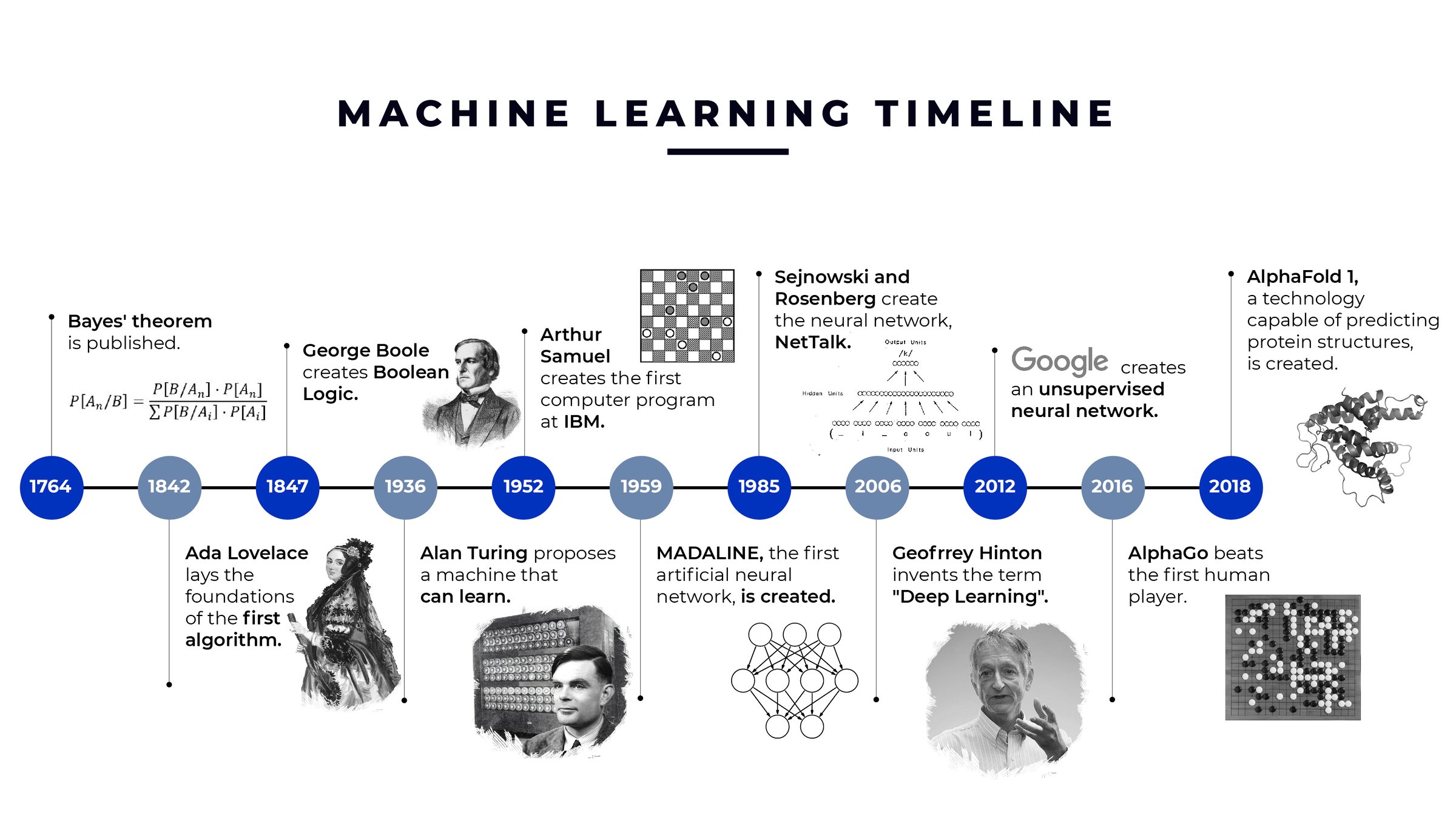
Traces timeline of machine learning, highlighting major milestones, context, examples, and future implications.
#Infobox
#Overview
Machine learning has transformed from a theoretical concept into a cornerstone of modern technology, powering applications across industries such as healthcare, finance, transportation, and entertainment. The field’s progression reflects advancements in computational power, algorithmic innovation, and data availability. Unlike traditional programming, ML systems derive patterns from data, enabling them to make predictions, classify inputs, and automate decision-making processes. The timeline of machine learning is marked by iterative breakthroughs, each building upon prior knowledge to push the boundaries of what machines can achieve.
#History / Background
#Early Foundations (Pre-1950s)
The origins of machine learning can be traced to the early 20th century, with foundational work in statistics, logic, and computation. Key developments include:
- 1943: Warren McCulloch and Walter Pitts proposed the first mathematical model of a neural network, inspired by biological neurons.
- 1950: Alan Turing’s Computing Machinery and Intelligence introduced the concept of machines that could learn, laying the groundwork for AI.
- 1952: Arthur Samuel developed the first self-learning program, a checkers-playing algorithm that improved with experience.
#The Golden Age (1950s–1970s)
This period saw the emergence of early AI and ML systems, driven by optimism and limited computational resources:
- 1956: The term "artificial intelligence" was coined at the Dartmouth Conference, marking the formal birth of AI as a field.
- 1958: Frank Rosenblatt invented the Perceptron, the first artificial neural network capable of learning.
- 1967: The Nearest Neighbor algorithm was introduced, enabling pattern recognition in data.
- 1970s: Research slowed due to computational limitations and skepticism about AI’s feasibility, leading to the first "AI winter."
#Revival and Expansion (1980s–1990s)
Advancements in algorithms and hardware revitalized ML research:
- 1982: John Hopfield introduced Hopfield networks, a type of recurrent neural network.
- 1986: Geoffrey Hinton, David Rumelhart, and Ronald Williams popularized backpropagation, a method for training multi-layer neural networks.
- 1992: Vladimir Vapnik and colleagues developed Support Vector Machines (SVMs), a powerful tool for classification tasks.
- 1997: IBM’s Deep Blue defeated world chess champion Garry Kasparov, showcasing AI’s potential in complex decision-making.
#The Data Revolution (2000s–2010s)
The explosion of digital data and computational power accelerated ML’s growth:
- 2006: Geoffrey Hinton’s work on deep belief networks reignited interest in deep learning.
- 2011: IBM’s Watson won Jeopardy!, demonstrating advanced natural language processing.
- 2012: A deep neural network achieved near-human performance in image recognition at the ImageNet Large Scale Visual Recognition Challenge.
- 2014: Generative Adversarial Networks (GANs) were introduced by Ian Goodfellow, enabling realistic data generation.
#Modern Era
(2020s–Present)
Recent years have seen ML integrate into everyday life, with breakthroughs in generative AI and large language models:
- 2020: OpenAI’s GPT-3 demonstrated human-like text generation, revolutionizing natural language processing.
- 2022: Stable Diffusion and DALL·E 2 showcased text-to-image generation, expanding creative applications.
- 2023: Large Language Models (LLMs) like Google’s Bard and Meta’s Llama became widely accessible, enabling advanced conversational AI.
#How It Works
Machine learning operates through iterative processes where models learn from data to make predictions or decisions. The core components include:
#Key Concepts
- Data: The foundation of ML, consisting of input-output pairs (supervised learning) or raw data (unsupervised learning).
- Features: Individual measurable properties or characteristics used to make predictions.
- Model: A mathematical representation of the relationship between inputs and outputs.
- Training: The process of adjusting a model’s parameters to minimize error on a given dataset.
- Evaluation: Assessing a model’s performance using metrics like accuracy, precision, recall, or loss functions.
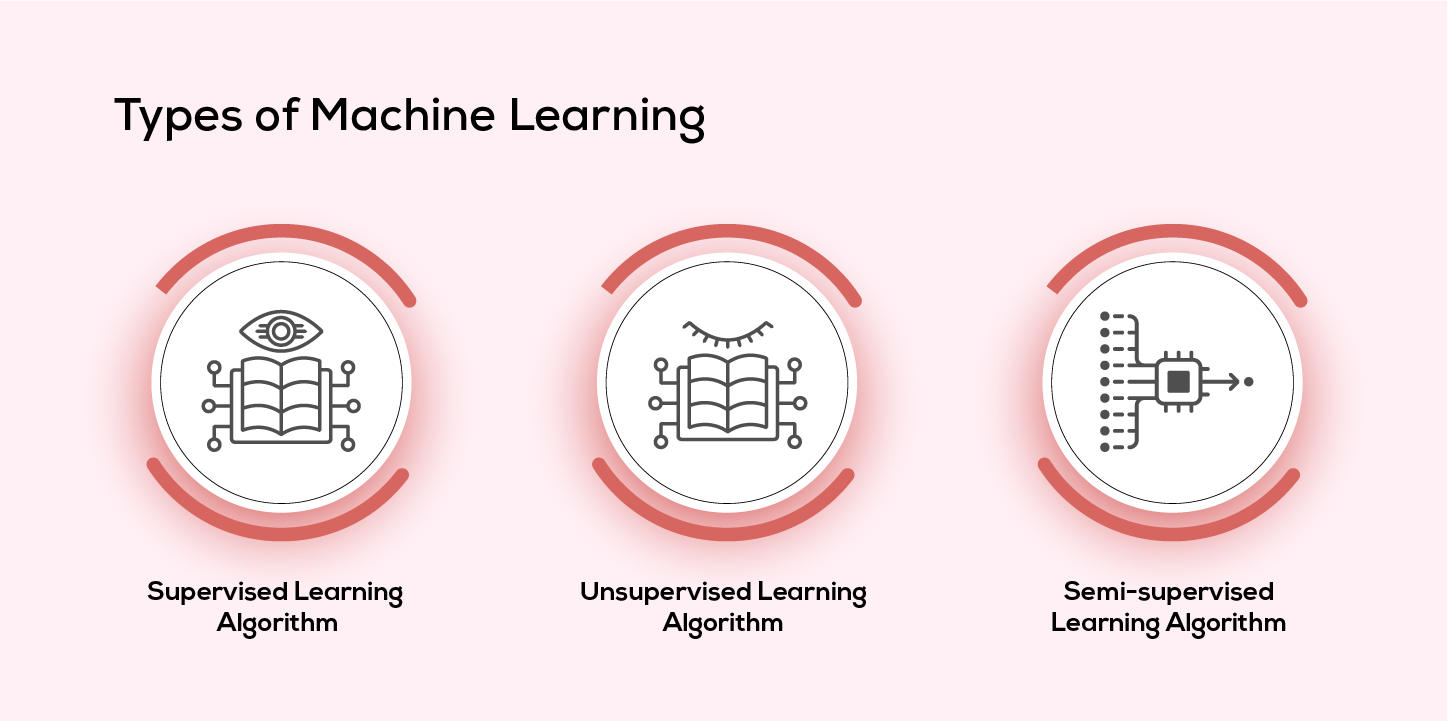
#Types of Machine Learning
- Supervised Learning: Models learn from labeled data (e.g., classification, regression). - Example: Spam detection using labeled emails.
- Unsupervised Learning: Models identify patterns in unlabeled data (e.g., clustering, dimensionality reduction). - Example: Customer segmentation in marketing.
- Reinforcement Learning: Models learn by interacting with an environment to maximize rewards (e.g., game-playing AI). - Example: AlphaGo’s strategy in the board game Go.
- Deep Learning: A subset of ML using neural networks with multiple layers to model complex patterns. - Example: Image and speech recognition.
#Algorithms and Techniques
- Linear Regression: Predicts continuous outcomes.
- Decision Trees: Classifies data based on feature splits.
- Neural Networks: Mimic the human brain’s structure for pattern recognition.
- Transformers: Enable efficient processing of sequential data (e.g., text, audio).
#Important Facts
- Neural Networks: Inspired by biological neurons, they consist of interconnected layers of nodes (neurons) that process information.
- Overfitting: A common issue where a model performs well on training data but poorly on unseen data. Techniques like regularization and cross-validation mitigate this.
- Bias-Variance Tradeoff: Balancing a model’s simplicity (bias) and flexibility (variance) to avoid underfitting or overfitting.
- Ethical Considerations: ML systems can perpetuate biases present in training data, raising concerns about fairness and accountability.
- Explainability: "Black-box" models (e.g., deep neural networks) often lack transparency, prompting research into interpretable AI.
#Timeline
- Foundational ideas
Core concepts and early methods shape Timeline of Machine Learning.
- Practical use
Tools, examples, and real-world deployments make the topic easier to evaluate.
- Responsible implementation
Current work focuses on reliability, governance, performance, and measurable impact.
#Related Terms
#FAQ
What does Timeline of Machine Learning cover?
Traces timeline of machine learning, highlighting major milestones, context, examples, and future implications.
Why is Timeline of Machine Learning important?
It helps readers understand key concepts, compare practical use cases, and evaluate how Machine Learning decisions affect outcomes, risks, and implementation choices.
What should readers verify before applying this topic?
Readers should compare benefits, limitations, data requirements, and related themes such as Timeline, Machine, Learning before using the ideas in real projects.
#References
- Timeline of Machine Learning terminology and background research
- Timeline of Machine Learning use cases, implementation examples, and limitations
- Machine Learning best practices, standards, and risk guidance
- Timeline case studies, benchmarks, and current industry analysis

Comments
No comments yet. Start the discussion with a useful note.