

#Short Answer
Covers the science behind natural language processing, including core concepts, practical examples, benefits, limitations, and risks in Language AI.
#Infobox
#Overview
Natural Language Processing (NLP) bridges the gap between human communication and computer understanding. It involves the development of algorithms and models that allow computers to process, analyze, and generate human language in both written and spoken forms. NLP systems are designed to handle tasks such as language translation, sentiment analysis, speech recognition, and text summarization. The field has evolved significantly over the past few decades, driven by advances in machine learning, deep learning, and the availability of large-scale language datasets. Modern NLP systems leverage neural networks, particularly transformer-based architectures, to achieve state-of-the-art performance in various language tasks. These systems are now integral to many real-world applications, including virtual assistants, customer service chatbots, and automated content generation.
#History / Background
#Early Foundations (1950s–1960s)
The origins of NLP can be traced back to the 1950s, with early work focusing on machine translation and rule-based systems. In 1950, Alan Turing proposed the "Turing Test" as a criterion for machine intelligence, which indirectly influenced the development of NLP. The Georgetown-IBM experiment in 1954 demonstrated the first automated translation of Russian into English, sparking interest in computational linguistics. During this period, researchers explored formal grammars and syntactic rules to model language. Noam Chomsky’s work on transformational grammar in the late 1950s provided a theoretical foundation for understanding the structure of human language, which later influenced NLP algorithms.
#Rule-Based and Statistical Approaches (1970s–1990s)
In the 1970s and 1980s, NLP research shifted toward rule-based systems, where linguists manually encoded grammatical rules into computer programs. These systems were limited by their reliance on predefined rules and struggled with the complexity and variability of natural language. The 1990s saw the emergence of statistical methods, which used probabilistic models to analyze language data. Techniques such as Hidden Markov Models (HMMs) and n-gram models became popular for tasks like speech recognition and part-of-speech tagging. The introduction of the Penn Treebank in 1993 provided a large annotated corpus that facilitated the training of statistical models.
#Machine Learning and Deep Learning Revolution (2000s–Present)
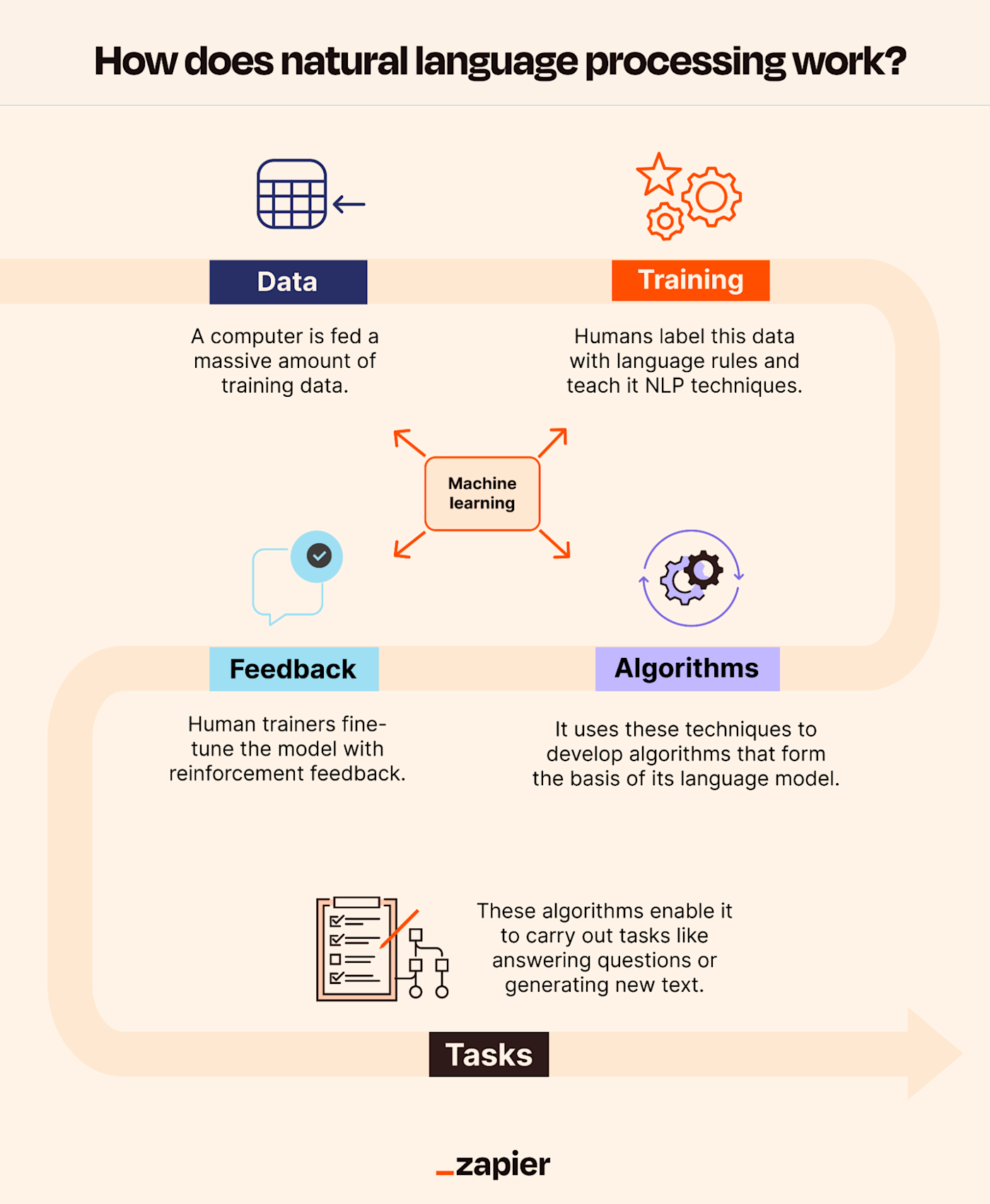
The 2000s marked a paradigm shift with the adoption of machine learning techniques in NLP. Supervised learning methods, such as Support Vector Machines (SVMs) and Conditional Random Fields (CRFs), improved performance in tasks like named entity recognition and sentiment analysis. The breakthrough came with the advent of deep learning in the 2010s. Neural networks, particularly Recurrent Neural Networks (RNNs) and Long Short-Term Memory (LSTM) networks, enabled models to capture long-range dependencies in language. The introduction of the transformer architecture in 2017, with the release of the "Attention Is All You Need" paper, revolutionized NLP by allowing models to process sequences in parallel and capture contextual relationships more effectively. Modern NLP systems, such as BERT (Bidirectional Encoder Representations from Transformers) and GPT (Generative Pre-trained Transformer), leverage pre-trained language models that can be fine-tuned for specific tasks. These models have achieved human-level performance in various benchmarks, including language understanding, question answering, and text generation.
#How It Works
#Core Components of NLP
- Tokenization Tokenization is the process of breaking down text into smaller units, such as words, phrases, or sentences, called tokens. This step is crucial for preparing text data for further analysis. For example, the sentence "Natural language processing is fascinating" might be tokenized into ["Natural", "language", "processing", "is", "fascinating"].
- Part-of-Speech (POS) Tagging POS tagging involves assigning grammatical labels (e.g., noun, verb, adjective) to each token in a sentence. This helps in understanding the syntactic structure of the text. For instance, the token "processing" might be tagged as a noun or a verb depending on the context.
- Parsing Parsing refers to the analysis of the syntactic structure of a sentence. Techniques such as constituency parsing and dependency parsing are used to generate parse trees that represent the hierarchical relationships between words. For example, a parse tree might show that "Natural language processing" is a noun phrase.
- Named Entity Recognition (NER) NER identifies and classifies named entities in text, such as people, organizations, locations, and dates. For example, in the sentence "Apple Inc. was founded by Steve Jobs in 1976," NER would identify "Apple Inc." as an organization, "Steve Jobs" as a person, and "1976" as a date.
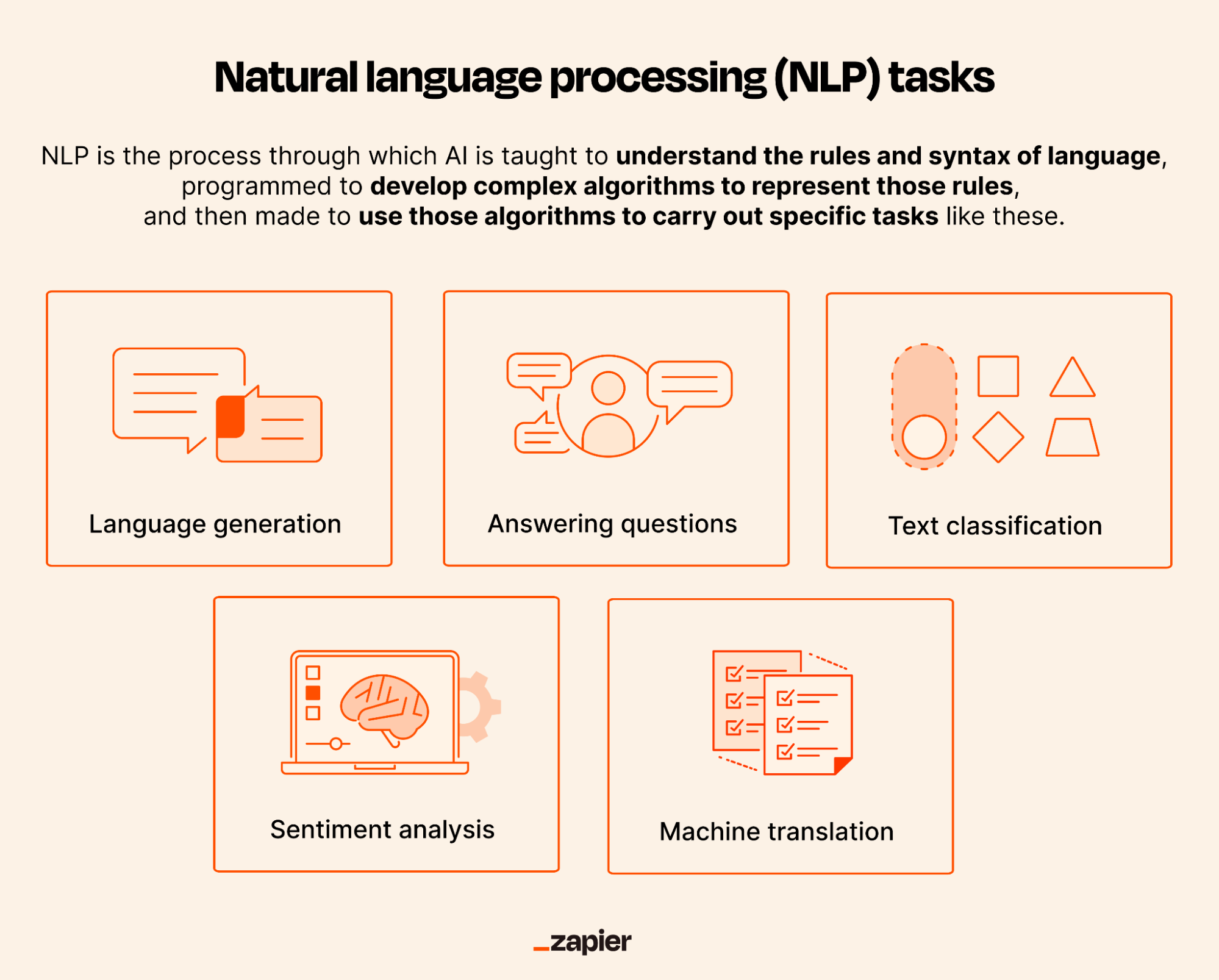
- Sentiment Analysis Sentiment analysis determines the emotional tone of a piece of text, classifying it as positive, negative, or neutral. This is widely used in social media monitoring, customer feedback analysis, and brand reputation management.
- Machine Translation Machine translation involves converting text from one language to another. Modern systems, such as Google Translate and DeepL, use neural machine translation (NMT) models that leverage transformer architectures to produce high-quality translations.
- Text Summarization Text summarization condenses a large body of text into a shorter version while retaining the key information. There are two main approaches: extractive summarization, which selects and combines important sentences, and abstractive summarization, which generates new sentences to convey the meaning.
- Speech Recognition Speech recognition converts spoken language into written text. Systems like Siri and Alexa use NLP techniques to transcribe speech and understand user commands.
#Key Techniques
and Models
- Bag-of-Words (BoW) and TF-IDF These are traditional techniques for representing text as numerical vectors. BoW counts the frequency of words in a document, while TF-IDF (Term Frequency-Inverse Document Frequency) weighs words based on their importance in a document relative to a corpus.
- Word Embeddings Word embeddings represent words as dense vectors in a continuous vector space, where semantically similar words are closer to each other. Popular models include Word2Vec, GloVe, and FastText.
- Recurrent Neural Networks (RNNs) and Long Short-Term Memory (LSTM) RNNs are designed to process sequential data by maintaining a hidden state that captures information from previous inputs. LSTMs, a type of RNN, address the vanishing gradient problem and are effective for tasks like language modeling and machine translation.
- Transformer Models Transformers, introduced in the paper "Attention Is All You Need," use self-attention mechanisms to process sequences in parallel. This architecture forms the backbone of models like BERT, GPT, and T5, which have achieved state-of-the-art performance in various NLP tasks.
- Pre-trained Language Models Pre-trained language models are trained on large corpora of text data and can be fine-tuned for specific tasks. Examples include BERT (developed by Google), RoBERTa (a robustly optimized version of BERT), and GPT-3 (developed by OpenAI).
#Important Facts
- NLP is a Multidisciplinary Field: It combines elements of computer science, linguistics, artificial intelligence, and statistics.
- Data Dependency: NLP models require large amounts of high-quality data for training. The performance of these models is heavily dependent on the diversity and representativeness of the training data.
- Bias in NLP: NLP systems can inherit biases present in the training data, leading to unfair or discriminatory outcomes. Addressing bias is an active area of research.
- Multilingual NLP: While English has been the primary focus of NLP research, there is growing interest in developing models for low-resource languages and multilingual applications.
- Ethical Considerations: NLP systems raise ethical concerns, such as privacy invasion, misinformation spread, and the potential for misuse in deepfake generation.
- Real-World Impact: NLP technologies are used in a wide range of applications, including healthcare (e.g., clinical text analysis), finance (e.g., fraud detection), and education (e.g., automated grading systems).
#Timeline
- Foundational ideas
Core concepts and early methods shape The Science Behind Natural Language Processing.
- Practical use
Tools, examples, and real-world deployments make the topic easier to evaluate.
- Responsible implementation
Current work focuses on reliability, governance, performance, and measurable impact.
#Related Terms
#FAQ
What does The Science Behind Natural Language Processing cover?
Covers the science behind natural language processing, including core concepts, practical examples, benefits, limitations, and risks in Language AI.
Why is The Science Behind Natural Language Processing important?
It helps readers understand key concepts, compare practical use cases, and evaluate how Language AI decisions affect outcomes, risks, and implementation choices.
What should readers verify before applying this topic?
Readers should compare benefits, limitations, data requirements, and related themes such as Science, Behind, Natural before using the ideas in real projects.
#References
- The Science Behind Natural Language Processing terminology and background research
- The Science Behind Natural Language Processing use cases, implementation examples, and limitations
- Language AI best practices, standards, and risk guidance
- Science case studies, benchmarks, and current industry analysis

Comments
No comments yet. Start the discussion with a useful note.