

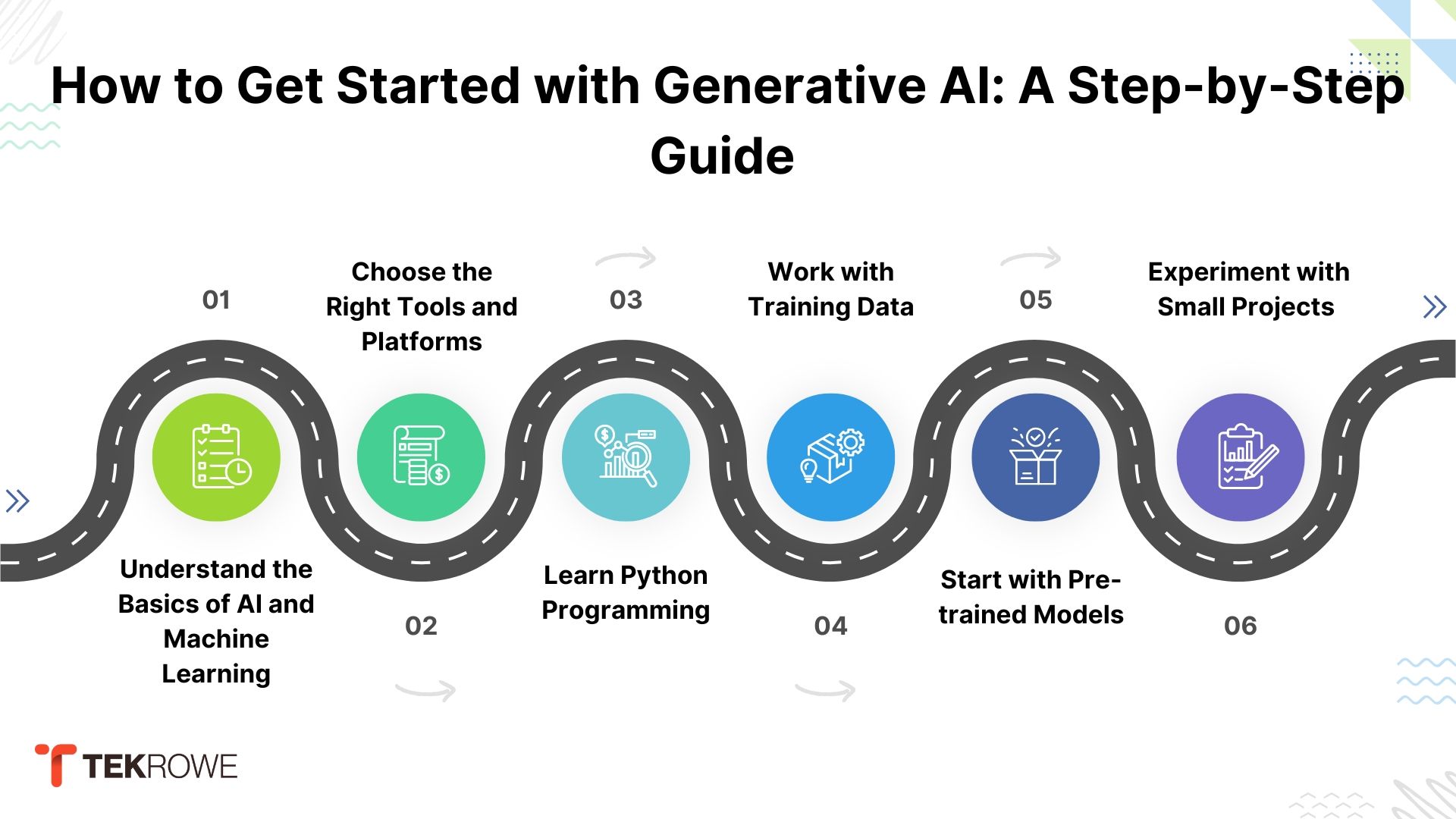
#Short Answer
Explains how to get started with generative ai, including the main process, tools, examples, risks, and practical implementation steps.
#Infobox
#Overview
Generative AI represents a transformative branch of artificial intelligence focused on creating new, original content rather than merely analyzing or classifying existing data. Unlike traditional AI systems that rely on rule-based or statistical methods, generative models learn the underlying structure of data—whether text, images, or audio—and use that understanding to produce novel outputs. These systems have gained prominence due to advances in deep learning, particularly in neural network architectures like transformers, which enable models to capture complex patterns and dependencies in large datasets. At its core, generative AI operates by training on vast amounts of data to identify statistical correlations. For example, a text-generating model learns the likelihood of word sequences based on training corpora, allowing it to generate coherent and contextually relevant sentences. Similarly, image-generating models analyze pixel distributions to synthesize realistic visuals. The versatility of generative AI has led to its adoption across industries, from creative arts and marketing to healthcare and scientific research. The accessibility of generative AI tools has democratized content creation, enabling individuals and organizations to automate tasks such as drafting emails, designing graphics, or composing music. However, the technology also raises significant ethical and societal challenges, including concerns about misinformation, intellectual property, and the potential for misuse in generating deepfakes or deceptive content.
#History / Background
The roots of generative AI can be traced to early experiments in artificial intelligence and machine learning during the mid-20th century. However, the field began to take shape in earnest with the advent of neural networks and deep learning in the 2010s.
#Early Foundations (1950s–2000s)
- 1950s–1960s: Early AI research explored symbolic systems and rule-based approaches, but these lacked the ability to generate novel content.
- 1980s–1990s: The rise of statistical machine learning introduced probabilistic models, such as Hidden Markov Models (HMMs), which laid groundwork for later generative techniques.
- 2000s: The introduction of deep learning architectures, particularly convolutional neural networks (CNNs) and recurrent neural networks (RNNs), enabled models to learn hierarchical representations of data.
#Breakthroughs in Generative Modeling (2010s)
- 2014: The introduction of Generative Adversarial Networks (GANs) by Ian Goodfellow revolutionized generative AI. GANs consist of two competing neural networks—a generator that creates data and a discriminator that evaluates it—leading to highly realistic outputs.
- 2017: The Transformer architecture, introduced in the paper "Attention Is All You Need," became a cornerstone for modern generative models. Its self-attention mechanism allowed models to process sequences of data (e.g., text) more efficiently than RNNs.
- 2018–2019: OpenAI released GPT (Generative Pre-trained Transformer), a language model trained on vast text datasets. GPT-2, released in 2019, demonstrated the ability to generate coherent and contextually relevant text, sparking widespread interest.
#The Era of Large-Scale Models (2020s)
- 2020: OpenAI unveiled GPT-3, a model with 175 billion parameters, showcasing unprecedented text generation capabilities. This marked a shift toward large-scale, pre-trained models that could be fine-tuned for specific tasks.
- 2021: DALL·E, developed by OpenAI, combined transformers with image generation, enabling the creation of images from textual descriptions.
- 2022: Stable Diffusion, an open-source diffusion model, gained popularity for its ability to generate high-quality images with lower computational costs. Meanwhile, Google’s LaMDA and Meta’s LLaMA expanded the capabilities of conversational AI.
- 2023–2024: The release of GPT-4 and models like Mistral 7B further refined generative AI, introducing multimodal capabilities (e.g., processing both text and images) and improved efficiency. Open-source alternatives, such as Stable Diffusion XL and Hugging Face’s model hub, lowered barriers to entry for developers.
#Commercial and Cultural Impact Generative AI has transitioned from academic research to mainstream adoption, with applications in:
- Creative industries: Artists, writers, and musicians use tools like Midjourney, Runway ML, and Suno AI to augment their creative processes.
- Business: Companies leverage generative AI for customer service (chatbots), content marketing, and product design.
- Science: Researchers employ generative models for drug discovery, protein folding (e.g., AlphaFold), and simulating physical systems.
#How It Works
Generative AI relies on several core principles and architectures to produce new content. The process typically involves training, inference, and fine-tuning, with variations depending on the type of content being generated (e.g., text, images, or audio).
#Core Architectures
- Generative Adversarial Networks (GANs)
- Components: A GAN consists of two neural networks—a generator and a discriminator—that compete in a zero-sum game.
- Process: - The generator creates synthetic data (e.g., images) from random noise. - The discriminator evaluates whether the data is real (from the training set) or fake (generated). - Over time, the generator improves its ability to produce realistic outputs, while the discriminator becomes better at detecting fakes.
- Applications: Image generation (e.g., faces, landscapes), video synthesis, and data augmentation.
- Challenges: Mode collapse (generator produces limited varieties), training instability, and difficulty in evaluating output quality.
- Variational Autoencoders (VAEs)
- Components: A VAE consists of an encoder (compresses input data into a latent space) and a decoder (reconstructs data from the latent space).
- Process: - The encoder maps input data to a probabilistic latent space. - The decoder samples from this space to generate new data. - VAEs are trained to minimize reconstruction error and ensure the latent space follows a Gaussian distribution.
- Applications: Image generation, anomaly detection, and data compression.
- Advantages: Stable training, interpretable latent space.
- Limitations: Outputs may lack sharpness compared to GANs.
- Transformers and Large Language Models (LLMs)
- Components: Transformers use self-attention mechanisms to weigh the importance of different parts of input data (e.g., words in a sentence).
- Process:
- Pre-training: Models are trained on large datasets (e.g., books, articles) to predict the next word or fill in missing words (e.g., masked language modeling).
- Fine-tuning: The pre-trained model is adapted to specific tasks (e.g., question answering, summarization) using smaller, task-specific datasets.
- Applications: Text generation, translation, code synthesis, and conversational AI.
- Key Models: GPT (OpenAI), PaLM (Google), LLaMA (Meta), Mistral (Mistral AI).
- Advantages: High-quality outputs, scalability, and versatility.
- Challenges: High computational costs, bias in training data, and hallucinations (generating false or nonsensical information).
- Diffusion Models
- Process:
- Forward Process: Gradually adds noise to data (e.g., an image) over many steps.
- Reverse Process: A neural network learns to reverse the noise addition, generating new data from pure noise.
- Applications: High-resolution image generation (e.g., Stable Diffusion, DALL·E 3), audio synthesis.
- Advantages: High-quality, diverse outputs; stable training compared to GANs.
- Limitations: Slow inference speed (requires many denoising steps).
#Training and Inference
- Training: - Models are trained on large datasets using supervised, unsupervised, or self-supervised learning. - Loss functions (e.g., cross-entropy for text, mean squared error for images) guide the optimization process. - Techniques like transfer learning (using pre-trained models) and reinforcement learning from human feedback (RLHF) improve performance.
- Inference: - Once trained, models generate new content by sampling from learned distributions. - For text, this involves autoregressive generation (predicting the next token based on previous tokens). - For images, models may use latent diffusion or autoregressive pixel generation.
#Key Techniques
- Prompt Engineering: Crafting input prompts to guide model outputs (e.g., "A futuristic city at night" for image generation).
- Fine-Tuning: Adapting pre-trained models to specific domains (e.g., medical text generation).
- Chain-of-Thought Prompting: Encouraging models to generate intermediate reasoning steps before producing a final answer.
- Multimodal Learning: Combining text, images, and other data types (e.g., models like CLIP or Flamingo).
#Important Facts
- Generative AI is not truly "creative": While it can produce novel outputs, these are derived from patterns in training data rather than original thought or consciousness.
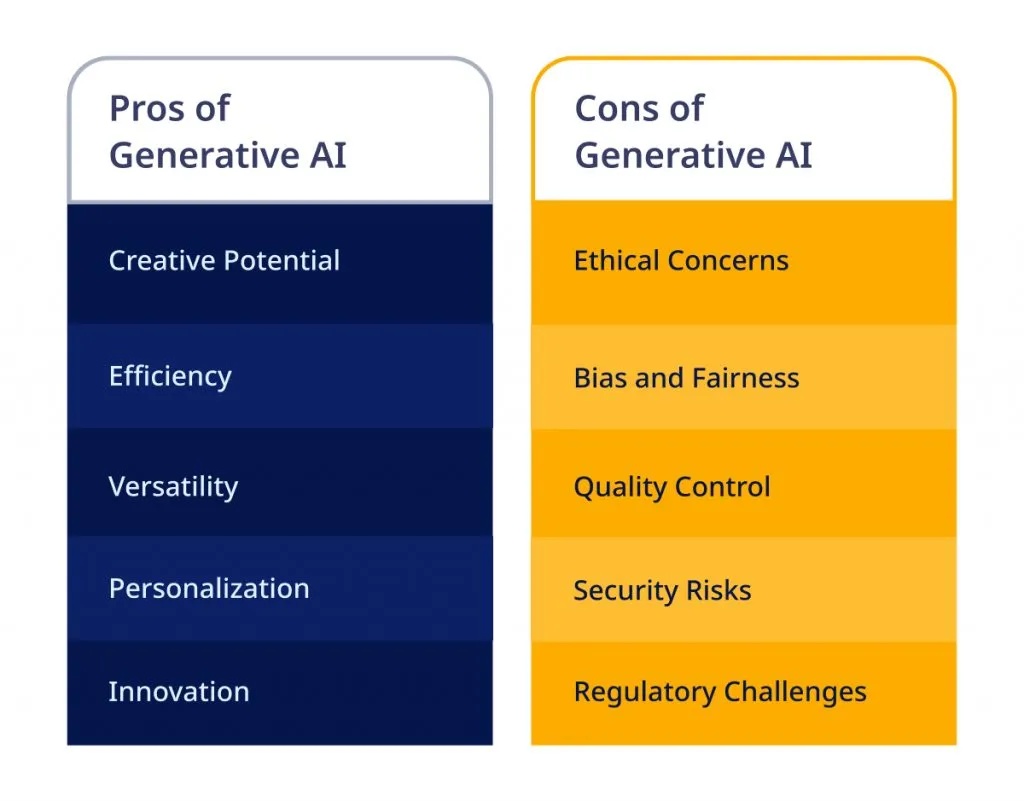
- Data quality is critical: Biases in training data (e.g., underrepresentation of certain demographics) can lead to biased or harmful outputs.
- Computational demands are high: Training large models (e.g., GPT-4) requires thousands of GPUs/TPUs and significant energy consumption.
- Ethical risks are significant: Generative AI can be used to create deepfakes, misinformation, or plagiarized content, necessitating robust safeguards.
- Open-source vs. proprietary models: Open-source models (e.g., Stable Diffusion) offer transparency and customization, while proprietary models (e.g., GPT-4) often provide higher performance but with usage restrictions.
- Regulation is evolving: Governments and organizations are developing frameworks to address issues like copyright, privacy, and AI safety (e.g., the EU AI Act, U.S. Executive Order on AI).
- Generative AI is a tool, not a replacement: It augments human creativity and productivity but does not eliminate the need for human oversight or judgment.
- Multimodal models are the future: Advances in combining text, images, audio, and video (e.g., Google’s Gemini, OpenAI’s Sora) are expanding the scope of generative AI.
#Timeline
- Foundational ideas
Core concepts and early methods shape How to Get Started with Generative AI.
- Practical use
Tools, examples, and real-world deployments make the topic easier to evaluate.
- Responsible implementation
Current work focuses on reliability, governance, performance, and measurable impact.
#Related Terms
#FAQ
What does How to Get Started with Generative AI cover?
Explains how to get started with generative ai, including the main process, tools, examples, risks, and practical implementation steps.
Why is How to Get Started with Generative AI important?
It helps readers understand key concepts, compare practical use cases, and evaluate how Generative AI decisions affect outcomes, risks, and implementation choices.
What should readers verify before applying this topic?
Readers should compare benefits, limitations, data requirements, and related themes such as Get, Started, Generative before using the ideas in real projects.
#References
- How to Get Started with Generative AI terminology and background research
- How to Get Started with Generative AI use cases, implementation examples, and limitations
- Generative AI best practices, standards, and risk guidance
- Get case studies, benchmarks, and current industry analysis



Comments
No comments yet. Start the discussion with a useful note.