

#Short Answer
Covers generative ai: pros and cons, including core concepts, practical examples, benefits, limitations, and risks in Generative AI.
#Infobox
#Overview
Generative AI represents a paradigm shift in artificial intelligence, enabling machines to produce human-like or novel outputs rather than merely analyzing or classifying data. At its core, generative AI leverages deep learning models trained on vast datasets to identify patterns and generate new instances that resemble the training data. This technology underpins a wide range of applications, from creative industries to scientific research, and has become a cornerstone of modern AI innovation. The rise of generative AI has been fueled by advances in computational power, the availability of large-scale datasets, and breakthroughs in neural network architectures. Unlike discriminative models, which classify inputs into predefined categories, generative models learn the underlying distribution of the data, allowing them to create entirely new content. This capability has led to transformative applications in fields such as art, entertainment, healthcare, and software development.
#History / Background
#Early Foundations (1950s–2010s)
The conceptual roots of generative AI trace back to the early days of artificial intelligence. In 1950, Alan Turing proposed the "Imitation Game" (later known as the Turing Test), which laid the groundwork for evaluating machine-generated outputs. Early generative models, such as Hidden Markov Models (HMMs) and Markov Decision Processes (MDPs), were used for simple tasks like text generation and speech synthesis. However, the field remained largely theoretical until the 2010s, when deep learning revolutionized AI. Key milestones include:
- 2014: Ian Goodfellow introduced Generative Adversarial Networks (GANs), a framework where two neural networks—a generator and a discriminator—compete to improve the quality of generated outputs.
- 2015: Variational Autoencoders (VAEs) emerged as another powerful generative model, offering a probabilistic approach to content creation.
- 2017: The Transformer architecture was introduced in the paper "Attention Is All You Need", enabling more efficient and scalable generative models, particularly for natural language processing (NLP).
#The Modern Era (2018–Present)
The late 2010s and early 2020s witnessed an explosion of generative AI applications, driven by:
- Large Language Models (LLMs): Models like GPT-3 (2020) and GPT-4 (2023) demonstrated unprecedented text generation capabilities, enabling chatbots, content writing, and code generation.
- Multimodal Models: Systems like DALL·E (2021) and Stable Diffusion (2022) combined text and image generation, allowing users to create visuals from textual descriptions.
- Diffusion Models: Introduced in 2020, these models improved the quality of image and video generation by iteratively refining outputs.
- Ethical and Regulatory Scrutiny: As generative AI became more accessible, concerns about misinformation, deepfakes, and copyright infringement prompted discussions on governance and regulation. Today, generative AI is a multi-billion-dollar industry, with companies and researchers continuously pushing the boundaries of what these systems can achieve.
#How It Works
Generative AI relies on several core techniques, each suited to different types of content generation. The most prominent methods include:
#
- Generative Adversarial Networks (GANs) GANs consist of two neural networks:
- Generator: Creates new data instances (e.g., images, text).
- Discriminator: Evaluates the authenticity of the generated data, distinguishing it from real data. The two networks are trained simultaneously in a competitive process, where the generator improves its outputs to fool the discriminator, while the discriminator becomes better at detecting fakes. This adversarial training leads to highly realistic outputs, particularly in image and video generation. Example: GANs are used to generate photorealistic faces, enhance image resolution, and create synthetic training data for computer vision tasks.
#
- Variational Autoencoders (VAEs) VAEs are probabilistic models that learn to encode and decode data. They consist of:
- Encoder: Compresses input data into a latent space representation.
- Decoder: Reconstructs data from the latent space, generating new variations. Unlike GANs, VAEs provide a structured latent space, allowing for controlled generation (e.g., interpolating between two images). They are widely used in drug discovery, anomaly detection, and creative applications.
#
- Transformers and Large Language Models (LLMs) Transformers, introduced in 2017, revolutionized generative AI by enabling models to process sequential data (e.g., text) in parallel. Key components include:
- Self-Attention Mechanism: Allows the model to weigh the importance of different parts of the input.
- Autoregressive Decoding: Generates outputs one token at a time, conditioning each new token on the previous ones. Example: Models like GPT-4 and PaLM use transformers to generate coherent, contextually relevant text, powering chatbots, translation tools, and content creation platforms.
#
- Diffusion Models Diffusion models generate data by gradually adding noise to the input and then learning to reverse the process. They consist of two phases:
- Forward Diffusion: Gradually corrupts the data with noise.
- Reverse Diffusion: Learns to denoise the corrupted data, reconstructing the original input or generating new samples. Example: Stable Diffusion and DALL·E 2 use diffusion models to create high-quality images from text prompts.
#
- Autoregressive Models These models generate data sequentially, predicting the next element based on previous ones. They are commonly used in:
- Text Generation: Models like GPT-3 predict the next word in a sentence.
- Time-Series Forecasting: Generates future data points based on historical trends.
#Important Facts
#Advantages of Generative AI
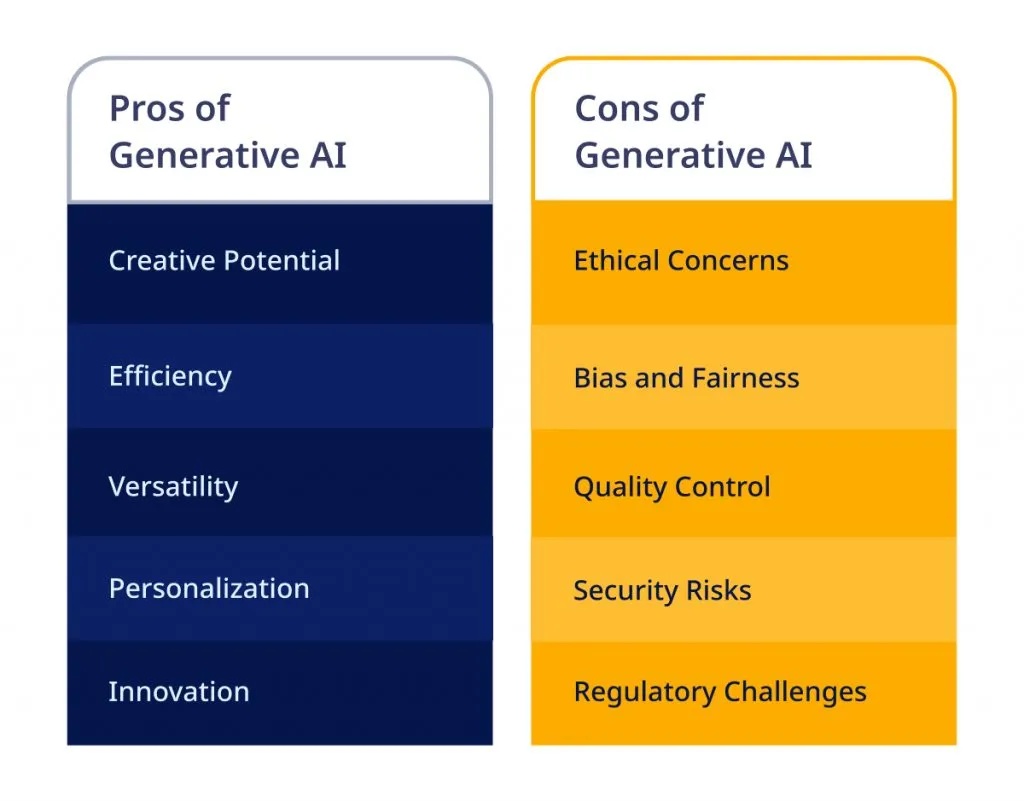
- Automation: Reduces the need for manual content creation, speeding up workflows in industries like marketing, design, and software development.
- Creativity Enhancement: Assists artists, writers, and musicians in generating novel ideas and drafts.
- Scalability: Can produce vast amounts of content quickly, making it ideal for large-scale applications.
- Personalization: Enables tailored content generation for individual users (e.g., personalized ads, recommendations).
- Scientific Discovery: Accelerates research in fields like drug discovery, materials science, and genomics by simulating experiments.
#Disadvantages and Challenges
- Bias and Fairness: Generative models trained on biased data can perpetuate stereotypes or discriminatory outputs.
- Misinformation Risks: Deepfakes and AI-generated text can be used to spread false information, posing threats to democracy and public trust.
- Copyright and Plagiarism: AI-generated content may infringe on existing copyrights or replicate protected works without attribution.
- High Computational Costs: Training large generative models requires significant computational resources, leading to high energy consumption and costs.
- Ethical Concerns: Issues such as consent (e.g., using someone’s likeness without permission), job displacement, and the potential for misuse in warfare or surveillance.
#Key Performance Metrics
- Fréchet Inception Distance (FID): Measures the quality of generated images by comparing their statistical properties to real images.
- Perplexity: Evaluates the performance of language models by assessing how well they predict a sample of text.
- Inception Score (IS): Assesses the diversity and quality of generated images.
- BLEU Score: Used in machine translation to evaluate the similarity between generated and reference texts.
#Timeline
- Foundational ideas
Core concepts and early methods shape Generative AI: Pros and Cons.
- Practical use
Tools, examples, and real-world deployments make the topic easier to evaluate.
- Responsible implementation
Current work focuses on reliability, governance, performance, and measurable impact.
#Related Terms
#FAQ
What does Generative AI: Pros and Cons cover?
Covers generative ai: pros and cons, including core concepts, practical examples, benefits, limitations, and risks in Generative AI.
Why is Generative AI: Pros and Cons important?
It helps readers understand key concepts, compare practical use cases, and evaluate how Generative AI decisions affect outcomes, risks, and implementation choices.
What should readers verify before applying this topic?
Readers should compare benefits, limitations, data requirements, and related themes such as Generative, AI, Pros before using the ideas in real projects.
#References
- Generative AI: Pros and Cons terminology and background research
- Generative AI: Pros and Cons use cases, implementation examples, and limitations
- Generative AI best practices, standards, and risk guidance
- Generative case studies, benchmarks, and current industry analysis


Comments
No comments yet. Start the discussion with a useful note.