

#Short Answer
Covers facts about natural language processing, including core concepts, practical examples, benefits, limitations, and risks in Language AI.
#Infobox
#Overview
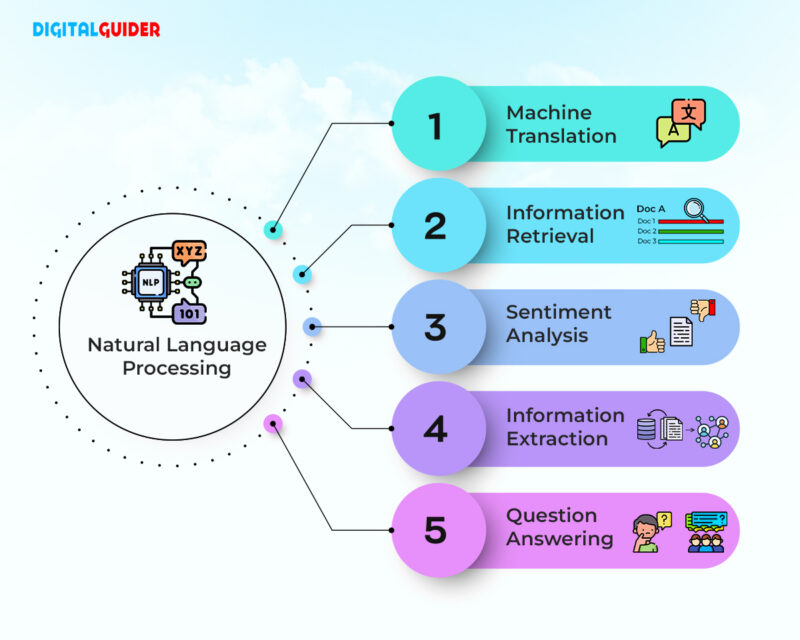
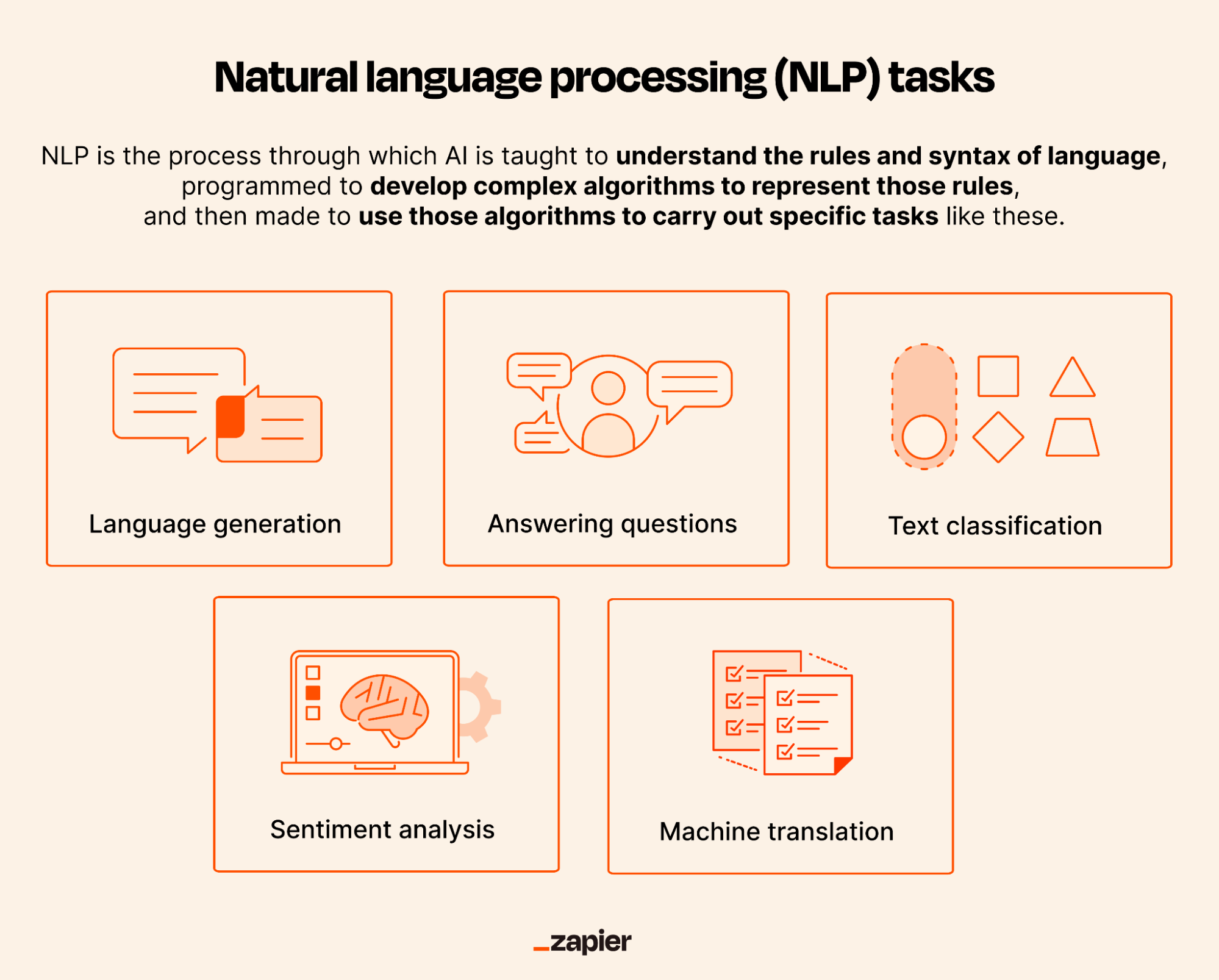
Natural Language Processing (NLP) bridges the gap between human communication and computer understanding. It involves the analysis and synthesis of natural language and speech, allowing machines to process human language in ways that are both efficient and contextually relevant. NLP systems are designed to handle unstructured text or speech data, converting it into structured formats that computers can process. The primary goal of NLP is to enable computers to perform tasks such as language translation, text classification, and conversational interactions with minimal human intervention. This is achieved through a combination of linguistic rules, statistical models, and machine learning algorithms. NLP has become a cornerstone of modern AI, driving innovations in industries ranging from healthcare to customer service.
#History / Background
The origins of NLP can be traced back to the 1950s, when researchers began exploring the possibility of machines understanding human language. One of the earliest milestones was the Georgetown-IBM experiment in 1954, where a computer successfully translated 60 Russian sentences into English. This event marked the beginning of machine translation research. In the 1960s and 1970s, NLP research focused on rule-based systems, which relied on predefined linguistic rules to process language. Notable projects from this era include SHRDLU, an early natural language understanding program developed by Terry Winograd, which could manipulate virtual blocks using natural language commands. The 1980s and 1990s saw a shift toward statistical methods, driven by advancements in computational power and the availability of large datasets. Researchers began using probabilistic models and machine learning techniques to improve language processing accuracy. The introduction of hidden Markov models (HMMs) and n-gram models played a significant role in this transition. The 21st century brought about a revolution in NLP with the advent of deep learning and neural networks. Models such as recurrent neural networks (RNNs) and long short-term memory (LSTM) networks enabled more sophisticated language understanding. The introduction of transformer models, particularly BERT (Bidirectional Encoder Representations from Transformers) and GPT (Generative Pre-trained Transformer), further advanced the field by improving contextual understanding and generating human-like text.
#How It Works
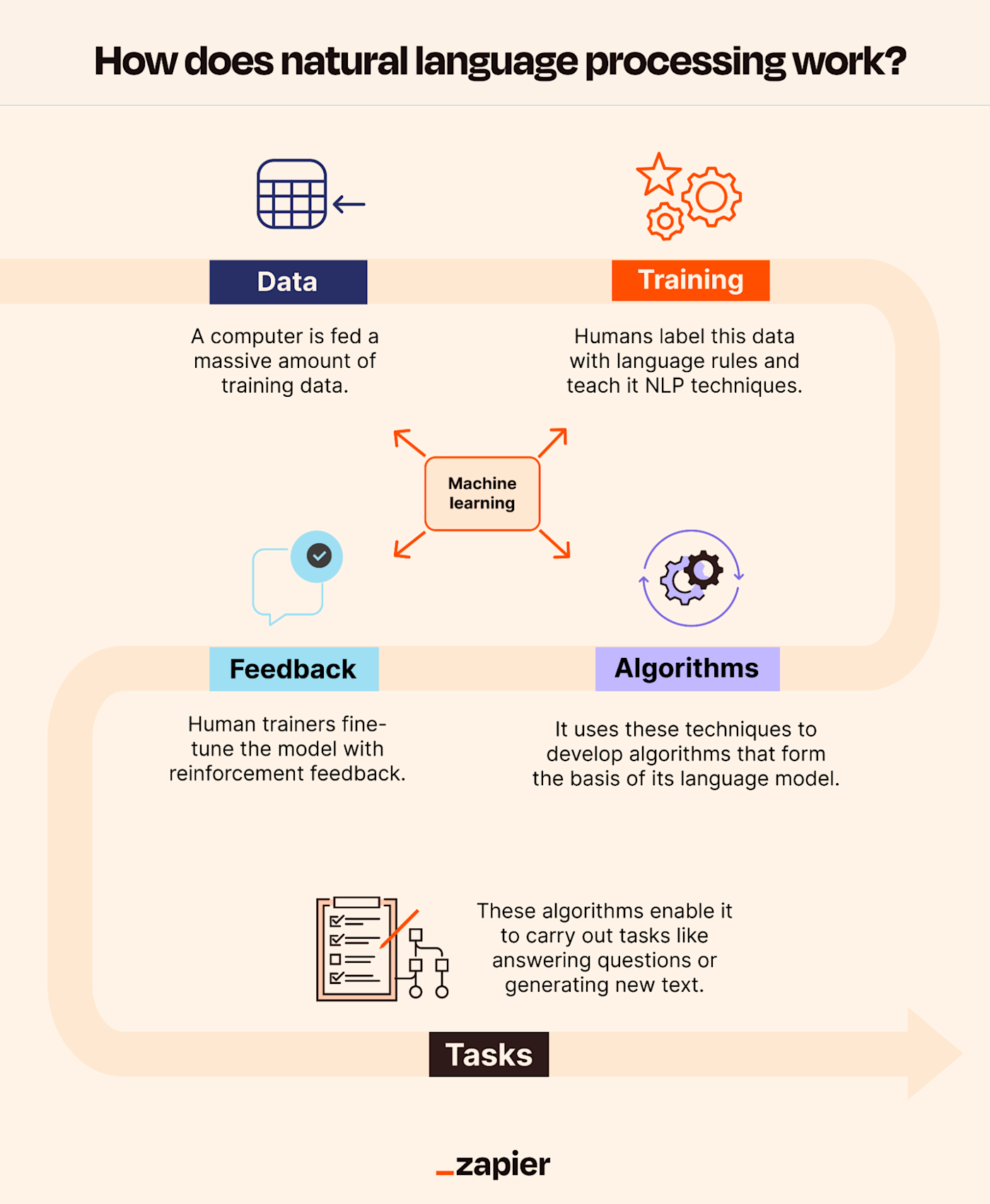
NLP systems operate through a series of interconnected steps, each designed to process and analyze language data. The process typically involves the following stages:
#
- Text Preprocessing Before analysis, raw text data must be cleaned and standardized. This includes:
- Tokenization: Splitting text into individual words or sentences.
- Normalization: Converting text to a consistent format (e.g., lowercase conversion, removing punctuation).
- Stopword Removal: Eliminating common words (e.g., "the," "is") that do not contribute to meaning.
- Stemming/Lemmatization: Reducing words to their base or root form (e.g., "running" → "run").
#
- Syntactic Analysis This stage focuses on the grammatical structure of sentences. Techniques include:
- Part-of-Speech (POS) Tagging: Identifying the grammatical role of each word (e.g., noun, verb).
- Parsing: Analyzing sentence structure to determine relationships between words (e.g., subject-verb-object).
- Dependency Parsing: Mapping grammatical dependencies between words in a sentence.
#
- Semantic Analysis Semantic analysis aims to extract meaning from text. Key methods include:
- Named Entity Recognition (NER): Identifying and classifying named entities (e.g., people, organizations, locations).
- Word Sense Disambiguation: Determining the correct meaning of ambiguous words based on context.
- Sentiment Analysis: Assessing the emotional tone of a text (e.g., positive, negative, neutral).
#
- Discourse Analysis This involves understanding the broader context of a conversation or document, including:
- Coreference Resolution: Identifying references to the same entity within a text (e.g., "he" → "John").
- Discourse Coherence: Ensuring logical flow and consistency in multi-sentence texts.
#
- Pragmatic Analysis The final stage considers the practical use of language in real-world contexts, such as:
- Speech Act Recognition: Identifying the intent behind a statement (e.g., request, command, question).
- Conversational Agents: Enabling machines to engage in dialogue with humans.
#Key Techniques and Models Modern NLP relies on advanced machine learning and deep learning techniques, including:
- Word Embeddings: Representing words as numerical vectors (e.g., Word2Vec, GloVe).
- Recurrent Neural Networks (RNNs): Processing sequential data, such as time-series text.
- Convolutional Neural Networks (CNNs): Extracting local features from text.
- Transformer Models: Leveraging self-attention mechanisms to capture long-range dependencies (e.g., BERT, GPT).
- Sequence-to-Sequence Models: Used in machine translation and text generation.
#Important Facts
- NLP is Ubiquitous: NLP is integrated into everyday technologies, including search engines (e.g., Google), virtual assistants (e.g., Siri, Alexa), and social media platforms (e.g., sentiment analysis for trending topics).
- Multilingual Capabilities: NLP supports over 100 languages, enabling cross-lingual communication and translation.
- Ethical Considerations: NLP systems can inadvertently perpetuate biases present in training data, raising concerns about fairness and inclusivity.
- Real-World Applications:
- Healthcare: NLP assists in extracting insights from medical records, aiding in diagnosis and treatment.
- Finance: Used for fraud detection, sentiment analysis of market trends, and customer service automation.
- Education: Powers intelligent tutoring systems and automated grading tools.
- Legal: Facilitates contract analysis and legal document summarization.
- Challenges:
- Ambiguity: Human language is inherently ambiguous, making it difficult for machines to interpret context accurately.
- Data Scarcity: High-quality labeled datasets are essential for training NLP models but are often scarce for low-resource languages.
- Computational Resources: Advanced NLP models require significant computational power, limiting accessibility for smaller organizations.
#Timeline
- Foundational ideas
Core concepts and early methods shape Facts About Natural Language Processing.
- Practical use
Tools, examples, and real-world deployments make the topic easier to evaluate.
- Responsible implementation
Current work focuses on reliability, governance, performance, and measurable impact.
#Related Terms
#FAQ
What does Facts About Natural Language Processing cover?
Covers facts about natural language processing, including core concepts, practical examples, benefits, limitations, and risks in Language AI.
Why is Facts About Natural Language Processing important?
It helps readers understand key concepts, compare practical use cases, and evaluate how Language AI decisions affect outcomes, risks, and implementation choices.
What should readers verify before applying this topic?
Readers should compare benefits, limitations, data requirements, and related themes such as Facts, About, Natural before using the ideas in real projects.
#References
- Facts About Natural Language Processing terminology and background research
- Facts About Natural Language Processing use cases, implementation examples, and limitations
- Language AI best practices, standards, and risk guidance
- Facts case studies, benchmarks, and current industry analysis
Comments
No comments yet. Start the discussion with a useful note.