

#Short Answer
Covers facts about ai in business, including core concepts, practical examples, benefits, limitations, and risks in Business & Marketing.
#Infobox
#Overview
Artificial Intelligence (AI) has transitioned from a futuristic concept to a core driver of business transformation. In 2025, AI is no longer confined to tech giants or research labs; it is embedded in everyday business operations, from customer-facing chatbots to predictive maintenance systems in manufacturing. The integration of AI enables companies to process vast datasets in real time, uncover hidden patterns, and make data-driven decisions with unprecedented accuracy. Businesses leverage AI to enhance customer experiences through personalized recommendations, automate repetitive tasks to reduce operational costs, and gain competitive advantages through predictive analytics. Industries such as healthcare, finance, retail, and logistics are particularly transformed by AI, with applications ranging from fraud detection in banking to drug discovery in pharmaceuticals. The scalability of AI solutions has been accelerated by cloud computing, which provides the computational power and storage required to train complex models. Additionally, the proliferation of AI-as-a-Service (AIaaS) platforms has democratized access to advanced AI tools, allowing even small and medium-sized enterprises (SMEs) to harness AI capabilities without significant upfront investment.
#History / Background
#Early Foundations (1950s–1980s)
The conceptual roots of AI in business trace back to the 1950s, when early computer scientists like Alan Turing and John McCarthy explored the possibility of machines exhibiting intelligent behavior. The term "artificial intelligence" was coined in 1956 at the Dartmouth Conference, marking the beginning of AI as a formal field of study. During this period, businesses began experimenting with rule-based systems and expert systems—programs designed to mimic human decision-making in specific domains. However, these early systems were limited by computational constraints and lacked the ability to learn from data.
#The AI Winter and Revival (1980s–2000s)
The 1980s saw a decline in AI investment due to unmet expectations and technical limitations, a period known as the "AI Winter." Despite this, research continued in niche areas such as machine learning and neural networks. The revival of AI in the late 1990s and early 2000s was fueled by advances in computing power, the availability of large datasets, and breakthroughs in algorithms like support vector machines and deep learning.
#The Big Data and Deep Learning Era (2010s–Present)
The explosion of big data in the 2010s provided the fuel for AI systems to learn and improve. Companies like Google, Amazon, and Facebook invested heavily in AI research, leading to the development of deep learning models capable of processing unstructured data such as images, text, and speech. By 2015, AI adoption in business began to accelerate, with applications in customer service (e.g., chatbots), supply chain optimization, and financial forecasting. The launch of cloud-based AI services by major tech companies further lowered the barriers to entry, enabling businesses of all sizes to integrate AI into their workflows.
#2025: The Era of Ubiquitous AI As of 2025, AI is deeply embedded in business ecosystems. The COVID-19 pandemic accelerated digital transformation, making AI an essential tool for resilience and innovation. Governments and regulatory bodies have also stepped in to establish frameworks for ethical AI use, ensuring transparency, accountability, and fairness.
#How It Works
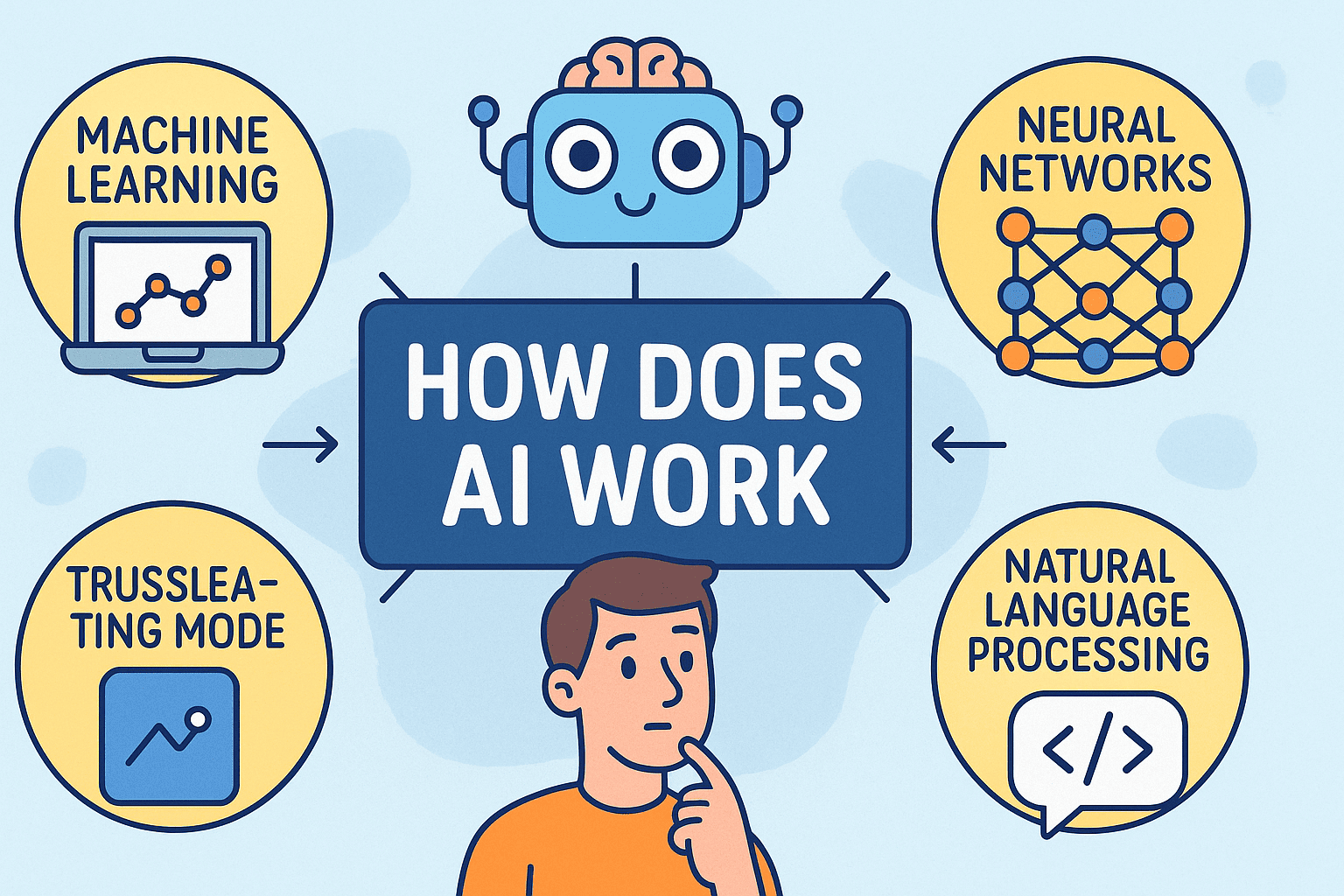
#Core AI Technologies in Business
- Machine Learning (ML)
- Supervised Learning: Models are trained on labeled datasets to make predictions or classifications (e.g., spam detection, demand forecasting).
- Unsupervised Learning: Identifies patterns in unlabeled data (e.g., customer segmentation, anomaly detection).
- Reinforcement Learning: Systems learn by interacting with environments to maximize rewards (e.g., dynamic pricing, robotics).
- Natural Language Processing (NLP) - Enables machines to understand, interpret, and generate human language. - Applications include sentiment analysis, chatbots, and automated document processing.
- Computer Vision - Uses deep learning to analyze and interpret visual data from images or videos. - Applications range from quality control in manufacturing to facial recognition in security systems.
- Robotic Process Automation (RPA) - Automates repetitive, rule-based tasks such as data entry, invoice processing, and customer onboarding. - Often integrated with AI to handle exceptions and unstructured data.
- Predictive Analytics - Combines statistical techniques and AI to forecast future trends based on historical data. - Used in finance for risk assessment, in marketing for customer lifetime value prediction, and in operations for maintenance scheduling.
#AI Workflow in Business
- Data Collection and Preprocessing - Businesses gather data from various sources (e.g., CRM systems, IoT sensors, transaction records). - Data is cleaned, normalized, and labeled to prepare for model training.
- Model Selection and Training - Organizations choose appropriate AI models based on their use case (e.g., decision trees for interpretability, neural networks for complex patterns). - Models are trained using historical data and validated to ensure accuracy.
- Deployment and Integration - AI models are deployed into production environments, often via APIs or embedded applications. - Integration with existing business systems (e.g., ERP, CRM) ensures seamless operation.
- Monitoring and Optimization - Continuous monitoring tracks model performance and detects drift (changes in data patterns). - Models are retrained periodically to maintain accuracy and relevance.
#Important Facts
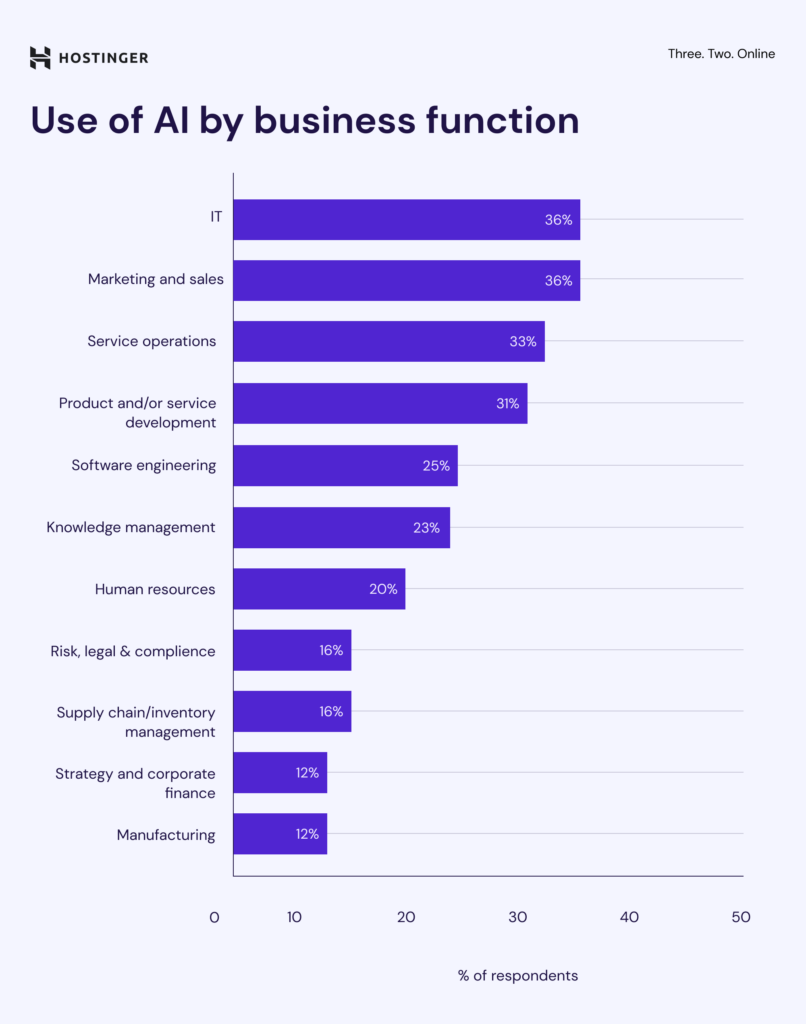
- Adoption Rates - As of 2025, 75% of businesses globally have adopted AI in at least one function, up from 55% in 2020 (Gartner). - The highest adoption rates are in the technology (93%), financial services (86%), and healthcare (81%) sectors.
- Economic Impact - AI is projected to contribute $15.7 trillion to the global economy by 2030, with $6.6 trillion from increased productivity and $9.1 trillion from consumption-side effects (PwC). - Companies using AI report an average 30% reduction in operational costs and a 25% increase in revenue (McKinsey).
- Job Market Transformation - AI is expected to create 97 million new jobs by 2025, while displacing 85 million jobs, resulting in a net gain of 12 million jobs (World Economic Forum). - Roles such as AI specialists, data scientists, and robotics engineers are among the fastest-growing.
- Industry-Specific Applications
- Healthcare: AI-driven diagnostics, drug discovery, and personalized treatment plans.
- Finance: Fraud detection, algorithmic trading, and credit scoring.
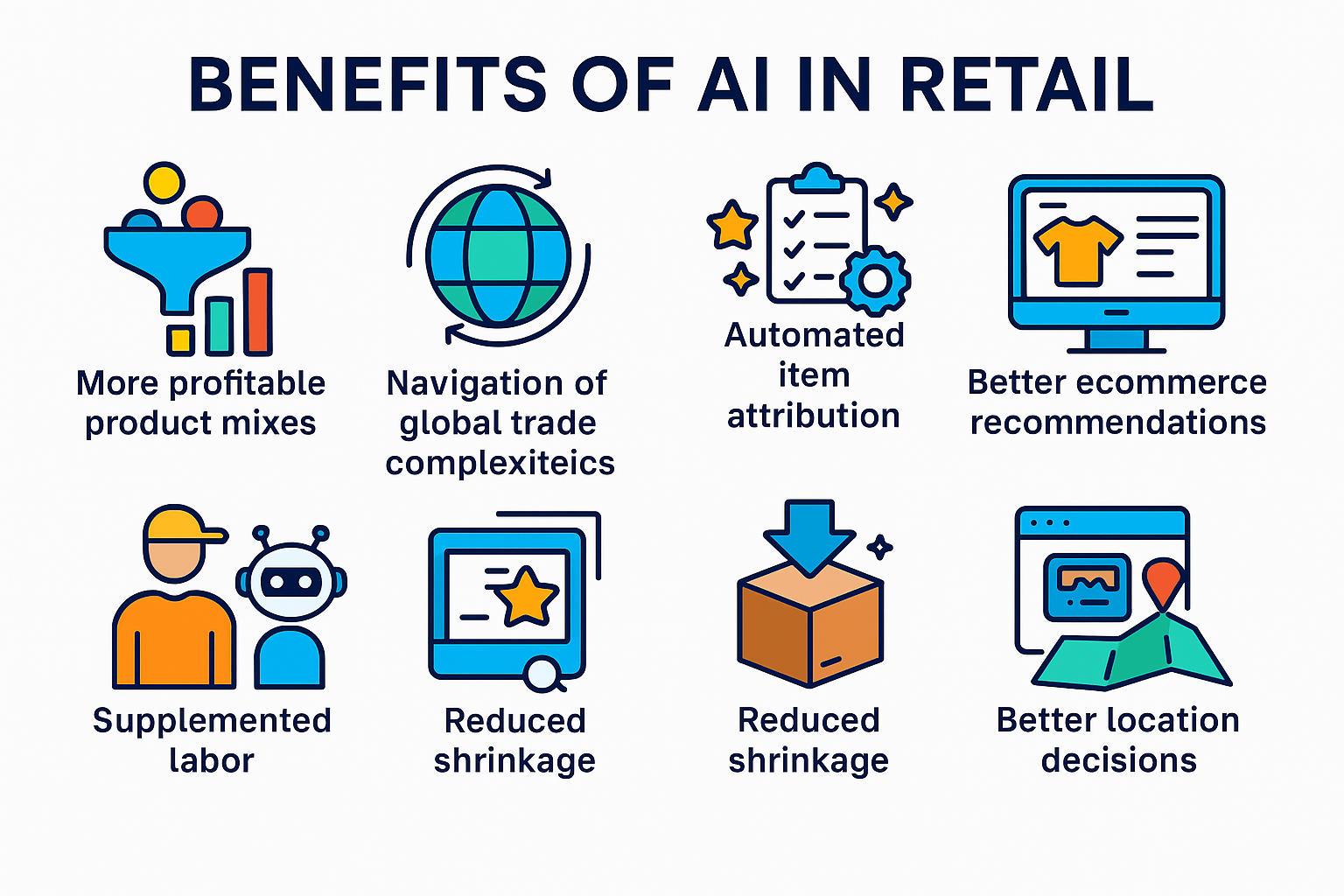
- Retail: Dynamic pricing, inventory optimization, and virtual try-on tools.
- Manufacturing: Predictive maintenance, quality control, and supply chain optimization.
- Ethical and Regulatory Considerations - The EU AI Act (2024) classifies AI systems into four risk categories, with strict regulations for high-risk applications like facial recognition. - Bias in AI models remains a critical challenge, with 68% of organizations reporting concerns about algorithmic fairness (Deloitte).
- Energy Consumption - Training large AI models can consume as much energy as five cars emit in their lifetimes (MIT Technology Review). - Companies are increasingly adopting green AI practices, such as using renewable energy for data centers and optimizing model efficiency.
#Timeline
- Foundational ideas
Core concepts and early methods shape Facts About AI in Business.
- Practical use
Tools, examples, and real-world deployments make the topic easier to evaluate.
- Responsible implementation
Current work focuses on reliability, governance, performance, and measurable impact.
#Related Terms
#FAQ
What does Facts About AI in Business cover?
Covers facts about ai in business, including core concepts, practical examples, benefits, limitations, and risks in Business & Marketing.
Why is Facts About AI in Business important?
It helps readers understand key concepts, compare practical use cases, and evaluate how Business & Marketing decisions affect outcomes, risks, and implementation choices.
What should readers verify before applying this topic?
Readers should compare benefits, limitations, data requirements, and related themes such as Facts, About, AI before using the ideas in real projects.
#References
- Facts About AI in Business terminology and background research
- Facts About AI in Business use cases, implementation examples, and limitations
- Business & Marketing best practices, standards, and risk guidance
- Facts case studies, benchmarks, and current industry analysis


Comments
No comments yet. Start the discussion with a useful note.