

#Short Answer
Covers facts about ai in retail, including core concepts, practical examples, benefits, limitations, and risks in Business & Marketing.
#Infobox
#Overview
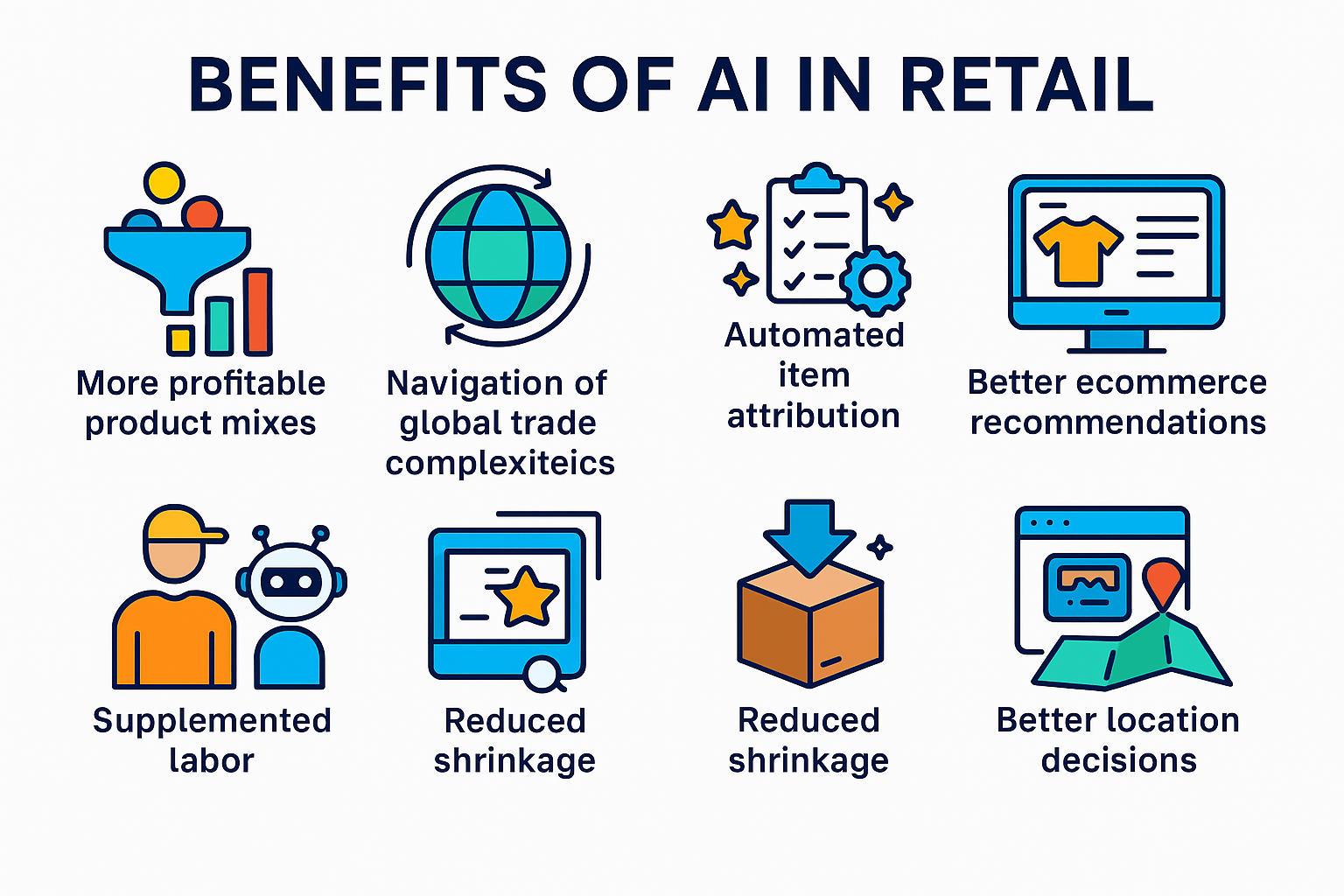
Artificial intelligence (AI) has revolutionized the retail industry by enabling data-driven decision-making, automation, and hyper-personalization. Retailers leverage AI to analyze vast datasets, predict consumer behavior, and streamline operations—from supply chain logistics to in-store customer interactions. The integration of AI in retail spans multiple domains, including e-commerce, brick-and-mortar stores, supply chain management, and marketing, making it a cornerstone of modern retail strategy. AI’s role in retail is multifaceted:
- Customer Experience: AI-powered chatbots, recommendation engines, and virtual assistants enhance engagement and satisfaction.
- Operational Efficiency: Predictive analytics optimize inventory levels, reduce waste, and improve delivery times.
- Sales & Marketing: Dynamic pricing models and targeted promotions increase conversion rates and customer loyalty.
- Security & Fraud Prevention: AI detects anomalies in transactions, reducing losses from fraud and theft. As AI continues to evolve, its applications in retail are expanding, with emerging trends such as autonomous stores, AI-driven visual search, and emotion recognition gaining traction.
#History / Background
#Early Foundations (1980s–2000s)
The roots of AI in retail trace back to the 1980s, when early expert systems were used for inventory management and demand forecasting. However, limited computational power and data availability restricted widespread adoption. The 1990s saw the rise of data mining techniques, which laid the groundwork for AI-driven analytics in retail.
#The E-Commerce Boom (2000s–2010s)
The proliferation of e-commerce platforms (e.g., Amazon, eBay) in the early 2000s accelerated AI adoption. Retailers began using recommendation algorithms (e.g., collaborative filtering) to suggest products based on user behavior. The 2010s marked a turning point with the advent of big data and cloud computing, enabling retailers to process vast datasets in real time.
#The AI Revolution (2015–Present)
The launch of deep learning and neural networks in the mid-2010s transformed AI in retail. Key milestones include:
- 2016: Amazon Go introduced cashier-less stores, leveraging computer vision and sensor fusion.
- 2017: Walmart deployed AI-powered inventory robots to monitor stock levels.
- 2018: Sephora launched an AI-powered virtual try-on tool using augmented reality (AR) and computer vision.
- 2020: The COVID-19 pandemic accelerated AI adoption, with retailers focusing on contactless shopping, chatbots, and automated warehouses. Today, AI is a $15+ billion market in retail, with projections indicating 30% annual growth through 2027.
#How It Works
#Core AI Technologies in Retail
- Machine Learning (ML)
- Supervised Learning: Used for demand forecasting, price optimization, and fraud detection (e.g., training models on historical sales data).
- Unsupervised Learning: Identifies patterns in customer segments (e.g., clustering shoppers based on purchase behavior).
- Reinforcement Learning: Optimizes dynamic pricing and inventory replenishment in real time.
- Natural Language Processing (NLP) - Powers chatbots and virtual assistants (e.g., H&M’s Kik bot, Lowe’s LoweBot). - Enables sentiment analysis from customer reviews and social media to gauge brand perception.
- Computer Vision
- Visual Search: Allows customers to upload images to find similar products (e.g., Pinterest Lens, Google Lens).
- Facial Recognition: Used for personalized marketing (e.g., recognizing loyal customers) and loss prevention in stores.
- Autonomous Checkout: Systems like Amazon Go use cameras and sensors to track items without manual scanning.
- Predictive Analytics - Forecasts demand, stockouts, and pricing trends using historical data and external factors (e.g., weather, holidays). - Tools like SAP’s AI-powered demand forecasting help retailers reduce overstock and stockouts by up to 30%.
- Robotics & Automation
- Warehouse Robots: Amazon’s Kiva robots automate order fulfillment, reducing processing time by 40%.
- Autonomous Delivery: Companies like Nuro and Starship use AI-driven robots for last-mile delivery.
#AI Workflow in Retail
- Data Collection - Gather data from POS systems, CRM tools, IoT sensors, social media, and web analytics.
- Data Processing - Clean, normalize, and structure data using ETL (Extract, Transform, Load) pipelines.
- Model Training - Develop AI models using ML frameworks (TensorFlow, PyTorch) and cloud platforms (AWS, Google Cloud).
- Deployment - Integrate AI solutions into retail management systems (RMS), e-commerce platforms, and mobile apps.
- Monitoring & Optimization - Continuously refine models using A/B testing and feedback loops to improve accuracy.
#Important Facts
#Market Growth & Adoption - The global AI in retail market is expected to grow from $5.7 billion in 2021 to $23.3 billion by 2027 (CAGR of 30.5%).
- 72% of retailers consider AI a top priority for their business strategy (Deloitte, 2023).
- North America leads the AI retail market, followed by Asia-Pacific (driven by China and India).
#Customer Impact
- Personalized recommendations increase sales by 10–30% (McKinsey).
- AI-powered chatbots reduce customer service costs by 30% while improving response times.
- 80% of consumers are more likely to shop with retailers that offer personalized experiences (Segment).
#Operational Efficiency
- AI-driven inventory management reduces stockouts by 20–50% and excess inventory by 10–20%.
- Autonomous warehouses cut order fulfillment time by up to 60%.
- Dynamic pricing (e.g., Uber’s surge pricing model adapted for retail) can boost profit margins by 5–10%.
#Emerging Trends
- Generative AI: Used for creating product descriptions, virtual models, and personalized marketing content.
- AI + IoT: Smart shelves with weight sensors alert staff when items are low.
- Emotion AI: Analyzes facial expressions and voice tones to gauge customer satisfaction in real time.
- Sustainability AI: Optimizes supply chains to reduce carbon footprints (e.g., route optimization for delivery trucks).
#Challenges & Limitations
- Data Privacy: 68% of consumers are concerned about how retailers use their data (PwC).
- High Implementation Costs: Small retailers may struggle with upfront investment (e.g., $50,000+ for an AI chatbot).
- Bias in AI Models: Poorly trained algorithms can lead to discriminatory pricing or hiring practices.
- Workforce Resistance: Employees may fear job displacement due to automation.
#Timeline
- Foundational ideas
Core concepts and early methods shape Facts About AI in Retail.
- Practical use
Tools, examples, and real-world deployments make the topic easier to evaluate.
- Responsible implementation
Current work focuses on reliability, governance, performance, and measurable impact.
#Related Terms
#FAQ
What does Facts About AI in Retail cover?
Covers facts about ai in retail, including core concepts, practical examples, benefits, limitations, and risks in Business & Marketing.
Why is Facts About AI in Retail important?
It helps readers understand key concepts, compare practical use cases, and evaluate how Business & Marketing decisions affect outcomes, risks, and implementation choices.
What should readers verify before applying this topic?
Readers should compare benefits, limitations, data requirements, and related themes such as Facts, About, AI before using the ideas in real projects.
#References
- Facts About AI in Retail terminology and background research
- Facts About AI in Retail use cases, implementation examples, and limitations
- Business & Marketing best practices, standards, and risk guidance
- Facts case studies, benchmarks, and current industry analysis


Comments
No comments yet. Start the discussion with a useful note.