


#Short Answer
Artificial Intelligence (AI) skills refer to the technical and soft competencies required to design, develop, deploy, and manage AI systems. Employers prioritize these skills to drive innovation, automate processes, and gain competitive advantages in data-driven industries.
#Infobox
#Overview
Artificial Intelligence skills encompass a broad spectrum of abilities essential for developing and implementing AI technologies. These skills are categorized into technical and soft skills, each playing a critical role in the AI ecosystem. Employers increasingly seek professionals with expertise in machine learning, data analysis, and programming languages like Python and R. The demand for AI talent has surged due to the technology's transformative impact on industries such as healthcare, finance, and retail.
AI skills are not limited to technical proficiency; they also include the ability to interpret data, communicate insights, and align AI solutions with business objectives. As AI continues to evolve, the skill set required for AI professionals expands, making continuous learning a necessity. Organizations invest in AI training programs to upskill their workforce, ensuring they remain competitive in a rapidly changing technological landscape.
#History / Background
#Early Developments
The concept of AI dates back to the 1950s, when pioneers like Alan Turing and John McCarthy laid the foundation for machine intelligence. Turing's 1950 paper, "Computing Machinery and Intelligence," introduced the Turing Test, a benchmark for AI capabilities. McCarthy coined the term "Artificial Intelligence" in 1956 during the Dartmouth Conference, marking the official birth of the field.
#Milestones in AI Skills
- 1950s–1960s: Early AI research focused on symbolic reasoning and problem-solving. Skills were limited to logic programming and basic algorithms.
- 1980s–1990s: The rise of expert systems and neural networks introduced new skill requirements, including knowledge representation and pattern recognition.
- 2000s: Machine learning gained prominence, requiring skills in statistical modeling, data preprocessing, and algorithm optimization.
- 2010s–Present: Deep learning and big data technologies expanded the scope of AI skills, emphasizing proficiency in frameworks like TensorFlow and PyTorch, as well as cloud computing platforms such as AWS and Google Cloud.
#How It Works
#Core Components of AI Skills
AI skills are structured around several key components that enable professionals to develop and deploy AI solutions effectively:
1. Technical Proficiency
Technical skills form the backbone of AI expertise. Professionals must be adept in programming languages such as Python, Java, and C++, which are essential for building AI models. Familiarity with libraries and frameworks like TensorFlow, Keras, and PyTorch is crucial for implementing machine learning and deep learning algorithms. Additionally, knowledge of data structures, algorithms, and software engineering principles ensures the development of robust and scalable AI systems.
2. Data Management and Analysis
AI relies heavily on data, making data management and analysis critical skills. Professionals must be skilled in data collection, cleaning, and preprocessing to ensure high-quality datasets. Proficiency in SQL and NoSQL databases, as well as tools like Apache Spark and Pandas, enables efficient data manipulation. Data visualization tools such as Tableau and Matplotlib help in interpreting and presenting data insights effectively.
3. Machine Learning and Deep Learning
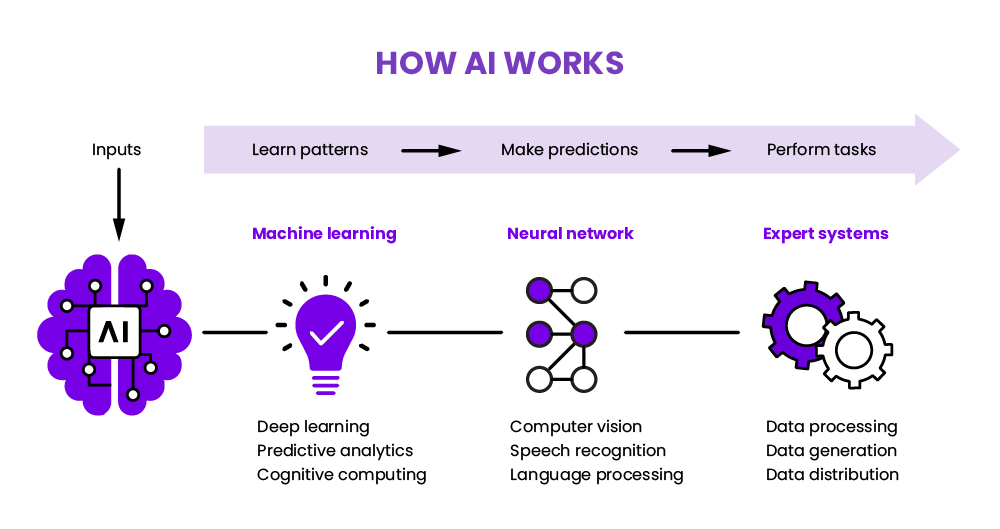
Machine learning (ML) and deep learning (DL) are central to AI development. ML skills include understanding supervised, unsupervised, and reinforcement learning techniques. Professionals must be able to select appropriate algorithms, train models, and evaluate their performance using metrics like accuracy, precision, and recall. Deep learning extends these capabilities with neural networks, requiring skills in architectures such as Convolutional Neural Networks (CNNs) and Recurrent Neural Networks (RNNs).
4. Cloud Computing and DevOps
Cloud computing platforms like AWS, Azure, and Google Cloud provide the infrastructure needed to deploy and scale AI models. Skills in cloud services, including compute, storage, and networking, are essential for managing AI workloads. DevOps practices, such as continuous integration and deployment (CI/CD), ensure the seamless integration of AI models into production environments. Familiarity with containerization tools like Docker and orchestration platforms like Kubernetes is also valuable.
5. Soft Skills
Soft skills complement technical abilities and are vital for AI professionals. Problem-solving and critical thinking enable professionals to address complex challenges and innovate solutions. Communication skills are essential for collaborating with cross-functional teams, including data scientists, engineers, and business stakeholders. Ethical considerations, such as bias mitigation and fairness in AI, are increasingly important as AI systems impact society.
#Important Facts
- AI Job Growth: The U.S. Bureau of Labor Statistics projects a 22% growth in AI-related jobs from 2023 to 2032, significantly outpacing the average for all occupations.
- High Demand for Python: Python is the most widely used programming language for AI, with 66% of developers using it for AI projects, according to a 2023 Stack Overflow survey.
- Salary Premium: AI professionals earn an average salary of $130,000 annually in the U.S., with senior roles exceeding $200,000.
- Ethical AI: 72% of organizations prioritize ethical AI practices, including bias detection and transparency, according to a 2023 Deloitte survey.
- Cloud Adoption: 85% of enterprises use cloud-based AI services, leveraging platforms like AWS SageMaker and Google Vertex AI for model development and deployment.
- Data Privacy Concerns: 68% of consumers are concerned about data privacy in AI applications, highlighting the need for robust security measures.
- Interdisciplinary Nature: AI skills are increasingly integrated with other fields, such as healthcare (medical imaging), finance (fraud detection), and retail (personalization).
#Timeline
- Alan Turing publishes 'Comput
Alan Turing publishes 'Computing Machinery and Intelligence,' introducing the Turing Test.
- John McCarthy coins the
John McCarthy coins the term 'Artificial Intelligence' at the Dartmouth Conference.
- ELIZA, an early natural
ELIZA, an early natural language processing program, is developed by Joseph Weizenbaum.
- Expert systems gain popularity
Expert systems gain popularity, requiring skills in knowledge representation and rule-based reasoning.
- IBM's Deep Blue defeats
IBM's Deep Blue defeats world chess champion Garry Kasparov, showcasing AI's potential in strategic games.
- IBM Watson wins Jeopardy!
IBM Watson wins Jeopardy!, demonstrating advancements in natural language understanding and machine learning.
- AlexNet, a deep convolutional
AlexNet, a deep convolutional neural network, achieves breakthrough performance in image recognition, sparking the deep learning revolution.
- AlphaGo defeats Lee Sedol
AlphaGo defeats Lee Sedol in the ancient board game Go, highlighting the power of reinforcement learning.
- GDPR (General Data Protection
GDPR (General Data Protection Regulation) comes into effect, emphasizing data privacy and ethical AI practices in the EU.
- AI adoption accelerates during
AI adoption accelerates during the COVID-19 pandemic, with applications in healthcare, remote work, and supply chain optimization.
- Generative AI tools like
Generative AI tools like DALL-E and ChatGPT gain widespread attention, driving demand for AI skills in creative and conversational applications.
#Related Terms
#FAQ
What does AI Skills: What Employers Look For cover?
AI skills: what employers look for covers practical examples, benefits, limitations, and important considerations for readers.
Why is AI Skills: What Employers Look For important?
It helps readers understand key concepts, compare practical use cases, and evaluate how Artificial Intelligence decisions affect outcomes, risks, and implementation choices.
What should readers verify before applying this topic?
Readers should compare the benefits, limitations, data requirements, and related themes such as Skill, Employer, AI Applications before using the ideas in real projects.
#References
- AI Skills: What Employers Look For terminology and background research
- AI Skills: What Employers Look For use cases, implementation examples, and limitations
- Artificial Intelligence best practices, standards, and risk guidance
- Skill case studies, benchmarks, and current industry analysis


Comments
No comments yet. Start the discussion with a useful note.