


#Short Answer
Artificial Intelligence refers to the simulation of human intelligence in machines programmed to think and act like humans. The field combines computer science, mathematics, psychology, and linguistics to create systems capable of performing tasks autonomously. AI systems are categorized into two types: narrow AI, designed for specific tasks, and artificial general intelligence (AGI), which aims to replicate human-like cognitive abilities across domains.
#Infobox
#Overview
Artificial Intelligence refers to the simulation of human intelligence in machines programmed to think and act like humans. The field combines computer science, mathematics, psychology, and linguistics to create systems capable of performing tasks autonomously. AI systems are categorized into two types: narrow AI, designed for specific tasks, and artificial general intelligence (AGI), which aims to replicate human-like cognitive abilities across domains.
AI terminology often includes acronyms and jargon essential for understanding the technology's evolution and applications. For instance, ML (Machine Learning) enables systems to improve performance through data exposure, while DL (Deep Learning) uses multi-layered neural networks to model complex patterns. Other critical terms include AI ethics, data science, and big data, which collectively shape the AI landscape.
#History / Background
The concept of AI dates back to antiquity, with myths and stories featuring artificial beings endowed with intelligence. However, the modern field began in the mid-20th century. In 1950, Alan Turing proposed the Turing Test as a criterion for machine intelligence, laying the groundwork for AI research. The term "Artificial Intelligence" was coined in 1956 by John McCarthy during the Dartmouth Conference, marking the birth of AI as an academic discipline.
Early AI research focused on symbolic reasoning and problem-solving, exemplified by programs like Logic Theorist (1956) and General Problem Solver (1957). The 1960s and 1970s saw the development of expert systems, which mimicked human decision-making in specialized domains. However, progress stalled due to limited computational power and data availability, leading to the "AI winter" of the 1980s and 1990s.
The resurgence of AI in the 21st century was driven by breakthroughs in machine learning and the availability of large datasets. The introduction of deep learning in the 2010s revolutionized fields like computer vision and NLP, enabling advancements such as AlexNet (2012) and AlphaGo (2016). Today, AI is a cornerstone of technological innovation, with applications spanning healthcare, finance, transportation, and entertainment.
#How It Works
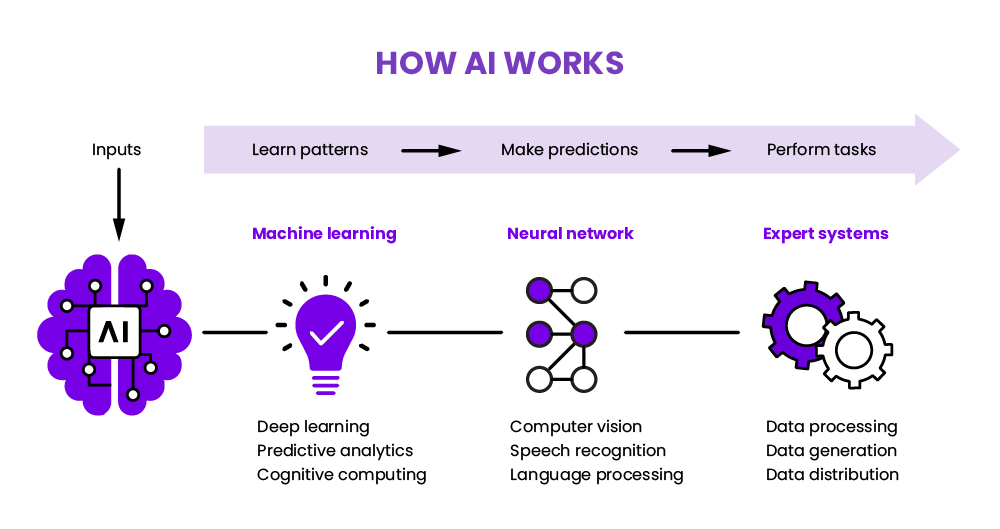
AI systems operate through a combination of algorithms, data, and computational power. The core methodologies include:
- Machine Learning (ML): Algorithms that learn patterns from data without explicit programming. Supervised learning uses labeled datasets, while unsupervised learning identifies hidden structures in unlabeled data.
- Deep Learning (DL): A subset of ML that employs artificial neural networks with multiple layers (deep networks) to model complex data representations. Convolutional Neural Networks (CNNs) excel in image recognition, while Recurrent Neural Networks (RNNs) are used for sequential data like text.
- Natural Language Processing (NLP): Enables machines to understand, interpret, and generate human language. Techniques include tokenization, sentiment analysis, and language modeling, powering applications like chatbots and translation services.
- Computer Vision: Focuses on enabling machines to interpret and make decisions based on visual input. Object detection, facial recognition, and autonomous navigation are key applications.
- Reinforcement Learning: Algorithms learn by interacting with an environment, receiving rewards for correct actions. This approach is used in robotics, gaming (e.g., AlphaGo), and autonomous systems.
AI systems require vast amounts of data for training, often sourced from the internet, sensors, or user interactions. The data is preprocessed to remove noise and bias before being fed into models. Training involves optimizing model parameters to minimize error, a process guided by loss functions and optimization algorithms like stochastic gradient descent (SGD). Once trained, models are deployed in real-world scenarios, where they may continue learning through feedback loops.
#Important Facts
- AI vs. Automation: While automation follows pre-programmed rules, AI systems adapt and improve over time through learning.
- Bias in AI: AI models can perpetuate biases present in training data, leading to unfair outcomes in applications like hiring or lending.
- Explainable AI (XAI): A growing field focused on making AI decisions transparent and interpretable, crucial for ethical and regulatory compliance.
- AI Hardware: Specialized hardware like GPUs (Graphics Processing Units) and TPUs (Tensor Processing Units) accelerates AI computations, enabling large-scale models.
- Ethical Concerns: Issues such as privacy, job displacement, and autonomous weaponry are central to AI ethics discussions.
- AI in Healthcare: Applications include diagnostic imaging, drug discovery, and personalized treatment plans, improving patient outcomes.
- Generative AI: Models like GPT can create human-like text, images, and music, raising questions about creativity and authenticity.
#Timeline
- Alan Turing publishes 'Comput
[Alan Turing](# 'Alan Turing') publishes 'Computing Machinery and Intelligence,' introducing the Turing Test.
- John McCarthy coins the
John McCarthy coins the term 'Artificial Intelligence' at the Dartmouth Conference.
- ELIZA, an early NLP
ELIZA, an early NLP program, simulates conversation by using pattern matching.
- Expert systems like MYCIN
Expert systems like MYCIN gain prominence in medical and industrial applications.
- IBM's Deep Blue defeats
IBM's Deep Blue defeats world chess champion Garry Kasparov.
- IBM Watson wins *Jeopardy!*
IBM Watson wins *Jeopardy!*, showcasing advanced NLP capabilities.
- AlexNet wins the ImageNet
AlexNet wins the ImageNet competition, demonstrating the power of deep learning in computer vision.
- AlphaGo defeats Lee Sedol
AlphaGo defeats Lee Sedol in the board game Go, a milestone for reinforcement learning.
- OpenAI releases GPT-3, a
OpenAI releases GPT-3, a language model capable of generating coherent text across diverse topics.
- Stable Diffusion and DALL·E
Stable Diffusion and DALL·E 2 popularize text-to-image generation, sparking debates on AI art.
#Related Terms
#FAQ
What does AI Acronyms And Terms Explained cover?
Explains AI acronyms and terms in plain language, covering the core idea, how it works, common uses, and why it matters.
Why is AI Acronyms And Terms Explained important?
It helps readers understand key concepts, compare practical use cases, and evaluate how Artificial Intelligence decisions affect outcomes, risks, and implementation choices.
What should readers verify before applying this topic?
Readers should compare the benefits, limitations, data requirements, and related themes such as Acronym, Term, AI Applications before using the ideas in real projects.
#References
- AI Acronyms And Terms Explained terminology and background research
- AI Acronyms And Terms Explained use cases, implementation examples, and limitations
- Artificial Intelligence best practices, standards, and risk guidance
- Acronym case studies, benchmarks, and current industry analysis



Comments
No comments yet. Start the discussion with a useful note.