

#Short Answer
Artificial Intelligence (AI) is a field of computer science focused on creating systems capable of performing tasks that typically require human intelligence. This guide provides a simple yet comprehensive overview of AI, its history, mechanisms, and applications.
#Infobox
#Overview
Artificial Intelligence (AI) refers to the simulation of human intelligence in machines programmed to think and learn. These systems are designed to perform tasks such as reasoning, problem-solving, understanding language, recognizing patterns, and making decisions. AI can be categorized into two main types: narrow AI, which is designed for specific tasks (e.g., voice assistants like Siri), and general AI, which would possess the ability to perform any intellectual task a human can (though this remains theoretical).
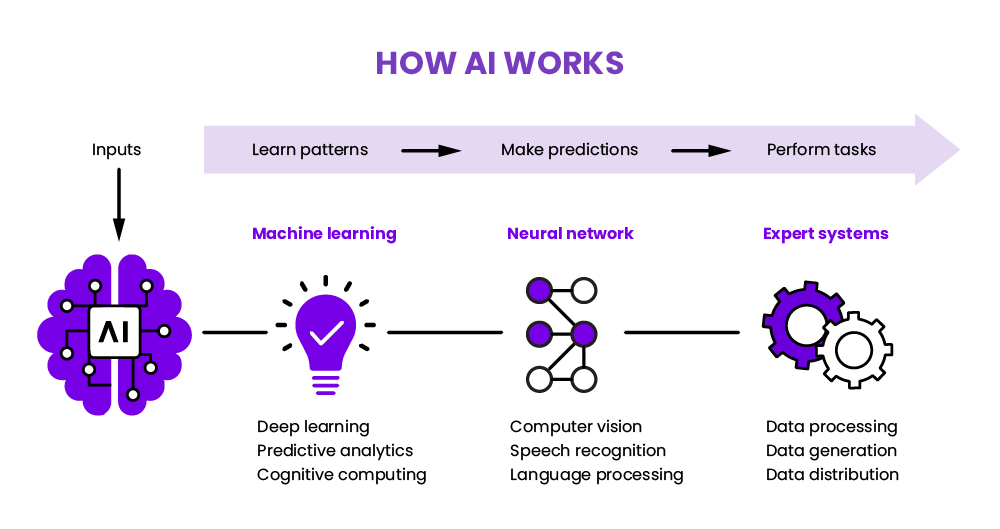
AI systems rely on algorithms and large datasets to improve their performance over time. Machine learning, a subset of AI, enables systems to learn from data without explicit programming. Deep learning, a further subset, uses neural networks with multiple layers to model complex patterns in data, powering advancements in image and speech recognition.
#History / Background
The concept of AI dates back to ancient myths and stories of artificial beings endowed with intelligence, such as the Greek myth of Talos or the Jewish legend of the Golem. However, the modern field of AI began in the mid-20th century.
Key Milestones:
- 1950: Alan Turing proposed the Turing Test, a criterion for determining a machine's ability to exhibit intelligent behavior equivalent to a human.
- 1956: The term "Artificial Intelligence" was coined by John McCarthy at the Dartmouth Conference, marking the official birth of AI as a field of study.
- 1950s–1960s: Early AI programs, such as Logic Theorist and General Problem Solver, demonstrated symbolic reasoning.
- 1966: ELIZA, an early natural language processing program, simulated conversation by using pattern matching.
- 1997: IBM's Deep Blue defeated world chess champion Garry Kasparov, showcasing AI's potential in strategic games.
- 2011: IBM Watson won Jeopardy!, demonstrating advanced natural language understanding.
- 2012: The breakthrough of deep learning in image recognition, with AlexNet winning the ImageNet competition.
- 2016: AlphaGo, developed by DeepMind, defeated a world champion Go player, a game considered far more complex than chess.
- 2020s: Rapid advancements in generative AI, including models like DALL-E and ChatGPT, enabling creative and conversational applications.
#How It Works
AI systems operate through a combination of algorithms, data, and computational power. The process generally involves the following steps:
- Data Collection: AI systems require large datasets to learn patterns. This data can include text, images, audio, or numerical values.
- Preprocessing: Data is cleaned, normalized, and structured to remove noise and inconsistencies.
- Model Selection: The appropriate algorithm or model is chosen based on the task. Common models include decision trees, support vector machines, and neural networks.
- Training: The model is trained on the dataset, adjusting its parameters to minimize errors. In supervised learning, the model learns from labeled data; in unsupervised learning, it identifies patterns without labels.
- Evaluation: The model's performance is tested on unseen data to assess its accuracy and generalization capabilities.
- Deployment: Once validated, the model is deployed in real-world applications, such as chatbots, recommendation systems, or autonomous vehicles.
- Feedback Loop: Continuous monitoring and feedback improve the model's performance over time.
Neural networks, particularly deep learning models, mimic the human brain's structure with interconnected layers of nodes (neurons). These networks excel in tasks like image and speech recognition due to their ability to process vast amounts of data and identify intricate patterns.
#Key Technologies
- Machine Learning (ML): Enables systems to learn from data and improve without explicit programming. Subfields include supervised learning, unsupervised learning, and reinforcement learning.
- Natural Language Processing (NLP): Focuses on the interaction between computers and human language, enabling applications like translation, sentiment analysis, and chatbots.
- Computer Vision: Involves training machines to interpret and analyze visual data, such as object detection in images or video.
- Robotics: Combines AI with mechanical engineering to create robots capable of performing physical tasks, from manufacturing to surgery.
- Generative AI: Uses models like transformers and generative adversarial networks (GANs) to create new content, including text, images, and music.
#Important Facts
- AI is not a single technology: It encompasses a wide range of techniques, including machine learning, natural language processing, and robotics.
- AI requires data: The quality and quantity of data directly impact an AI system's performance.
- AI is not infallible: Systems can produce biased or incorrect results due to flawed data or algorithms.
- AI is transforming industries: Healthcare (diagnosis, drug discovery), finance (fraud detection, algorithmic trading), and transportation (self-driving cars) are among the sectors benefiting from AI advancements.
- Ethical concerns: Issues such as privacy, job displacement, and algorithmic bias require careful consideration and regulation.
- AI is evolving rapidly: Breakthroughs in hardware (e.g., GPUs, TPUs) and software (e.g., transformer models) are accelerating AI's capabilities.
#Timeline
- Alan Turing proposes the
Alan Turing proposes the Turing Test.
- John McCarthy coins the
John McCarthy coins the term 'Artificial Intelligence' at the Dartmouth Conference.
- ELIZA, an early chatbot
ELIZA, an early chatbot, is developed.
- IBM's Deep Blue defeats
IBM's Deep Blue defeats Garry Kasparov in chess.
- IBM Watson wins *Jeopardy!*
IBM Watson wins *Jeopardy!*
- AlexNet wins the ImageNet
AlexNet wins the ImageNet competition, sparking advancements in deep learning.
- AlphaGo defeats a world
AlphaGo defeats a world champion Go player.
- OpenAI releases GPT-3, a
OpenAI releases GPT-3, a powerful language model.
- Stable Diffusion and DALL-E
Stable Diffusion and DALL-E 2 enable text-to-image generation.
- ChatGPT and other generative
ChatGPT and other generative AI tools gain widespread adoption.
#Related Terms
#FAQ
What does AI Explained: A Simple Guide cover?
Explains AI in plain language, covering the core idea, how it works, common uses, and why it matters.
Why is AI Explained: A Simple Guide important?
It helps readers understand key concepts, compare practical use cases, and evaluate how Artificial Intelligence decisions affect outcomes, risks, and implementation choices.
What should readers verify before applying this topic?
Readers should compare the benefits, limitations, data requirements, and related themes such as AI Applications, Automation, Future Technology before using the ideas in real projects.
#References
- AI Explained: A Simple Guide terminology and background research
- AI Explained: A Simple Guide use cases, implementation examples, and limitations
- Artificial Intelligence best practices, standards, and risk guidance
- AI Applications case studies, benchmarks, and current industry analysis




Comments
No comments yet. Start the discussion with a useful note.