

#Short Answer
Reviews the pros and cons of AI, including benefits, risks, limitations, and trade-offs.
#Infobox
#Overview
Artificial Intelligence (AI) is a branch of computer science focused on creating systems capable of performing tasks that typically require human intelligence. These tasks include reasoning, learning, problem-solving, perception, and language understanding. AI systems are designed to analyze data, recognize patterns, and make decisions with minimal human intervention. The field has evolved from theoretical concepts in the mid-20th century to practical applications in modern society, revolutionizing industries such as healthcare, finance, transportation, and entertainment.
AI can be categorized into two main types: narrow AI (or weak AI), which is designed for specific tasks (e.g., voice assistants like Siri), and general AI (or strong AI), which aims to replicate human-like cognitive abilities across all domains. While narrow AI is already prevalent, general AI remains a theoretical goal. Additionally, AI technologies are often classified based on their functionality, such as reactive machines, limited memory systems, theory of mind, and self-aware AI.
#History / Background
#Early Developments
The foundations of AI were laid in the 1950s, with key contributions from mathematicians and computer scientists. In 1950, Alan Turing published "Computing Machinery and Intelligence", introducing the Turing Test as a criterion for determining a machine's ability to exhibit intelligent behavior. The term "Artificial Intelligence" was coined in 1956 by John McCarthy during the Dartmouth Conference, which is widely regarded as the birth of AI as a formal academic discipline.
Early AI research focused on symbolic reasoning and problem-solving. Programs like the Logic Theorist (1956), developed by Allen Newell and Herbert Simon, demonstrated that machines could solve mathematical theorems. However, progress was limited by computational constraints and the complexity of human cognition.
#AI Winters and Renaissance
The field experienced periods of reduced funding and interest, known as AI winters, due to unmet expectations and technological limitations. The first AI winter occurred in the 1970s, followed by another in the late 1980s and early 1990s, when expert systems failed to deliver on their promises. However, advancements in computing power, data availability, and algorithms led to a resurgence in the 2000s, often referred to as the AI renaissance.
Key breakthroughs during this period included the development of deep learning techniques, which enabled machines to process vast amounts of data and improve performance in tasks like image and speech recognition. The introduction of neural networks with multiple layers (deep neural networks) significantly enhanced AI capabilities, leading to applications such as self-driving cars and personalized recommendation systems.
#How It Works
#Core Technologies
AI systems rely on several core technologies to function:
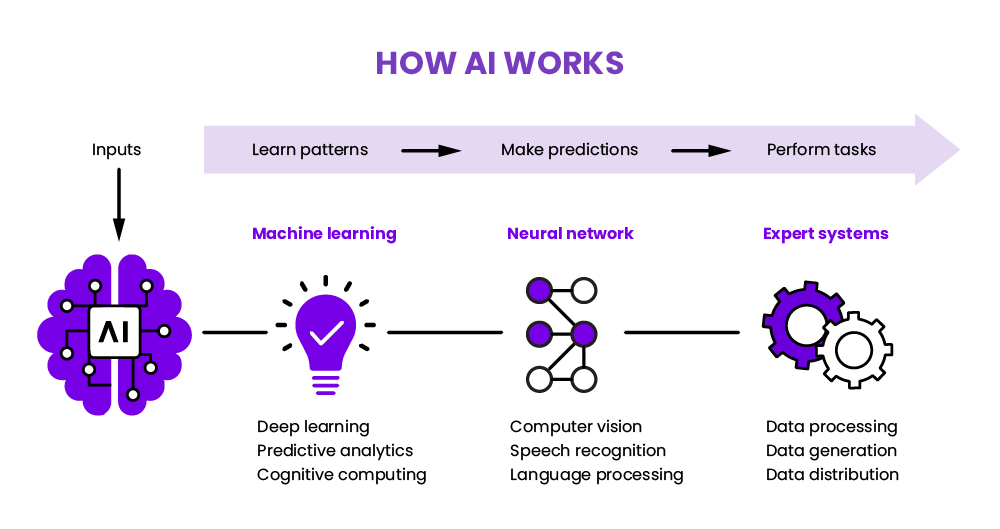
- Machine Learning (ML): A subset of AI that enables systems to learn from data without explicit programming. ML algorithms identify patterns and make predictions based on input data. Common techniques include supervised learning, unsupervised learning, and reinforcement learning.
- Natural Language Processing (NLP): Focuses on the interaction between computers and human language. NLP enables machines to understand, interpret, and generate human language, powering applications like chatbots, translation services, and sentiment analysis.
- Computer Vision: Involves the analysis and interpretation of visual data, such as images and videos. Computer vision is used in facial recognition, medical imaging, and autonomous vehicles.
- Robotics: Combines AI with mechanical engineering to create machines capable of performing physical tasks. Robots equipped with AI can navigate environments, manipulate objects, and interact with humans.
- Expert Systems: AI programs designed to mimic the decision-making abilities of human experts in specific domains. These systems use rule-based logic to provide solutions to complex problems.
#Data and Algorithms
AI systems require large datasets for training and validation. The quality and diversity of data directly impact the performance of AI models. Algorithms, which are sets of rules or instructions, guide the learning process. For example, neural networks use interconnected nodes (neurons) to process data, with weights adjusted during training to minimize errors. Deep learning, a subset of ML, employs multi-layered neural networks to model complex patterns in data.
Training an AI model involves feeding it labeled data (supervised learning) or allowing it to discover patterns independently (unsupervised learning). Reinforcement learning, another approach, involves training models through trial and error, with rewards for correct actions and penalties for incorrect ones. Once trained, AI models can make predictions or decisions on new, unseen data.
#Important Facts
- AI in Healthcare: AI is transforming healthcare through applications like diagnostic imaging, drug discovery, and personalized treatment plans. For example, AI algorithms can analyze medical images to detect diseases such as cancer with high accuracy.
- Autonomous Vehicles: Self-driving cars use AI to interpret sensor data, navigate roads, and make real-time decisions. Companies like Tesla and Waymo are at the forefront of developing autonomous vehicle technology.
- Natural Language Processing: AI-powered chatbots and virtual assistants, such as Siri and Alexa, use NLP to understand and respond to human queries. Translation services like Google Translate leverage NLP to bridge language barriers.
- Ethical Concerns: AI raises ethical questions regarding bias in algorithms, privacy invasion, and job displacement. Ensuring fairness, transparency, and accountability in AI systems is a critical challenge.
- AI in Finance: Financial institutions use AI for fraud detection, algorithmic trading, and risk assessment. AI-driven tools analyze market trends and predict investment opportunities with greater precision.
- Robotics: AI-powered robots are used in manufacturing, healthcare, and space exploration. For instance, surgical robots assist doctors in performing minimally invasive procedures.
#Timeline
YearEvent1950Alan Turing publishes "Computing Machinery and Intelligence", introducing the Turing Test.1956John McCarthy coins the term "Artificial Intelligence" at the Dartmouth Conference.1966ELIZA, an early natural language processing program, is developed by Joseph Weizenbaum.1997IBM's Deep Blue defeats world chess champion Garry Kasparov.2011IBM Watson wins Jeopardy!, demonstrating advanced natural language processing capabilities.2012Google's deep learning algorithm achieves breakthroughs in image recognition.2016AlphaGo, developed by DeepMind, defeats a world champion Go player.2020AI models like GPT-3 demonstrate advanced language generation capabilities.2023Generative AI tools, such as DALL-E and MidJourney, gain widespread popularity for creating images and text from textual descriptions.
#Related Terms
#FAQ
What does AI: Pros And Cons cover?
Reviews the pros and cons of AI, including benefits, risks, limitations, and trade-offs.
Why is AI: Pros And Cons important?
It helps readers understand key concepts, compare practical use cases, and evaluate how Artificial Intelligence decisions affect outcomes, risks, and implementation choices.
What should readers verify before applying this topic?
Readers should compare the benefits, limitations, data requirements, and related themes such as Comparison, Trade Offs, AI Applications before using the ideas in real projects.
#References
- AI: Pros And Cons terminology and background research
- AI: Pros And Cons use cases, implementation examples, and limitations
- Artificial Intelligence best practices, standards, and risk guidance
- Comparison case studies, benchmarks, and current industry analysis


Comments
No comments yet. Start the discussion with a useful note.