


#Short Answer
Provides a broad overview of AI in transportation, including common applications, benefits, challenges, and implementation considerations.
#Infobox
Artificial Intelligence in Transportation Field Transportation Subfields Autonomous vehicles, Traffic management, Predictive maintenance, Logistics optimization Key Technologies Machine learning, Computer vision, Sensor fusion, Reinforcement learning Notable Applications Self-driving cars, Smart traffic lights, Route optimization, Fleet management Major Contributors Waymo, Tesla, Uber, Siemens Mobility, IBM Impact Reduced accidents, Lower emissions, Improved efficiency, Cost savings
#Overview
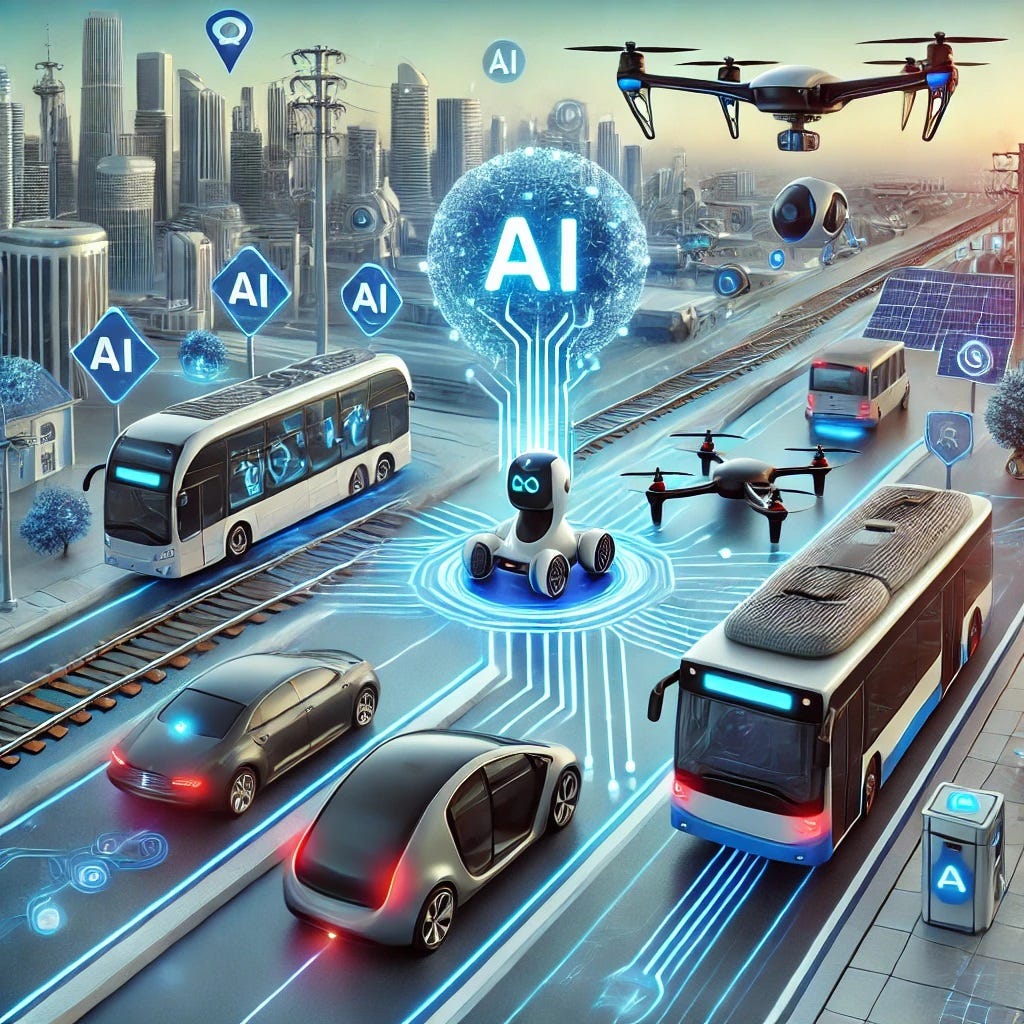
AI in transportation integrates advanced computational techniques to address challenges in mobility, logistics, and infrastructure management. By analyzing vast datasets from sensors, GPS, and historical records, AI systems enable real-time decision-making, reducing human error and improving operational efficiency. Key applications include autonomous vehicles, traffic flow optimization, predictive maintenance for infrastructure, and dynamic route planning for logistics fleets.
The integration of AI has led to significant advancements in reducing traffic congestion, lowering carbon emissions, and enhancing road safety. Governments and private enterprises worldwide are investing heavily in AI-driven transportation solutions to create smarter, more sustainable cities. The technology also plays a crucial role in emergency response systems, public transit management, and freight transportation, making it a cornerstone of modern intelligent transportation systems (ITS).
#Key Areas of Application
- Autonomous Vehicles: Self-driving cars and trucks use AI to interpret sensor data, navigate roads, and make real-time driving decisions.
- Traffic Management Systems: AI-powered adaptive traffic lights and congestion prediction models optimize traffic flow and reduce delays.
- Predictive Maintenance: Machine learning algorithms analyze equipment data to forecast failures in vehicles, railways, and infrastructure before they occur.
- Logistics and Fleet Optimization: AI enhances route planning, fuel efficiency, and delivery scheduling for commercial fleets.
- Public Transportation: AI improves scheduling, passenger demand forecasting, and real-time transit updates for buses, trains, and subways.
#History / Background
The concept of AI in transportation dates back to the mid-20th century, with early experiments in automation and robotics. The 1980s saw the development of expert systems for traffic management, while the 1990s introduced neural networks for pattern recognition in vehicle control. The real breakthrough came in the 2000s with advancements in computing power and the availability of big data, enabling more sophisticated AI applications.
In 2004, the DARPA Grand Challenge marked a pivotal moment, where autonomous vehicles demonstrated their ability to navigate long distances without human intervention. This event spurred significant investment from tech companies and automotive manufacturers. By the 2010s, companies like Tesla, Waymo, and Uber began testing self-driving cars on public roads, while governments launched smart city initiatives to integrate AI into urban transportation networks.
#Evolution of Autonomous Vehicles
The progression of autonomous vehicles can be categorized into six levels, defined by the Society of Automotive Engineers (SAE):
- Level 0: No automation; the driver performs all tasks.
- Level 1: Driver assistance features like adaptive cruise control.
- Level 2: Partial automation, where the vehicle can control steering and acceleration but requires human oversight.
- Level 3: Conditional automation; the vehicle can handle most driving tasks but may request human intervention in complex scenarios.
- Level 4: High automation; the vehicle can operate without human input in specific conditions (e.g., geofenced areas).
- Level 5: Full automation; the vehicle operates under all conditions without any human intervention.
As of 2023, most commercially available autonomous systems operate at Level 2 or Level 3, with Level 4 vehicles being tested in limited environments, such as Waymo's operations in Phoenix, Arizona.
#How It Works
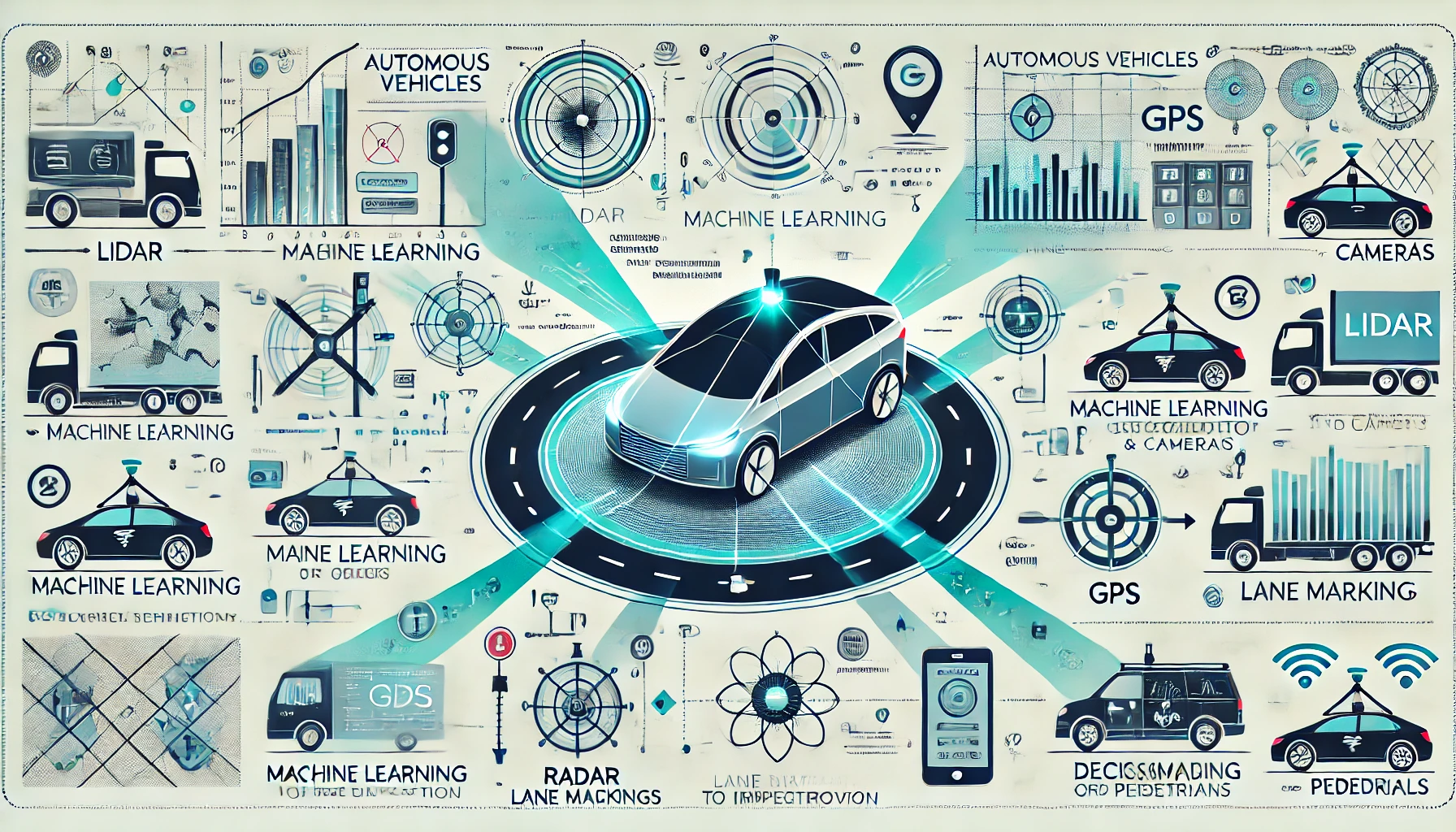
AI in transportation relies on a combination of machine learning, computer vision, and sensor fusion to process and act upon real-time data. The core components include:
#Data Collection and Sensors
AI systems gather data from multiple sources:
- Cameras: Capture visual data for object detection, lane recognition, and traffic sign interpretation.
- LiDAR (Light Detection and Ranging): Uses laser pulses to create 3D maps of surroundings, essential for autonomous vehicles.
- Radar: Detects the speed and distance of objects, even in poor visibility conditions.
- GPS and IMU (Inertial Measurement Unit): Provides precise location and orientation data.
- V2X (Vehicle-to-Everything) Communication: Enables vehicles to exchange data with traffic lights, other vehicles, and infrastructure.
#Machine Learning and Algorithms
AI models in transportation are trained on vast datasets to recognize patterns and make predictions. Common techniques include:
- Supervised Learning: Used for tasks like traffic sign recognition, where labeled datasets train the model to classify objects.
- Unsupervised Learning: Helps in clustering traffic patterns or identifying anomalies in sensor data.
- Reinforcement Learning: Enables autonomous vehicles to learn optimal driving strategies through trial and error, improving decision-making over time.
- Deep Learning: Powers computer vision systems in self-driving cars, enabling them to interpret complex visual scenes.
#Real-Time Decision Making
AI systems process sensor data in real-time to make split-second decisions. For example:
- An autonomous vehicle detects a pedestrian crossing the road and applies brakes.
- A traffic management AI adjusts signal timings based on live traffic data to reduce congestion.
- A logistics AI reroutes a delivery truck in response to unexpected road closures.
Edge computing plays a crucial role by processing data locally on devices (e.g., vehicles or traffic sensors) rather than relying solely on cloud-based systems, reducing latency and improving response times.
#Important Facts
- Safety Improvements: AI-driven systems have the potential to reduce traffic accidents by up to 90%, according to studies by the National Highway Traffic Safety Administration (NHTSA).
- Economic Impact: The global AI in transportation market is projected to reach $10.3 billion by 2027, growing at a CAGR of 17.8%.
- Environmental Benefits: AI-optimized routes can reduce fuel consumption by 10-15%, lowering greenhouse gas emissions.
- Job Transformation: While AI automates certain driving jobs, it also creates new roles in AI development, data analysis, and fleet management.
- Regulatory Challenges: Governments worldwide are grappling with creating frameworks for AI-driven transportation, balancing innovation with safety and ethical considerations.
#Timeline
Year Milestone 1980s Early expert systems for traffic management introduced. 1997 Carnegie Mellon's Navlab project develops autonomous vehicle prototypes. 2004 DARPA Grand Challenge sparks interest in autonomous vehicle technology. 2010 Google's self-driving car project (later Waymo) begins testing. 2016 Tesla introduces Autopilot, a semi-autonomous driving system. 2018 Waymo launches the first commercial autonomous taxi service in Arizona. 2020 AI-powered traffic management systems deployed in major cities like Singapore and Los Angeles. 2022 European Union approves regulations for Level 3 autonomous driving. 2023 Autonomous delivery robots and drones begin operating in urban areas.
#Related Terms
#FAQ
What does AI In Transportation: A Complete Overview cover?
Provides a broad overview of AI in transportation, including common applications, benefits, challenges, and implementation considerations.
Why is AI In Transportation: A Complete Overview important?
It helps readers understand key concepts, compare practical use cases, and evaluate how Technology decisions affect outcomes, risks, and implementation choices.
What should readers verify before applying this topic?
Readers should compare the benefits, limitations, data requirements, and related themes such as Transportation, Autonomous Systems, Mobility before using the ideas in real projects.
#References
- AI In Transportation: A Complete Overview terminology and background research
- AI In Transportation: A Complete Overview use cases, implementation examples, and limitations
- Technology best practices, standards, and risk guidance
- Transportation case studies, benchmarks, and current industry analysis

Comments
No comments yet. Start the discussion with a useful note.