

#Short Answer
Explores how artificial intelligence shapes transportation and autonomous vehicles, covering practical use cases, benefits, limitations, and risks.
#Infobox
Autonomous Vehicles Type Autonomous vehicle technology Industry Automotive, Transportation Key Technologies Artificial Intelligence, Computer Vision, Sensor Fusion, Machine Learning, LiDAR, RADAR Primary Developers Waymo, Tesla, Cruise, Zoox, Mobileye, NVIDIA First Prototype 1980s (CMU Navlab) First Commercial Deployment 2016 (Singapore, nuTonomy) SAE Levels Level 0–5 (SAE J3016)
#Overview
Autonomous vehicles represent a transformative shift in transportation, integrating artificial intelligence (AI) with mechanical and electronic systems to enable self-driving capabilities. These vehicles use a combination of sensors, onboard computers, and AI algorithms to interpret real-time data from their environment, including road conditions, traffic signals, pedestrians, and other vehicles. The goal is to improve road safety, reduce traffic congestion, enhance mobility for non-drivers, and lower emissions through optimized driving patterns.
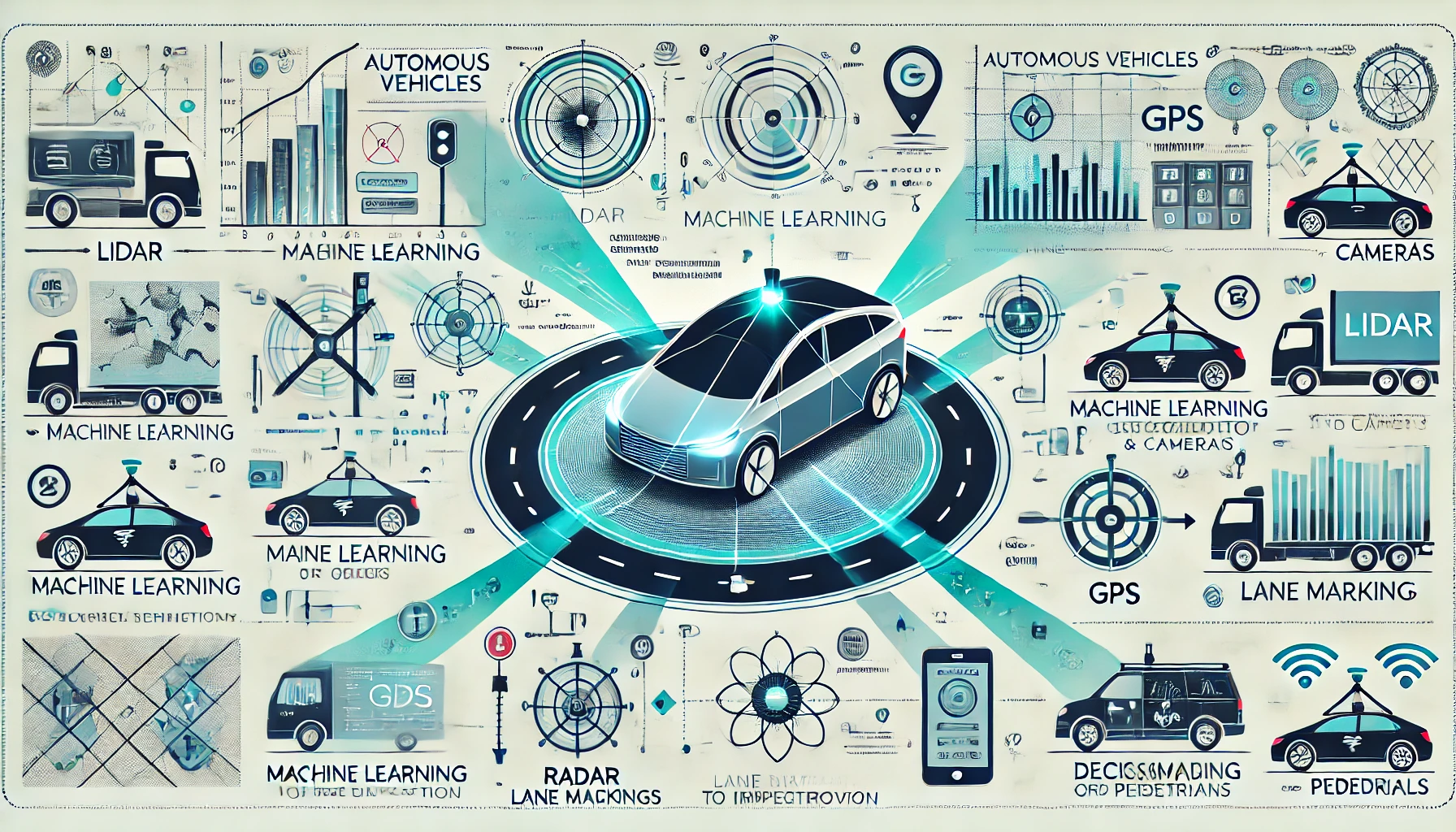
AI plays a central role in autonomous vehicle systems, enabling continuous learning and adaptation. Machine learning models process vast amounts of data collected during operation, improving decision-making over time. Computer vision systems interpret visual inputs from cameras, while sensor fusion combines data from LiDAR, radar, and ultrasonic sensors to create a comprehensive understanding of the vehicle’s surroundings. This multi-layered approach allows autonomous vehicles to respond to dynamic and unpredictable environments with high reliability.
#Levels of Autonomy
The Society of Automotive Engineers (SAE) defines six levels of driving automation, ranging from Level 0 (no automation) to Level 5 (full automation):
- Level 0: No automation; the human driver performs all driving tasks.
- Level 1: Driver assistance; the vehicle can control either steering or acceleration/deceleration, but not both simultaneously.
- Level 2: Partial automation; the vehicle can control both steering and acceleration/deceleration under certain conditions, but the human must remain engaged and monitor the environment.
- Level 3: Conditional automation; the vehicle can handle all aspects of driving in specific conditions, but the human must be ready to take control when requested.
- Level 4: High automation; the vehicle can operate autonomously in defined areas and conditions without human intervention, though it may not function outside those parameters.
- Level 5: Full automation; the vehicle can operate autonomously in all conditions and environments without any human input.
#History / Background
#Early Developments
The concept of autonomous vehicles dates back to the mid-20th century. One of the earliest milestones was the Linrrican Wonder, a radio-controlled car developed in 1925 by Houdina Radio Control. In the 1970s and 1980s, research institutions such as Carnegie Mellon University (CMU) and the Bundeswehr University Munich began experimenting with autonomous navigation using early AI and computer vision systems.
In 1986, CMU’s Navlab project developed one of the first autonomous vehicles, capable of navigating roads using camera-based guidance. This laid the foundation for modern autonomous driving research. During the same period, Japan’s Ministry of International Trade and Industry launched the Autonomous Vehicle Systems project, aiming to develop intelligent transportation systems.
#Modern Era
The 2000s marked a turning point with the DARPA Grand Challenges, a series of competitions that spurred innovation in autonomous vehicle technology. In 2004, no vehicle completed the course; by 2005, five vehicles finished the 132-mile desert route, with Stanford’s Stanley winning the challenge. This event catalyzed investment and accelerated development by major tech and automotive companies.
In 2010, Google launched its self-driving car project, later becoming Waymo in 2016. Tesla introduced its Autopilot system in 2014, bringing semi-autonomous features to consumer vehicles. By the mid-2010s, companies such as Uber, Cruise, and Zoox entered the space, focusing on ride-hailing and urban mobility solutions.
Regulatory frameworks began to evolve in response to these advancements. The U.S. National Highway Traffic Safety Administration (NHTSA) issued guidelines for autonomous vehicle testing and deployment, while the European Union established harmonized rules under the General Safety Regulation. Cities such as Singapore, San Francisco, and Phoenix became early testing grounds for commercial autonomous services.
#How It Works
#Sensor Suite
Autonomous vehicles rely on a suite of sensors to perceive their environment:
- LiDAR (Light Detection and Ranging): Uses laser pulses to create high-resolution 3D maps of surroundings, detecting objects up to 200 meters away with centimeter-level precision.
- RADAR (Radio Detection and Ranging): Measures the distance and velocity of objects using radio waves, effective in various weather conditions.
- Cameras: Provide visual data for object recognition, lane detection, and traffic sign interpretation. Often used in conjunction with deep learning models for semantic segmentation.
- Ultrasonic Sensors: Detect nearby objects at short range, commonly used for parking assistance and low-speed maneuvering.
- GPS and IMU (Inertial Measurement Unit): Provide positioning and orientation data, essential for navigation and dead reckoning when GPS signals are weak.
#Perception and Localization
Sensor data is processed by perception algorithms to identify and classify objects such as vehicles, pedestrians, cyclists, and road infrastructure. Computer vision models, often based on convolutional neural networks (CNNs), analyze camera feeds to recognize traffic signs, lane markings, and obstacles.
Simultaneously, the vehicle uses Simultaneous Localization and Mapping (SLAM) to build and update a map of its environment in real time. This allows the vehicle to determine its precise location even in areas without prior mapping.
#Path Planning and Control
Once the environment is understood, the autonomous system generates a safe and efficient path to the destination. Path planning occurs at multiple levels:
- Behavioral Planning: Decides the vehicle’s overall behavior, such as lane changes, merging, or yielding to emergency vehicles.
- Motion Planning: Computes the specific trajectory the vehicle should follow, considering kinematic constraints and dynamic obstacles.
- Vehicle Control: Translates planned trajectories into steering, acceleration, and braking commands executed by the vehicle’s actuators.
Machine learning models, particularly reinforcement learning, are increasingly used to optimize decision-making in complex scenarios by learning from vast datasets of real-world driving experiences.
#Human-Machine Interface
In semi-autonomous systems (Levels 1–3), the interface alerts the driver when intervention is required and provides situational awareness through dashboards, heads-up displays, and auditory warnings. For fully autonomous vehicles (Levels 4–5), the interface may include passenger infotainment systems and communication modules to interact with other vehicles and infrastructure.
#Important Facts
- Autonomous vehicles are expected to reduce traffic fatalities by up to 94% by eliminating human error, which accounts for over 90% of accidents.
- The global autonomous vehicle market is projected to reach $2.1 trillion by 2030, driven by advancements in AI and regulatory support.
- Waymo’s robotaxi service in Phoenix has completed over 1 million autonomous miles, one of the largest real-world deployments.
- Tesla’s Full Self-Driving (FSD) software uses neural networks trained on billions of miles of real-world driving data.
- Autonomous trucks are being tested for long-haul freight transport, potentially reducing fuel consumption and delivery times through platooning and optimized routing.
- Cybersecurity is a critical concern, as autonomous vehicles are vulnerable to hacking attacks targeting sensors, communication systems, and software updates.
- Ethical dilemmas, such as the "trolley problem," remain unresolved in AI decision-making, raising questions about how vehicles should prioritize safety in unavoidable accident scenarios.
#Timeline
Year Event 1925 Houdina Radio Control demonstrates the Linrrican Wonder, a radio-controlled car. 1977 Japan’s Tsukuba Mechanical Engineering Lab develops an autonomous vehicle using cameras and computer vision. 1986 Carnegie Mellon University launches the Navlab project, creating one of the first autonomous vehicles. 2004 DARPA Grand Challenge: No vehicle completes the 150-mile desert course. 2005 Stanford’s Stanley wins the DARPA Grand Challenge, completing a 132-mile route in under 7 hours. 2010 Google launches its self-driving car project. 2014 Tesla introduces Autopilot, a semi-autonomous driving system. 2016 nuTonomy deploys the first autonomous taxi service in Singapore. 2018 Waymo launches a commercial robotaxi service in Phoenix, Arizona. 2020 Cruise and Zoox begin testing autonomous ride-hailing services in San Francisco. 2023 China approves the first commercial deployment of Level 4 autonomous vehicles for public use.
#Related Terms
#FAQ
What does AI And Transportation: Autonomous Vehicles cover?
Explores how artificial intelligence shapes transportation and autonomous vehicles, covering practical use cases, benefits, limitations, and risks.
Why is AI And Transportation: Autonomous Vehicles important?
It helps readers understand key concepts, compare practical use cases, and evaluate how Technology decisions affect outcomes, risks, and implementation choices.
What should readers verify before applying this topic?
Readers should compare the benefits, limitations, data requirements, and related themes such as Transportation, Autonomou, Vehicle before using the ideas in real projects.
#References
- AI And Transportation: Autonomous Vehicles terminology and background research
- AI And Transportation: Autonomous Vehicles use cases, implementation examples, and limitations
- Technology best practices, standards, and risk guidance
- Transportation case studies, benchmarks, and current industry analysis


Comments
No comments yet. Start the discussion with a useful note.