

#Short Answer
Explores how artificial intelligence shapes transportation and smart mobility, covering practical use cases, benefits, limitations, and risks.
#Infobox
Artificial Intelligence (AI) in Transportation refers to the integration of AI technologies—such as machine learning, computer vision, and predictive analytics—into transportation systems to enhance efficiency, safety, sustainability, and user experience. It powers autonomous vehicles, traffic management, logistics optimization, and smart infrastructure, transforming mobility into a more intelligent and adaptive ecosystem.
AI in Transportation Overview Field: Transportation Engineering, Artificial Intelligence Key Technologies: Machine Learning, Computer Vision, IoT, Predictive Analytics, Edge Computing Applications: Autonomous Vehicles, Traffic Management, Smart Logistics, Predictive Maintenance Benefits: Reduced Congestion, Lower Emissions, Enhanced Safety, Operational Efficiency Challenges: Data Privacy, Cybersecurity, Regulatory Hurdles, Public Acceptance Major Players: Waymo, Tesla, Uber, Siemens Mobility, HERE Technologies, Bosch
#Overview
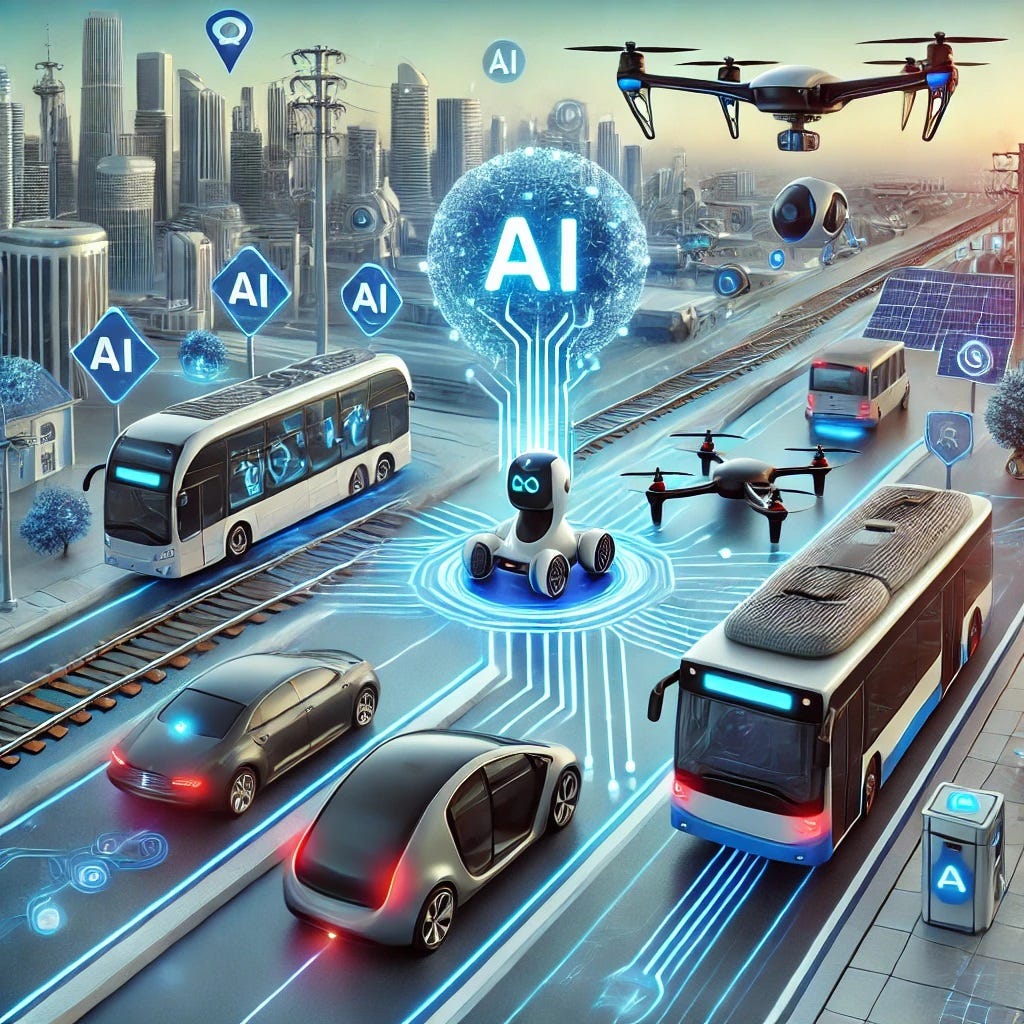
Artificial Intelligence in transportation represents a paradigm shift from traditional, human-dependent systems to autonomous, data-driven networks. AI enables vehicles and infrastructure to perceive, analyze, and respond to dynamic environments in real time. This transformation spans multiple domains, including road, rail, air, and maritime transport, with applications ranging from individual mobility solutions to large-scale urban traffic systems.
The core objective of AI in transportation is to create "smart mobility"—a concept that emphasizes connectivity, efficiency, and sustainability. By leveraging sensors, cameras, GPS, and communication networks, AI systems collect vast amounts of data, which are then processed using advanced algorithms to optimize routes, predict demand, prevent accidents, and reduce environmental impact. The integration of AI is particularly pivotal in addressing challenges such as urban congestion, climate change, and aging infrastructure.
#History / Background
The concept of AI in transportation traces its origins to early experiments in automation and robotics. In the 1980s and 1990s, researchers began exploring autonomous vehicle technology, with projects like the Autonomous Land Vehicle at Carnegie Mellon University and Japan’s Tsukuba Mechanical Engineering Laboratory demonstrating early forms of computer vision and path planning.
Significant milestones include:
- 1997: The first successful autonomous vehicle demonstration on public roads by Ernst Dickmanns in Germany.
- 2004: The DARPA Grand Challenge, a competition that spurred innovation in autonomous navigation and robotics.
- 2010: Google’s self-driving car project, later spun off as Waymo, began extensive testing.
- 2016: Tesla introduced Autopilot, a semi-autonomous driving system using AI and deep learning.
- 2020: The deployment of AI-powered traffic management systems in cities like Singapore and Pittsburgh.
These developments were accelerated by advancements in computing power, the availability of big data, and breakthroughs in neural networks, particularly deep learning. The convergence of AI with the Internet of Things (IoT) and 5G connectivity has further enabled real-time data exchange and intelligent decision-making.
#How It Works
#Core AI Technologies
AI in transportation relies on several foundational technologies:
- Machine Learning (ML): Used for pattern recognition, predictive modeling, and decision-making. Supervised learning trains models on labeled data (e.g., identifying traffic signs), while reinforcement learning enables systems to learn optimal behaviors through trial and error (e.g., optimizing traffic light timings).
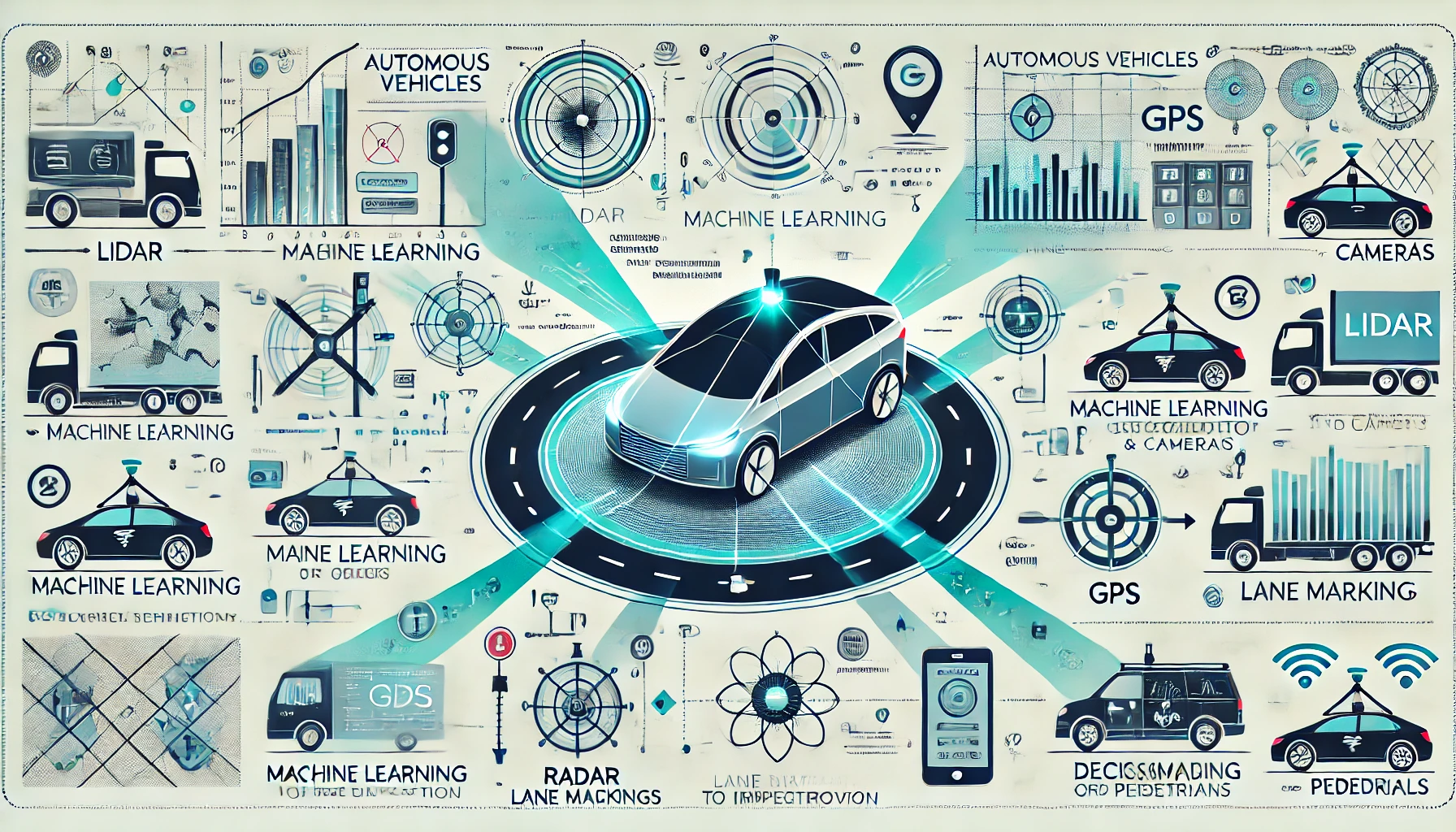
- Computer Vision: Enables vehicles and infrastructure to interpret visual data from cameras and LiDAR. It detects pedestrians, obstacles, lane markings, and traffic signals, forming the basis for autonomous driving.
- Natural Language Processing (NLP): Facilitates human-machine interaction, such as voice-activated navigation systems or chatbots for customer service in public transport.
- Predictive Analytics: Analyzes historical and real-time data to forecast traffic patterns, equipment failures, and demand surges, allowing proactive interventions.
- Edge Computing: Processes data locally on devices (e.g., vehicles or traffic sensors) to reduce latency and improve response times, critical for safety applications.
#Key Applications
Autonomous Vehicles
Self-driving cars and trucks use a combination of sensors (LiDAR, radar, cameras), AI algorithms, and high-definition maps to navigate roads. The AI system continuously processes sensor data to identify objects, predict their movements, and make real-time driving decisions. Levels of autonomy range from Level 2 (partial automation) to Level 5 (full automation), as defined by SAE International.
Traffic Management Systems
AI-powered traffic management centers analyze data from cameras, loop detectors, and connected vehicles to dynamically adjust signal timings, reroute traffic, and detect incidents. Systems like SCOOT (Split Cycle Offset Optimization Technique) and SCATS (Sydney Coordinated Adaptive Traffic System) use AI to minimize congestion and improve flow.
Smart Logistics and Fleet Management
AI optimizes supply chains by predicting delivery times, selecting optimal routes, and managing fleet operations. Machine learning models analyze weather, traffic, and demand data to reduce fuel consumption and delivery times. Companies like Amazon and FedEx use AI-driven route optimization to enhance efficiency.
Predictive Maintenance
AI monitors the health of vehicles and infrastructure (e.g., railways, bridges) by analyzing sensor data for anomalies. Machine learning models predict equipment failures before they occur, reducing downtime and maintenance costs. For example, AI can detect vibrations in train wheels that indicate potential defects.
Mobility-as-a-Service (MaaS)
AI enables integrated transportation platforms that combine public transit, ride-sharing, bike-sharing, and car rentals into a single, user-friendly service. Apps like Moovit and Citymapper use AI to provide real-time route suggestions and multi-modal trip planning.
#Important Facts
- Economic Impact: The global AI in transportation market is projected to reach $10.3 billion by 2027, growing at a CAGR of 17.8% from 2020 to 2027 (MarketsandMarkets).
- Safety Improvements: AI-powered advanced driver-assistance systems (ADAS) can reduce road accidents by up to 40% (World Health Organization).
- Environmental Benefits: AI-driven route optimization can cut fuel consumption and CO₂ emissions by 10–20% in logistics operations.
- Regulatory Landscape: Over 40 countries have established regulatory frameworks for autonomous vehicles, with the EU and U.S. leading in safety standards.
- Data Volume: A single autonomous vehicle can generate up to 4 terabytes of data per day, requiring advanced AI models for real-time processing.
- Public Trust: Surveys indicate that 63% of consumers are concerned about the safety of fully autonomous vehicles, highlighting the need for transparency and education.
#Timeline
Year Event 1980s Early autonomous vehicle research begins at universities and research labs. 1997 Ernst Dickmanns’ autonomous vehicle completes a 1,600 km journey in Germany. 2004 DARPA Grand Challenge inspires breakthroughs in autonomous navigation. 2010 Google launches its self-driving car project. 2016 Tesla introduces Autopilot, a semi-autonomous driving system. 2018 Waymo launches the first commercial autonomous ride-hailing service in Phoenix, Arizona. 2020 Singapore deploys AI-powered traffic management systems citywide. 2022 China approves the first fully autonomous robotaxis for public use in Beijing. 2023 European Union adopts the AI Act, setting global standards for AI in transportation.
#Related Terms
#FAQ
What does AI And Transportation: Smart Mobility cover?
Explores how artificial intelligence shapes transportation and smart mobility, covering practical use cases, benefits, limitations, and risks.
Why is AI And Transportation: Smart Mobility important?
It helps readers understand key concepts, compare practical use cases, and evaluate how Technology decisions affect outcomes, risks, and implementation choices.
What should readers verify before applying this topic?
Readers should compare the benefits, limitations, data requirements, and related themes such as Transportation, Smart, Mobility before using the ideas in real projects.
#References
- AI And Transportation: Smart Mobility terminology and background research
- AI And Transportation: Smart Mobility use cases, implementation examples, and limitations
- Technology best practices, standards, and risk guidance
- Transportation case studies, benchmarks, and current industry analysis



Comments
No comments yet. Start the discussion with a useful note.