

#Short Answer
AI: Everything You Need to Know explains the main ideas, common uses, benefits, limitations, and risks within Artificial Intelligence.
#Infobox
Artificial Intelligence Field Computer science Subfields Machine learning, Deep learning, Natural language processing, Computer vision, Robotics, Expert systems Key People Alan Turing, John McCarthy, Marvin Minsky, Geoffrey Hinton, Yann LeCun, Andrew Ng First Introduced 1956 (Dartmouth Conference) Major Contributions Turing Test, Neural Networks, Expert Systems, Reinforcement Learning, Generative AI Applications Autonomous vehicles, Medical diagnosis, Speech recognition, Recommendation systems, Fraud detection Ethical Concerns Bias, Privacy, Job displacement, Autonomous weapons, Misinformation
#Overview
Artificial Intelligence is a multidisciplinary field of computer science focused on creating systems capable of performing tasks that typically require human intelligence. These tasks include visual perception, speech recognition, decision-making, language translation, and problem-solving. AI systems are designed to analyze vast amounts of data, identify patterns, and make predictions or take actions with minimal human intervention.
The development of AI has been driven by advancements in computing power, the availability of large datasets, and breakthroughs in algorithms, particularly in the realms of machine learning and neural networks. AI technologies are broadly classified into two categories: narrow AI, which is designed for a specific task (e.g., facial recognition or chatbots), and artificial general intelligence (AGI), which aims to replicate human-like cognitive abilities across a wide range of tasks. As of 2024, most AI systems in use are narrow AI, while AGI remains a theoretical goal.
#Types of AI
- Reactive Machines: AI systems with no memory, reacting to current inputs (e.g., IBM's Deep Blue chess player).
- Limited Memory: Systems that use past data to inform decisions (e.g., self-driving cars).
- Theory of Mind: Hypothetical AI that understands human emotions and intentions (not yet achieved).
- Self-Aware AI: AI with consciousness and self-awareness (a futuristic concept).
#History / Background
The concept of artificial intelligence dates back to ancient myths and stories of artificial beings endowed with intelligence or consciousness. However, the modern field of AI began in the mid-20th century. Key milestones include:
- 1950: Alan Turing publishes "Computing Machinery and Intelligence," introducing the Turing Test as a criterion for machine intelligence.
- 1956: The term "Artificial Intelligence" is coined at the Dartmouth Conference, marking the official birth of AI as a field.
- 1958: John McCarthy develops the Lisp programming language, which becomes foundational for AI research.
- 1966: ELIZA, an early natural language processing program, is created by Joseph Weizenbaum.
- 1997: IBM's Deep Blue defeats world chess champion Garry Kasparov, demonstrating AI's potential in complex decision-making.
- 2011: IBM Watson wins Jeopardy!, showcasing AI's ability to understand and process human language.
- 2012: The rise of deep learning, driven by breakthroughs in neural networks, leads to significant improvements in image and speech recognition.
- 2016: AlphaGo, developed by DeepMind, defeats a world champion Go player, highlighting AI's advanced strategic capabilities.
- 2022: The release of Generative Pre-trained Transformers (GPT) models, such as ChatGPT, revolutionizes natural language processing and generative AI.
#How It Works
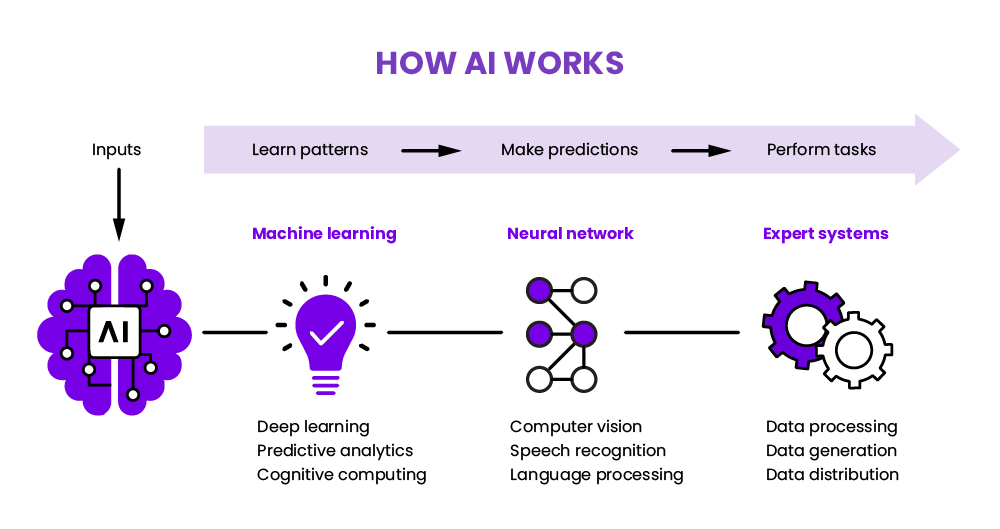
AI systems operate through a combination of algorithms, data, and computational power. The core methodologies include:
#Machine Learning
Machine learning (ML) is a subset of AI that enables systems to learn from data without explicit programming. ML algorithms identify patterns and make decisions based on input data. Key types of ML include:
- Supervised Learning: The model is trained on labeled data (e.g., spam detection, image classification).
- Unsupervised Learning: The model identifies patterns in unlabeled data (e.g., customer segmentation, anomaly detection).
- Reinforcement Learning: The model learns by interacting with an environment and receiving rewards or penalties (e.g., robotics, game-playing AI).
#Deep Learning
Deep learning is a specialized form of machine learning that uses artificial neural networks with multiple layers (hence "deep") to model complex patterns in data. These networks, inspired by the human brain, consist of interconnected nodes (neurons) that process information hierarchically. Key architectures include:
- Convolutional Neural Networks (CNNs): Optimized for image and video processing.
- Recurrent Neural Networks (RNNs): Designed for sequential data, such as time series or natural language.
- Transformers: Used in natural language processing tasks, enabling models like GPT to generate human-like text.
#Natural Language Processing
Natural Language Processing (NLP) enables machines to understand, interpret, and generate human language. Techniques include:
- Tokenization: Breaking text into words or phrases for analysis.
- Sentiment Analysis: Determining the emotional tone of a text.
- Machine Translation: Translating text between languages (e.g., Google Translate).
- Text Generation: Creating coherent and contextually relevant text (e.g., chatbots, content generation).
#Computer Vision
Computer vision focuses on enabling machines to interpret and make decisions based on visual input. Applications include:
- Object Detection: Identifying and locating objects in images or videos.
- Facial Recognition: Recognizing and verifying human faces.
- Medical Imaging: Assisting in diagnosing diseases from X-rays, MRIs, or CT scans.
- Autonomous Vehicles: Using cameras and sensors to navigate and avoid obstacles.
#Important Facts
- AI is not a single technology but a collection of techniques and methodologies.
- The global AI market is projected to reach $1.8 trillion by 2030, growing at a CAGR of 37.3% from 2023 to 2030.
- AI-powered tools like ChatGPT and DALL-E have democratized access to advanced AI capabilities.
- Ethical concerns around AI include bias in algorithms, privacy violations, and the potential for autonomous weapons.
- AI is transforming industries such as healthcare (diagnosis, drug discovery), finance (fraud detection, algorithmic trading), and manufacturing (predictive maintenance, robotics).
- The concept of the technological singularity suggests a future where AI surpasses human intelligence, leading to unpredictable societal changes.
#Timeline
Year Milestone 1950 Alan Turing proposes the Turing Test. 1956 Dartmouth Conference coins the term "Artificial Intelligence." 1966 ELIZA, an early chatbot, is developed. 1997 IBM's Deep Blue defeats Garry Kasparov in chess. 2011 IBM Watson wins Jeopardy!. 2012 Breakthroughs in deep learning lead to significant improvements in image recognition. 2016 AlphaGo defeats a world champion Go player. 2018 OpenAI releases GPT-1, the first in a series of groundbreaking language models. 2020 AI models like GPT-3 demonstrate advanced natural language understanding and generation. 2022 Stable Diffusion and DALL-E 2 enable high-quality image generation from text prompts. 2023 ChatGPT reaches 100 million users within two months of launch, highlighting the rapid adoption of generative AI.
#Related Terms
#FAQ
What does AI: Everything You Need To Know cover?
AI: everything you need to know covers practical examples, benefits, limitations, and important considerations for readers.
Why is AI: Everything You Need To Know important?
It helps readers understand key concepts, compare practical use cases, and evaluate how Artificial Intelligence decisions affect outcomes, risks, and implementation choices.
What should readers verify before applying this topic?
Readers should compare the benefits, limitations, data requirements, and related themes such as AI Applications, Automation, Future Technology before using the ideas in real projects.
#References
- AI: Everything You Need To Know terminology and background research
- AI: Everything You Need To Know use cases, implementation examples, and limitations
- Artificial Intelligence best practices, standards, and risk guidance
- AI Applications case studies, benchmarks, and current industry analysis


Comments
No comments yet. Start the discussion with a useful note.