

#Short Answer
AI Ethics is an interdisciplinary field that combines philosophy, computer science, law, and social sciences to address the ethical challenges posed by artificial intelligence. It seeks to answer critical questions such as:
#Infobox
#Overview
AI Ethics is an interdisciplinary field that combines philosophy, computer science, law, and social sciences to address the ethical challenges posed by artificial intelligence. It seeks to answer critical questions such as:
- How can AI systems be designed to avoid discrimination and bias?
- Who is responsible when an AI system causes harm?
- How can transparency be ensured in AI decision-making processes?
- What measures can protect user privacy in an AI-driven world?
The goal of AI ethics is not only to mitigate risks but also to harness AI's potential for the greater good, ensuring that technological advancements align with societal values and human dignity.
#Why AI Ethics Matters
AI systems influence critical aspects of life, including healthcare, finance, employment, and criminal justice. Without ethical guidelines, AI can perpetuate existing biases, invade privacy, and make decisions that are difficult to understand or challenge. Ethical AI promotes trust, inclusivity, and sustainability, ensuring that technological progress benefits everyone, not just a privileged few.
#History / Background
#Early Developments
The concept of AI ethics emerged alongside the development of artificial intelligence in the mid-20th century. Early pioneers like Alan Turing and Norbert Wiener raised concerns about the ethical implications of intelligent machines. In 1950, Turing proposed the famous Turing test, which sparked debates about machine intelligence and consciousness.
#Modern Era
The 21st century has seen a surge in AI ethics discussions due to the rapid advancement and widespread adoption of AI technologies. Key milestones include:
- 2016: The European Union released its Ethics Guidelines for Trustworthy AI, emphasizing human-centric values.
- 2018: The IEEE published its Ethically Aligned Design report, outlining principles for ethical AI development.
- 2019: The OECD adopted the OECD AI Principles, which promote inclusive growth and human-centered AI.
- 2020: The European Commission proposed the Artificial Intelligence Act, a regulatory framework for AI systems.
#How It Works
AI ethics is implemented through a combination of principles, frameworks, and practices designed to guide the development and deployment of AI systems. Key components include:
#Core Principles
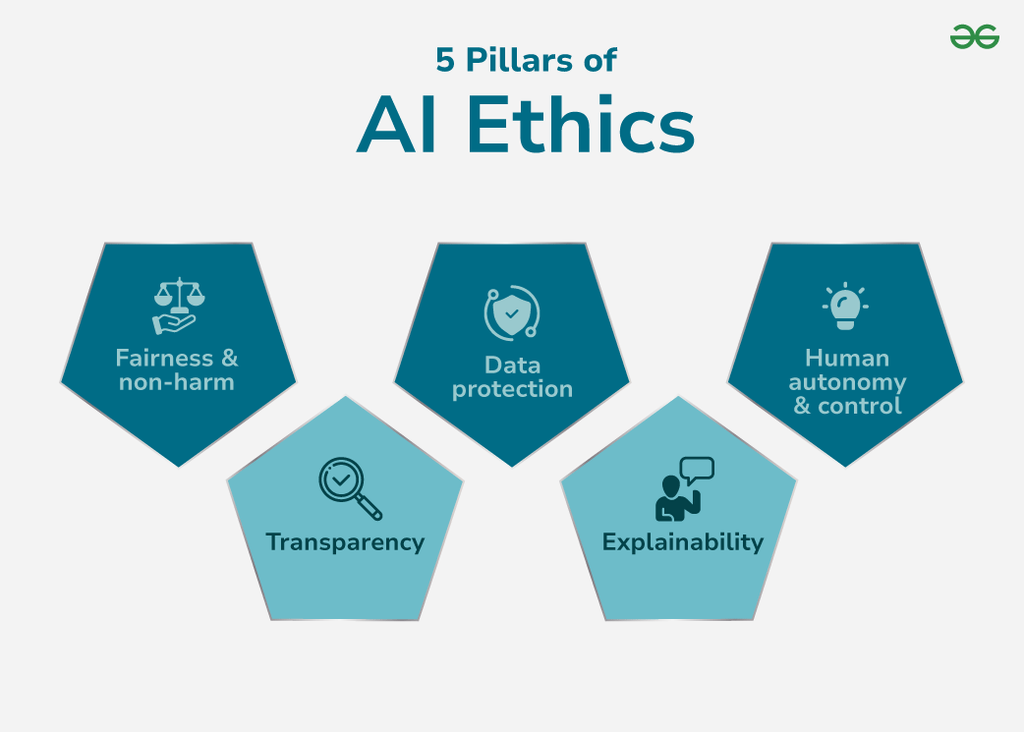
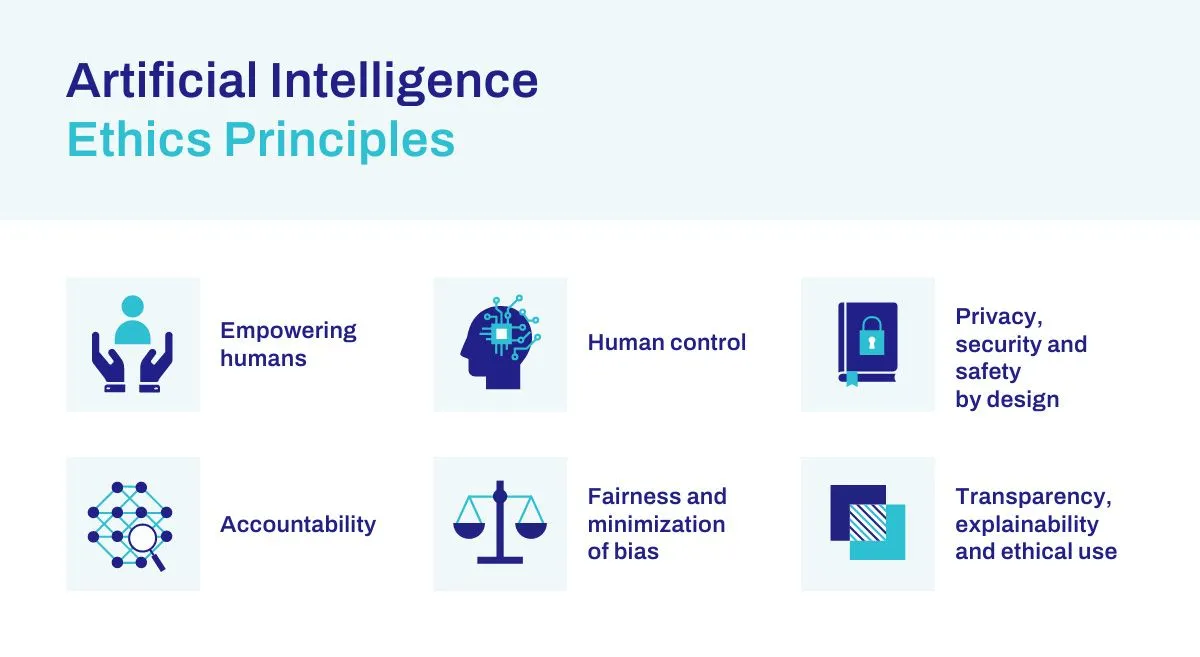
Several core principles underpin AI ethics:
Fairness:
AI systems should be designed to avoid discrimination and ensure equal opportunities for all individuals, regardless of race, gender, or socioeconomic status.
Transparency:
AI systems should be explainable, allowing users to understand how decisions are made. This includes providing clear documentation and reasoning for AI outputs.
Accountability:
Developers and organizations must take responsibility for the actions and outcomes of their AI systems. This includes implementing mechanisms for auditing and correcting errors.
Privacy:
AI systems should respect user privacy by minimizing data collection, ensuring secure storage, and obtaining informed consent for data usage.
Human-Centric Design:
AI should be developed to augment human capabilities rather than replace them, prioritizing human well-being and autonomy.
#Ethical Frameworks
Various frameworks have been proposed to operationalize AI ethics. Some of the most influential include:
- Asimov's Laws of Robotics: A set of fictional rules proposed by science fiction writer Isaac Asimov, which inspired real-world ethical discussions about AI governance.
- IEEE Global Initiative on Ethics of Autonomous Systems: A framework that emphasizes transparency, accountability, and human rights in AI development.
- EU Trustworthy AI Guidelines: A set of seven requirements for trustworthy AI, including human agency, technical robustness, and societal well-being.
#Implementation Practices
To put AI ethics into practice, organizations and developers can adopt the following strategies:
- Ethics Review Boards: Establish internal or external boards to assess the ethical implications of AI projects.
- Diverse Development Teams: Include individuals from diverse backgrounds to identify and mitigate biases in AI systems.
- Bias Audits: Regularly test AI systems for biases in data and algorithms, and correct any identified issues.
- Explainable AI (XAI): Use techniques like LIME (Local Interpretable Model-agnostic Explanations) and SHAP (SHapley Additive exPlanations) to make AI decisions more interpretable.
- User Feedback Mechanisms: Allow users to report concerns or errors, ensuring continuous improvement and accountability.
#Important Facts
- AI systems can inadvertently perpetuate biases present in their training data, leading to discriminatory outcomes.
- Transparency in AI is often challenging due to the complexity of machine learning models, particularly deep learning systems.
- Regulatory frameworks for AI ethics vary widely across countries, with some regions adopting strict guidelines while others lag behind.
- Ethical AI is not just a technical challenge but also a societal one, requiring collaboration between governments, businesses, and civil society.
- Public awareness and education about AI ethics are essential to foster informed decision-making and demand for ethical practices.
#Timeline
- Alan Turing proposes the
Alan Turing proposes the Turing test, sparking debates about machine intelligence.
- Early discussions on AI
Early discussions on AI ethics focus on the potential risks of intelligent machines.
- European Union releases its
European Union releases its Ethics Guidelines for Trustworthy AI.
- IEEE publishes the Ethically
IEEE publishes the Ethically Aligned Design report.
- OECD adopts the OECD
OECD adopts the OECD AI Principles.
- European Commission proposes t
European Commission proposes the Artificial Intelligence Act.
- Increased global focus on
Increased global focus on AI ethics, with more countries and organizations adopting ethical guidelines and regulations.
#Related Terms
#FAQ
What does AI Ethics For Dummies: A Beginner’s Overview cover?
AI ethics for dummies: a beginner’s overview covers practical examples, benefits, limitations, and important considerations for readers.
Why is AI Ethics For Dummies: A Beginner’s Overview important?
It helps readers understand key concepts, compare practical use cases, and evaluate how AI Ethics decisions affect outcomes, risks, and implementation choices.
What should readers verify before applying this topic?
Readers should compare the benefits, limitations, data requirements, and related themes such as Beginner Friendly, Ethics, Dummie before using the ideas in real projects.
#References
- AI Ethics For Dummies: A Beginner’s Overview terminology and background research
- AI Ethics For Dummies: A Beginner’s Overview use cases, implementation examples, and limitations
- AI Ethics best practices, standards, and risk guidance
- Beginner Friendly case studies, benchmarks, and current industry analysis


Comments
No comments yet. Start the discussion with a useful note.