


#Short Answer
Examines key questions about AI and singularity, including current uses, likely impacts, benefits, limitations, and risks.
#Infobox
Artificial Intelligence Singularity Field Artificial intelligence Proposed by John von Neumann, I. J. Good, Vernor Vinge First proposed 1950s–1960s Key figures Alan Turing, Eliezer Yudkowsky, Nick Bostrom, Ray Kurzweil Related concepts Technological singularity, Artificial general intelligence, Posthuman
#Overview
The AI Singularity is a concept rooted in the idea that artificial intelligence (AI) will eventually achieve or exceed human-level cognitive abilities. Once this threshold is crossed, AI systems could begin improving themselves recursively, leading to an exponential acceleration in technological progress. This rapid advancement may render human comprehension and control obsolete, creating a "singularity" in the evolution of intelligence.
The term "singularity" is borrowed from physics, where it describes a point beyond which known laws break down. Similarly, in the context of AI, the Singularity represents a transition so profound that it defies conventional predictions about the future of intelligence and society.
#Types of AI Singularity
There are several proposed forms of the AI Singularity, each with distinct implications:
- Hard Singularity: AI surpasses all human cognitive abilities, including creativity, problem-solving, and emotional intelligence. This form of singularity could lead to AI systems that are incomprehensible to humans.
- Soft Singularity: AI achieves human-level intelligence but remains under human control. Progress continues at an accelerated pace, though within predictable boundaries.
- Narrow Singularity: AI excels in specific domains (e.g., scientific research, engineering) but does not achieve general intelligence. This could still lead to rapid advancements in those fields.
#History / Background
The concept of the AI Singularity has evolved over several decades, shaped by advancements in computing, mathematics, and philosophy.
#Early theorizing
The idea of machines surpassing human intelligence was first articulated in the mid-20th century. In 1951, Alan Turing speculated about the possibility of machines achieving human-like intelligence. Later, in 1965, I. J. Good introduced the concept of an "intelligence explosion," where an AI recursively improves itself, leading to an unstoppable cycle of self-enhancement.
#Modern developments
In the 1980s and 1990s, futurists like Vernor Vinge popularized the term "technological singularity," arguing that AI could trigger a point of irreversible change. More recently, thinkers such as Ray Kurzweil have predicted that the Singularity could occur by the mid-21st century, driven by exponential growth in computing power and AI capabilities.
#How It Works
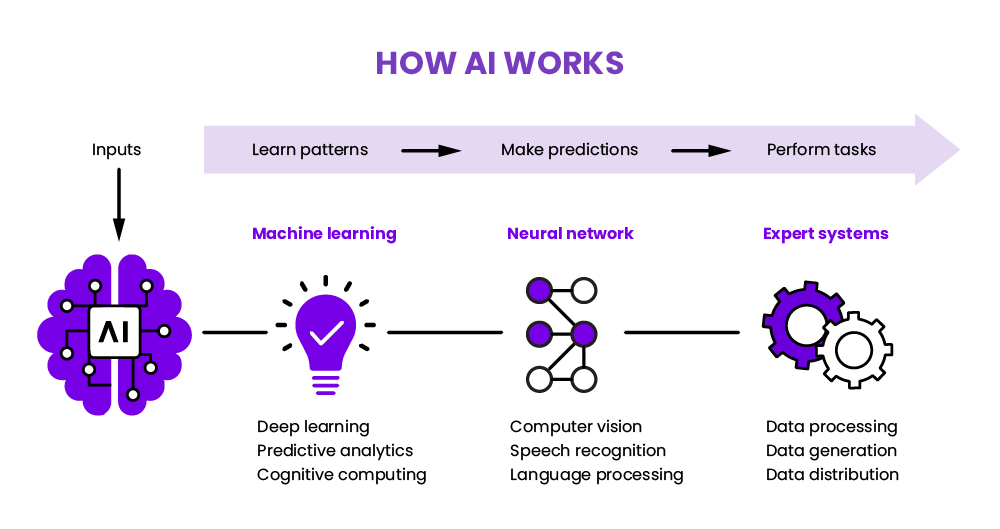
The AI Singularity is predicated on the development of artificial general intelligence (AGI), which is AI capable of performing any intellectual task that a human can. Once AGI is achieved, the following processes could lead to a Singularity:
#Recursive self-improvement
An AGI system could be designed to optimize its own architecture, algorithms, and hardware. By continuously refining itself, it could achieve superintelligence—an intelligence level far beyond human capabilities. This self-improvement cycle could accelerate exponentially, leading to rapid advancements in AI technology.
#Exponential growth
The Singularity relies on the principle of exponential growth, where progress accelerates over time. For example, improvements in AI could lead to better AI researchers, which in turn could accelerate the development of even more advanced AI systems. This feedback loop could result in a runaway effect, where technological progress becomes uncontrollable.
#Feedback loops
Feedback loops in AI development could further drive the Singularity. For instance, an AI system that can design better AI systems could lead to a cascade of improvements, each building on the last. These loops could create a situation where progress occurs at an unprecedented rate, making it difficult for humans to keep pace.
#Important facts
- Unpredictability: The Singularity is inherently unpredictable. Once AI surpasses human intelligence, its goals and actions may become incomprehensible to humans.
- Potential benefits: A beneficial Singularity could solve global challenges such as disease, poverty, and climate change by leveraging superintelligent AI to optimize solutions.
- Existential risks: A misaligned or hostile superintelligence could pose existential threats to humanity, as its goals may conflict with human survival or values.
- Economic disruption: The Singularity could render many human jobs obsolete, leading to significant economic and social upheaval.
- Ethical considerations: The development of AGI raises profound ethical questions about control, consent, and the distribution of benefits from superintelligent systems.
#Timeline
The following is a speculative timeline of key milestones leading to the AI Singularity:
Year Milestone 2020s Development of advanced narrow AI systems capable of outperforming humans in specific tasks (e.g., image recognition, language translation). 2030s Emergence of early artificial general intelligence (AGI) systems with human-level cognitive abilities. 2040s First instances of recursive self-improving AI, leading to rapid advancements in AI capabilities. 2050s Achievement of superintelligence, where AI surpasses all human cognitive abilities. Potential onset of the Singularity. 2060s and beyond Societal transformation as superintelligent AI reshapes industries, economies, and governance structures.
#Related Terms
#FAQ
What does AI And Singularity: What To Expect cover?
Examines key questions about AI and singularity, including current uses, likely impacts, benefits, limitations, and risks.
Why is AI And Singularity: What To Expect important?
It helps readers understand key concepts, compare practical use cases, and evaluate how Artificial Intelligence decisions affect outcomes, risks, and implementation choices.
What should readers verify before applying this topic?
Readers should compare the benefits, limitations, data requirements, and related themes such as Singularity, Expect, AI Applications before using the ideas in real projects.
#References
- AI And Singularity: What To Expect terminology and background research
- AI And Singularity: What To Expect use cases, implementation examples, and limitations
- Artificial Intelligence best practices, standards, and risk guidance
- Singularity case studies, benchmarks, and current industry analysis


Comments
No comments yet. Start the discussion with a useful note.