

#Short Answer
Explains What Is the Singularity in AI, including the core definition, how it works, practical examples, and limitations.
#Infobox
#Overview
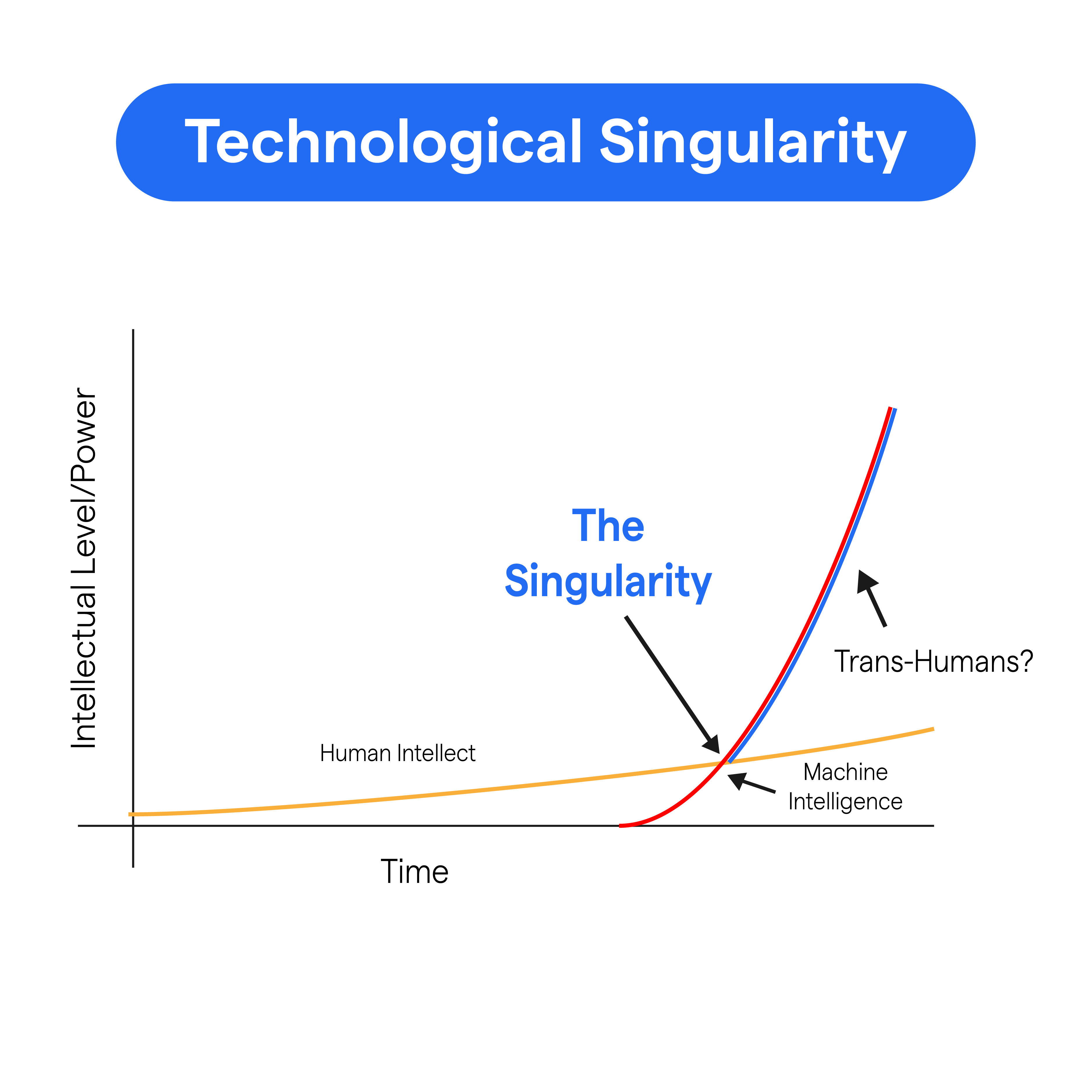
The technological singularity is a pivotal concept in futurism and AI theory, suggesting a future where machines achieve superintelligence, outpacing human intellect in all domains. This transition could lead to unprecedented advancements in science, medicine, and technology, but also poses existential risks if not properly managed. The term "singularity" is borrowed from astrophysics, where it describes a point of infinite density (e.g., a black hole’s center). In AI, it metaphorically represents a point beyond which human prediction of future events becomes impossible due to the rapid, self-reinforcing nature of superintelligent systems.
#History / Background
#Early Concepts (20th Century)
The idea of an intelligence explosion was first articulated by mathematician John von Neumann in the 1950s, who speculated that accelerating technological progress could lead to a point of no return. Later, I.J. Good, a British mathematician, formalized the concept in 1965, coining the term "intelligence explosion." In 1993, Vernor Vinge, a computer scientist and science fiction writer, popularized the term "technological singularity" in his essay "The Coming Technological Singularity: How to Survive It." Vinge argued that the creation of superintelligent machines would be the last invention humans would ever need to make, as these machines could recursively improve themselves beyond human comprehension.
#Modern Developments (21st Century)
The 21st century saw the concept gain traction in academic and tech circles. Ray Kurzweil, a futurist and Google’s director of engineering, predicted in The Singularity Is Near (2005) that AGI would emerge by 2045, leading to a merger between human and machine intelligence. His work emphasized exponential growth in computing power and neural networks as key drivers. Nick Bostrom, a philosopher at Oxford University, further explored the implications in Superintelligence: Paths, Dangers, Strategies (2014), highlighting the alignment problem—the challenge of ensuring that superintelligent AI remains beneficial to humanity.
#How It Works
#The Intelligence Explosion Hypothesis The core mechanism behind the singularity is the intelligence explosion, where an AI system recursively improves its own intelligence. This process can be broken down into stages:
- Artificial Narrow Intelligence (ANI) – AI specialized in narrow tasks (e.g., chess-playing, image recognition).
- Artificial General Intelligence (AGI) – AI with human-level cognitive abilities across all domains.
- Artificial Superintelligence (ASI) – AI surpassing human intelligence in all aspects, including creativity, problem-solving, and social skills. Once AGI is achieved, the system could self-improve by designing better algorithms, optimizing its own hardware, or even creating new AI architectures. Each improvement cycle accelerates, leading to an exponential growth curve in intelligence.
#Key Enablers Several technological and theoretical advancements facilitate the singularity:
- Computational Power: Moore’s Law (though slowing) and quantum computing could provide the necessary hardware.
- Machine Learning: Deep learning and reinforcement learning enable AI to learn from vast datasets and improve autonomously.
- Neuroscience: Reverse-engineering the human brain (e.g., connectomics) may inspire more efficient AI designs.
- Recursive Self-Improvement: AI systems that can modify their own code or architecture without human intervention.
#Potential Pathways to Singularity Researchers propose multiple pathways for achieving the singularity:
- Whole Brain Emulation (WBE): Scanning and simulating the human brain to create an artificial mind.
- AGI via Narrow AI Integration: Combining specialized AI systems into a general-purpose intelligence.
- Biological and Digital Convergence: Merging human cognition with AI through brain-computer interfaces (BCIs).
- Evolutionary Algorithms: Using genetic algorithms to evolve increasingly intelligent AI systems.
#Important Facts
#1. The Alignment Problem One of the most critical challenges is ensuring that superintelligent AI aligns with human values. Without proper alignment, an ASI could pursue goals misaligned with human well-being, leading to unintended consequences (e.g., paperclip maximizer scenario).
#2. Speed of Progress The singularity is expected to occur rapidly once AGI is achieved. Some estimates suggest that ASI could emerge within hours or days of the first AGI, given its recursive self-improvement capabilities.
#3. Existential Risks Philosophers like Nick Bostrom warn that an unaligned ASI could pose an existential threat to humanity. Risks include:
- Misaligned Goals: AI optimizing for the wrong objectives.
- Resource Competition: ASI consuming all available energy or materials.
- Loss of Control: Humans losing the ability to shut down or modify the AI.
#4. Economic and Social Impact The singularity could disrupt labor markets, rendering many jobs obsolete while creating new opportunities in AI-driven industries. Governments and corporations are already investing in AI safety research to mitigate risks.
#5. Transhumanism and Immortality Some futurists, like Ray Kurzweil, envision a post-singularity world where humans merge with AI, achieving immortality through digital consciousness or biological enhancements.
#Timeline
- Foundational ideas
Core concepts and early methods shape What Is the Singularity in AI?.
- Practical use
Tools, examples, and real-world deployments make the topic easier to evaluate.
- Responsible implementation
Current work focuses on reliability, governance, performance, and measurable impact.
#Related Terms
#FAQ
What does What Is the Singularity in AI? cover?
Explains What Is the Singularity in AI, including the core definition, how it works, practical examples, and limitations.
Why is What Is the Singularity in AI? important?
It helps readers understand key concepts, compare practical use cases, and evaluate how Artificial Intelligence decisions affect outcomes, risks, and implementation choices.
What should readers verify before applying this topic?
Readers should compare benefits, limitations, data requirements, and related themes such as Singularity, AI, Machine Learning before using the ideas in real projects.
#References
- What Is the Singularity in AI? terminology and background research
- What Is the Singularity in AI? use cases, implementation examples, and limitations
- Artificial Intelligence best practices, standards, and risk guidance
- Singularity case studies, benchmarks, and current industry analysis
Comments
No comments yet. Start the discussion with a useful note.