

#Short Answer
Explains What Is Bard, including the core definition, how it works, practical examples, and limitations.
#Infobox
#Overview
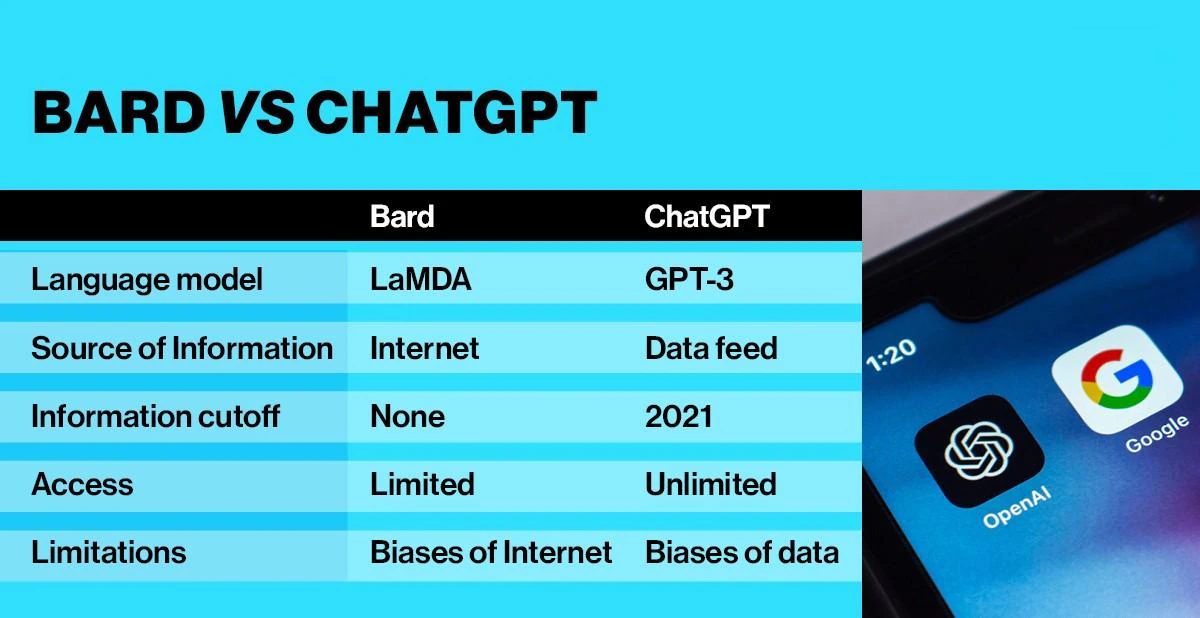
Bard is an AI-powered chatbot developed by Google, serving as a conversational interface for users to interact with generative artificial intelligence. Unlike traditional search engines that provide links, Bard generates human-like responses to queries, enabling users to obtain concise explanations, summaries, and creative content. It is built on Google’s proprietary language models, initially LaMDA (Language Model for Dialogue Applications), and later transitioned to PaLM 2, enhancing its reasoning, coding, and multilingual capabilities. Bard is positioned as a complement to Google Search, offering a more interactive and conversational experience. It can assist with tasks such as drafting emails, generating ideas, solving mathematical problems, and providing real-time updates on topics like news, science, and technology. The chatbot is designed to be accessible via web browsers and integrates seamlessly with other Google services, including Google Workspace.
#History / Background
#Origins and Development The development of Bard traces back to Google’s long-standing research in natural language processing (NLP) and machine learning. Google’s AI research division, Google Brain, and DeepMind have contributed significantly to advancements in large language models. The initial breakthrough came with LaMDA, introduced in 2021, which demonstrated the ability to engage in open-ended, coherent conversations across a wide range of topics. LaMDA was trained on vast amounts of text data, enabling it to understand context, nuance, and even humor. However, its deployment was initially limited to internal testing and select partnerships due to concerns about accuracy, bias, and safety.
#Public Launch Google officially announced Bard on February 6, 2023, as a conversational AI service powered by LaMDA. The announcement coincided with the growing public interest in generative AI tools like ChatGPT, which had gained widespread attention for its ability to generate human-like text. Bard was positioned as Google’s response to this trend, emphasizing its real-time information retrieval capabilities and integration with Google’s vast knowledge base. Bard was initially launched in a limited capacity, with access restricted to a small group of users in the United States and the United Kingdom. This phased rollout allowed Google to gather feedback and refine the model’s responses before expanding availability.
#Transition to PaLM 2 In May 2023, Google announced that Bard would transition from LaMDA to PaLM 2, a more advanced language model. PaLM 2 was trained on a larger and more diverse dataset, improving its performance in reasoning, coding, and multilingual tasks. This transition also enabled Bard to support a broader range of languages and provide more accurate and contextually relevant responses.
#Global Expansion Following its initial launch, Google expanded Bard’s availability to additional countries and languages. By late 2023, Bard was accessible in over 180 countries and supported more than 40 languages. Google also introduced new features, such as image generation (via integration with Imagen 2) and support for extensions that allow users to interact with third-party services like Google Maps, YouTube, and Flights.
#How It Works
#Core Technology Bard operates on large language models (LLMs), which are trained on massive datasets comprising text from books, articles, websites, and other sources. These models use transformer architectures, a type of neural network that excels at processing sequential data, such as text. The transformer architecture allows Bard to understand context, generate coherent responses, and maintain conversational flow.
#Training Process
- Data Collection: The model is trained on a diverse dataset that includes text from the internet, books, and other publicly available sources. This data is filtered to remove harmful, biased, or irrelevant content.
- Pre-training: The model learns to predict the next word in a sequence, enabling it to generate text that resembles human writing.
- Fine-tuning: The model is further refined using human feedback and reinforcement learning to improve accuracy, reduce bias, and align responses with user expectations.
- Safety and Alignment: Google implements safety measures to mitigate risks such as generating harmful content, spreading misinformation, or enabling malicious use. This includes content moderation, bias detection, and user feedback loops.
#Response Generation When a user inputs a query, Bard processes the text to understand the intent and context. It then generates a response by predicting the most likely sequence of words that aligns with the input. The response is dynamically generated, meaning it can vary slightly between interactions for the same query. Bard also incorporates real-time information retrieval by fetching data from the web, ensuring that responses are up-to-date. This is particularly useful for queries related to news, weather, sports, and other time-sensitive topics.
#Multimodal Capabilities In addition to text-based interactions, Bard supports multimodal inputs and outputs. Users can upload images, and Bard can analyze them to provide descriptions, answer questions about the content, or generate related text. For example, a user might upload a photo of a plant and ask Bard to identify the species or suggest care instructions. Bard also integrates with Google’s Imagen 2 model to generate images based on text prompts, further expanding its creative capabilities.
#Important Facts
- Real-Time Information: Unlike static AI models, Bard can fetch and incorporate real-time data from the internet, making it useful for queries about current events, weather, and stock prices.
- Multilingual Support: Bard supports over 40 languages, including English, Spanish, French, German, Hindi, Japanese, and Chinese, making it accessible to a global audience.
- Coding Assistance: Bard can generate, explain, and debug code in multiple programming languages, including Python, JavaScript, and C++. It can also assist with algorithm design and problem-solving.
- Creative Writing: Users can leverage Bard to generate poems, stories, scripts, and marketing copy. It can also help with brainstorming ideas and refining drafts.
- Integration with Google Services: Bard integrates with Google Workspace, allowing users to draft emails in Gmail, create documents in Google Docs, and generate slides in Google Slides.
- Privacy and Security: Google emphasizes user privacy, stating that Bard does not store personal data from conversations. However, conversations may be reviewed for quality and safety purposes.
- Ethical Considerations: Google has implemented safeguards to prevent Bard from generating harmful, misleading, or biased content. Users can provide feedback to improve the model’s responses.
- Accessibility: Bard is designed to be user-friendly, with a simple interface that requires no technical expertise to use. It is available on both desktop and mobile devices.
#Timeline
- Foundational ideas
Core concepts and early methods shape What Is Bard?.
- Practical use
Tools, examples, and real-world deployments make the topic easier to evaluate.
- Responsible implementation
Current work focuses on reliability, governance, performance, and measurable impact.
#Related Terms
#FAQ
What does What Is Bard? cover?
Explains What Is Bard, including the core definition, how it works, practical examples, and limitations.
Why is What Is Bard? important?
It helps readers understand key concepts, compare practical use cases, and evaluate how Artificial Intelligence decisions affect outcomes, risks, and implementation choices.
What should readers verify before applying this topic?
Readers should compare benefits, limitations, data requirements, and related themes such as Bard, AI, Machine Learning before using the ideas in real projects.
#References
- What Is Bard? terminology and background research
- What Is Bard? use cases, implementation examples, and limitations
- Artificial Intelligence best practices, standards, and risk guidance
- Bard case studies, benchmarks, and current industry analysis


Comments
No comments yet. Start the discussion with a useful note.