

#Short Answer
Explains What Is the History of AI, including the core definition, how it works, practical examples, and limitations.
#Infobox
#Overview
Artificial Intelligence (AI) is a branch of computer science focused on creating systems capable of performing tasks that typically require human intelligence. These tasks include reasoning, learning, perception, problem-solving, and decision-making. AI systems are designed to analyze vast amounts of data, recognize patterns, and make predictions or decisions with minimal human intervention. The field of AI has evolved significantly since its inception, transitioning from theoretical concepts to practical applications that permeate modern society. From virtual assistants like Siri and Alexa to advanced medical diagnostics and autonomous vehicles, AI has become an integral part of daily life. Its development has been driven by advancements in computing power, algorithmic innovations, and the availability of large datasets. AI can be broadly categorized into two types: Narrow AI (or Weak AI), which is designed for specific tasks, and General AI (or Strong AI), which aims to replicate human-like intelligence across a wide range of activities. While Narrow AI is already prevalent in various industries, General AI remains a theoretical goal with ongoing research.
#History / Background
#Early Concepts and Myths (Ancient Times – 19th Century)
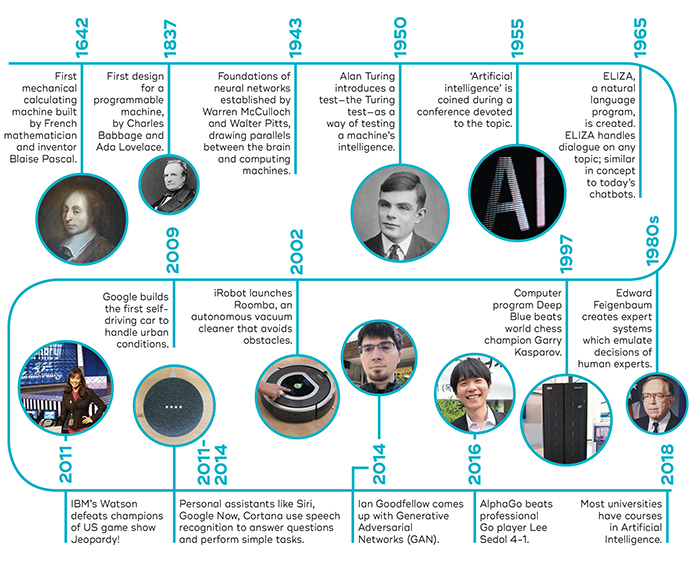
The idea of artificial beings with intelligence or consciousness dates back to ancient civilizations. Greek myths featured automatons like the bronze giant Talos, while Chinese and Egyptian legends described mechanical servants. Philosophers such as Aristotle explored logical reasoning, laying early groundwork for AI. In the 17th century, philosopher and mathematician René Descartes pondered whether machines could think, while Gottfried Wilhelm Leibniz envisioned a universal calculus of reasoning. The 19th century saw the creation of Charles Babbage’s Analytical Engine, an early mechanical computer, and Ada Lovelace’s notes on its potential for symbolic computation—often regarded as the first algorithm intended for a machine.
#Foundations of AI (Early 20th Century)
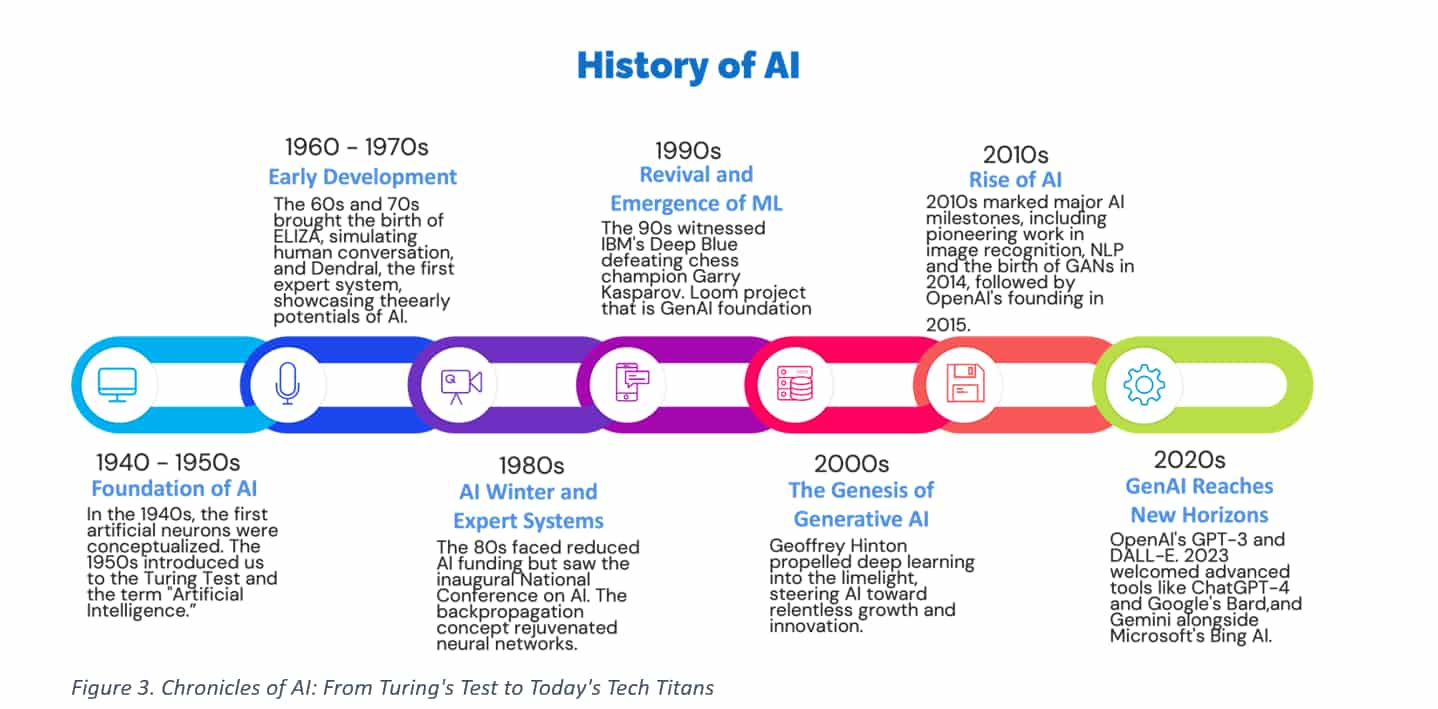
The 20th century marked a turning point with the formalization of logic and computation. Alan Turing’s 1936 paper on the Turing Machine introduced the concept of a universal computing device, while his 1950 paper "Computing Machinery and Intelligence" proposed the Turing Test as a criterion for machine intelligence. In 1943, Warren McCulloch and Walter Pitts developed the first mathematical model of a neural network, simulating the human brain’s structure. This laid the foundation for connectionism, a key AI paradigm.
#The Birth of AI (1956)
The term "Artificial Intelligence" was coined in 1956 at the Dartmouth Conference, organized by John McCarthy, Marvin Minsky, Nathaniel Rochester, and Claude Shannon. This event is widely regarded as the birth of AI as a formal academic discipline. Early AI research focused on symbolic reasoning, problem-solving, and search algorithms. Key developments included:
- Logic Theorist (1956): Developed by Allen Newell and Herbert Simon, it proved mathematical theorems using symbolic logic.
- General Problem Solver (1957): An early AI program designed to mimic human problem-solving strategies.
- ELIZA (1966): An early natural language processing program created by Joseph Weizenbaum, simulating a psychotherapist.
#The AI Winter and Revival (1970s – 1990s)
Despite early optimism, AI research faced significant challenges, including limited computational power and unrealistic expectations. The AI Winter (1970s–1980s) saw reduced funding and interest due to failures in delivering on ambitious promises. However, progress continued in specialized areas:
- Expert Systems (1980s): Programs like MYCIN (for medical diagnosis) and DENDRAL (for chemical analysis) demonstrated AI’s practical utility.
- Machine Learning (1980s–1990s): Geoffrey Hinton’s work on backpropagation revitalized neural networks, while Tom Mitchell’s definition of machine learning as "the study of computer algorithms that improve automatically through experience" became foundational.
- IBM’s Deep Blue (1997): The first AI system to defeat a world chess champion (Garry Kasparov), showcasing AI’s potential in complex decision-making.
#The Modern AI Era (2000s – Present)
The 21st century has witnessed an AI renaissance, driven by:
- Big Data: The explosion of digital data enabled more robust training of AI models.
- Computational Power: Advances in GPUs and TPUs accelerated training of deep learning models.
- Algorithmic Innovations: Breakthroughs in deep learning, reinforcement learning, and transformers revolutionized AI capabilities. Key milestones include:
- 2011: IBM’s Watson defeated human champions on Jeopardy!
- 2012: AlexNet, a deep convolutional neural network, achieved record accuracy in image recognition.
- 2016: AlphaGo (by DeepMind) defeated a world champion Go player, surpassing human intuition.
- 2020s: The rise of generative AI models like DALL·E, Stable Diffusion, and ChatGPT, capable of creating human-like text, images, and code.
#How It Works
#Core Principles of AI AI systems operate based on several fundamental principles:
- Data-Driven Learning:
- Supervised Learning: Models are trained on labeled data (e.g., classifying emails as spam or not).
- Unsupervised Learning: Models identify patterns in unlabeled data (e.g., customer segmentation).
- Reinforcement Learning: Agents learn by interacting with an environment and receiving rewards (e.g., AlphaGo).
- Algorithms and Models:
- Neural Networks: Inspired by the human brain, these consist of interconnected layers of nodes (neurons) that process data hierarchically.
- Deep Learning: A subset of machine learning using multi-layered neural networks (e.g., CNNs for images, RNNs for sequences).
- Symbolic AI: Uses logical rules and knowledge representations (e.g., expert systems).
- Natural Language Processing (NLP): - Enables machines to understand, generate, and translate human language (e.g., chatbots, translation services). - Techniques include word embeddings (Word2Vec, GloVe) and transformers (BERT, GPT).
- Computer Vision: - Allows machines to interpret visual data (e.g., facial recognition, autonomous driving). - Uses convolutional neural networks (CNNs) to process images and videos.
- Robotics: - Combines AI with mechanical systems to perform physical tasks (e.g., manufacturing robots, drones).
#Key Technologies
- Machine Learning (ML): Algorithms that improve with experience.
- Deep Learning: Neural networks with many layers, enabling complex pattern recognition.
- Generative AI: Models that create new content (text, images, audio) based on training data.
- Edge AI: Deploying AI models on local devices (e.g., smartphones) for real-time processing.
#Important Facts
- AI is not new: The concept dates back to ancient myths, but modern AI began in the mid-20th century.
- AI is everywhere: From recommendation systems (Netflix, Amazon) to fraud detection (credit cards), AI powers countless applications.
- AI can be biased: Training data often reflects societal biases, leading to discriminatory outcomes (e.g., facial recognition inaccuracies for certain demographics).
- AI lacks common sense: While advanced in specific tasks, AI struggles with general knowledge and contextual understanding.
- AI and jobs: While AI automates repetitive tasks, it also creates new roles in AI development, ethics, and oversight.
- AI in healthcare: Used for drug discovery, diagnostic imaging, and personalized treatment plans.
- AI ethics: Concerns include privacy, job displacement, autonomous weapons, and the alignment of AI goals with human values.
#Timeline
- Foundational ideas
Core concepts and early methods shape What Is the History of AI?.
- Practical use
Tools, examples, and real-world deployments make the topic easier to evaluate.
- Responsible implementation
Current work focuses on reliability, governance, performance, and measurable impact.
#Related Terms
#FAQ
What does What Is the History of AI? cover?
Explains What Is the History of AI, including the core definition, how it works, practical examples, and limitations.
Why is What Is the History of AI? important?
It helps readers understand key concepts, compare practical use cases, and evaluate how AI Trends decisions affect outcomes, risks, and implementation choices.
What should readers verify before applying this topic?
Readers should compare benefits, limitations, data requirements, and related themes such as History, AI, Machine Learning before using the ideas in real projects.
#References
- What Is the History of AI? terminology and background research
- What Is the History of AI? use cases, implementation examples, and limitations
- AI Trends best practices, standards, and risk guidance
- History case studies, benchmarks, and current industry analysis


Comments
No comments yet. Start the discussion with a useful note.