


#Short Answer
Explains What Is the Future of AI, including the core definition, how it works, practical examples, and limitations.
#Infobox
#Overview
The future of artificial intelligence is poised to redefine human civilization, merging computational power with human cognition to solve complex problems. AI is transitioning from narrow applications—such as image recognition and chatbots—to more general and autonomous systems capable of reasoning, creativity, and decision-making. This evolution is driven by exponential growth in data availability, computational resources, and algorithmic innovations. AI’s integration into society is expected to enhance productivity, improve healthcare diagnostics, optimize logistics, and personalize education. However, it also raises profound questions about job markets, ethical governance, and the balance between human agency and machine autonomy. As AI systems become more advanced, they may achieve artificial general intelligence (AGI), potentially surpassing human capabilities in most economically valuable work. The trajectory of AI development is not predetermined; it depends on technological breakthroughs, regulatory frameworks, public acceptance, and international cooperation. The future of AI will likely be a blend of utopian advancements and dystopian risks, necessitating proactive measures to ensure alignment with human values.
#History / Background
#Early Foundations (1950s–1980s)
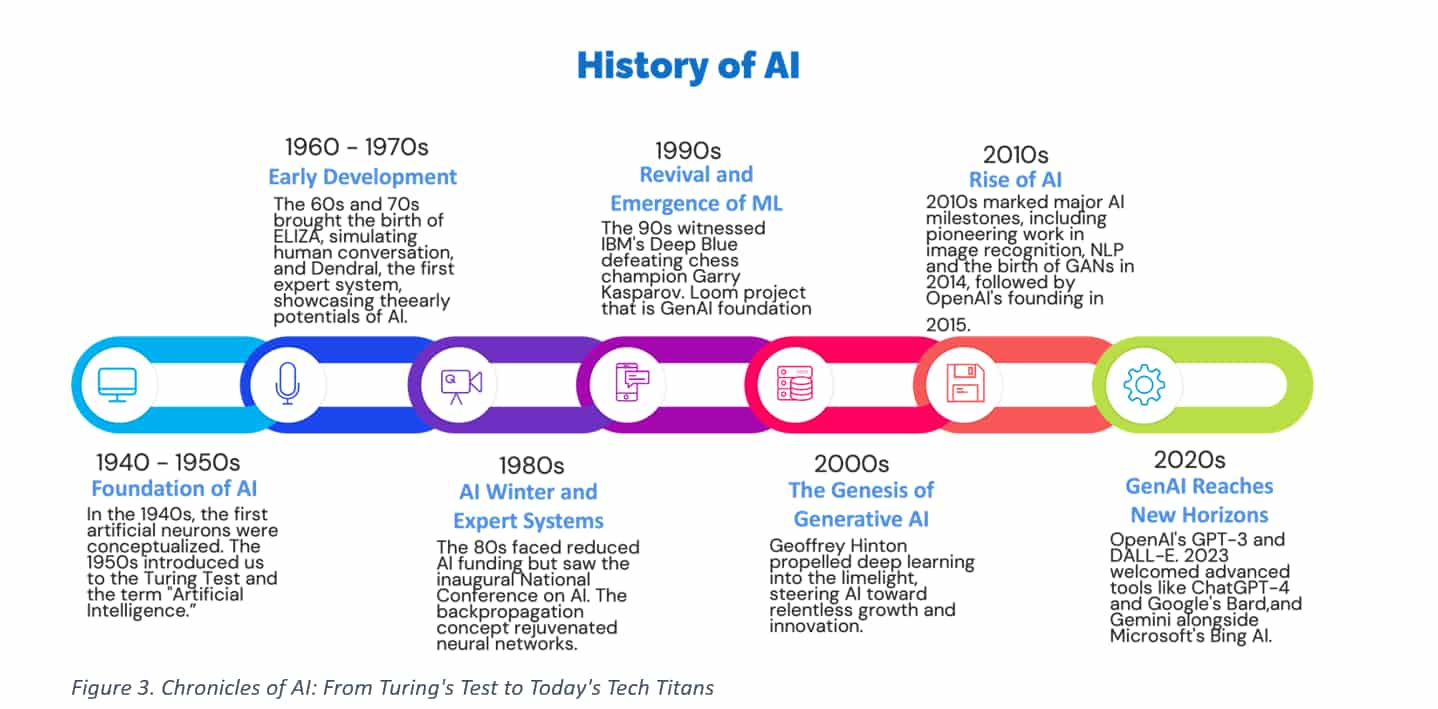
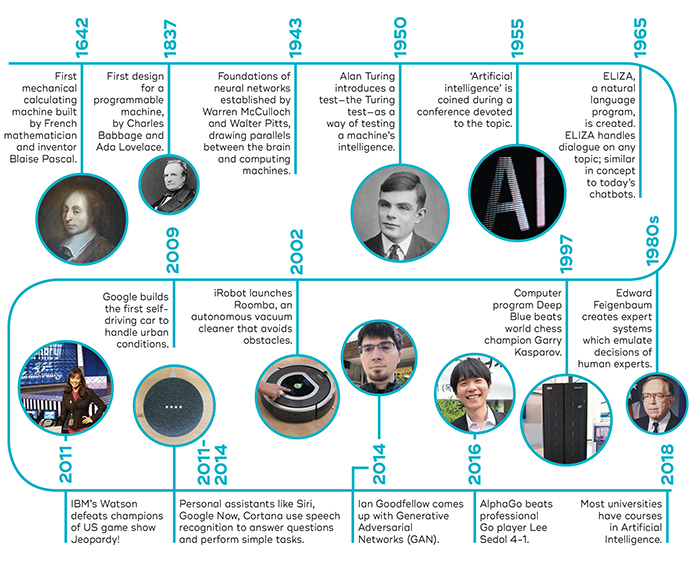
The concept of artificial intelligence dates back to the mid-20th century. In 1950, Alan Turing proposed the "Turing Test" as a criterion for machine intelligence. The term "artificial intelligence" was coined in 1956 at the Dartmouth Conference, where pioneers like John McCarthy, Marvin Minsky, and Claude Shannon laid the groundwork for the field. Early AI systems were rule-based and lacked learning capabilities. Programs like ELIZA (1966), a natural language processing chatbot, demonstrated the potential for human-machine interaction but were limited in scope. The 1970s and 1980s saw the rise of expert systems, which mimicked human decision-making in specific domains, such as medical diagnosis.
#The AI Winter and Revival (1990s–2010s)
Despite initial optimism, AI faced periods of reduced funding and interest, known as "AI winters," due to unmet expectations and technological limitations. However, advancements in computing power and data storage in the 1990s reignited progress. Key milestones included IBM’s Deep Blue defeating world chess champion Garry Kasparov in 1997 and the development of machine learning algorithms that improved with data. The 2010s marked a turning point with the advent of deep learning, powered by neural networks with multiple layers. Breakthroughs such as AlexNet’s victory in the ImageNet competition (2012) demonstrated the power of convolutional neural networks (CNNs) in image recognition. Concurrently, the availability of large datasets and cloud computing enabled scalable AI applications.
#The Modern Era (2020s–Present)
The 2020s have witnessed the rapid deployment of AI across industries, fueled by advances in generative AI, reinforcement learning, and multimodal systems. Models like GPT-3 (2020) and DALL·E (2021) showcased the ability of AI to generate human-like text and images, respectively. The rise of transformer architectures has revolutionized natural language processing, enabling applications such as real-time translation, content creation, and conversational agents. AI has become a cornerstone of digital transformation, with applications in finance (algorithmic trading), healthcare (drug discovery), transportation (self-driving cars), and entertainment (personalized recommendations). Governments and corporations are investing heavily in AI research, with countries like the United States, China, and the European Union competing for technological leadership.
#How It Works
#Core Technologies
- Machine Learning (ML) ML enables systems to learn from data without explicit programming. Supervised learning uses labeled data to train models, while unsupervised learning identifies patterns in unlabeled data. Reinforcement learning (RL) trains agents to make sequences of decisions by rewarding desired outcomes.
- Deep Learning A subset of ML, deep learning employs artificial neural networks with many layers (hence "deep") to model complex patterns. Convolutional neural networks (CNNs) excel in image and video processing, while recurrent neural networks (RNNs) and transformers handle sequential data like text.
- Natural Language Processing (NLP) NLP bridges the gap between human language and machine understanding. Techniques include tokenization, sentiment analysis, and language modeling. Transformer models like BERT and GPT leverage attention mechanisms to process context in language.
- Computer Vision AI systems analyze and interpret visual data from the world. Applications include facial recognition, autonomous vehicle navigation, and medical imaging. Techniques such as object detection and segmentation rely on CNNs and other deep learning models.
- Robotics AI-driven robotics combines perception, decision-making, and actuation. Robots use sensors to gather data, AI algorithms to interpret it, and actuators to perform tasks. Examples include industrial robots, drones, and humanoid robots like Boston Dynamics’ Atlas.
#Training and Inference AI systems undergo two primary phases:
- Training: Models are fed large datasets to learn patterns and relationships. This process requires significant computational power and is often conducted on GPUs or TPUs.
- Inference: Once trained, models make predictions or decisions on new, unseen data. Inference can occur in real-time or batch mode, depending on the application.
#Challenges in AI Development
- Data Quality: AI models are only as good as the data they are trained on. Biased, incomplete, or noisy data can lead to inaccurate or unfair outcomes.
- Computational Resources: Training advanced models demands substantial energy and hardware, raising concerns about sustainability and accessibility.
- Explainability: Many AI models, particularly deep learning systems, operate as "black boxes," making it difficult to interpret their decisions.
- Ethical Considerations: Issues such as privacy invasion, algorithmic bias, and autonomous weapons require careful regulation and oversight.
#Important Facts
- AI Market Growth: The global AI market is projected to reach $1.8 trillion by 2030, growing at a compound annual growth rate (CAGR) of 37.3% from 2023 to 2030.
- Job Market Impact: According to the World Economic Forum, AI is expected to displace 85 million jobs by 2025 but create 97 million new roles, resulting in a net gain of 12 million jobs.
- Healthcare Applications: AI can analyze medical images with accuracy comparable to or exceeding human experts, aiding in early disease detection such as cancer and diabetic retinopathy.
- Climate Change: AI optimizes energy consumption in smart grids, predicts weather patterns, and accelerates climate modeling, contributing to sustainability efforts.
- Autonomous Vehicles: Companies like Tesla, Waymo, and Cruise are developing self-driving cars, with Level 4 autonomy (fully autonomous under certain conditions) expected to become commercially viable by the late 2020s.
- Generative AI: Tools like MidJourney and Stable Diffusion have democratized content creation, enabling users to generate high-quality images, music, and text from simple prompts.
- AI in Education: Adaptive learning platforms use AI to personalize education, identifying student strengths and weaknesses to tailor instruction.
- Ethical AI Frameworks: The European Union’s AI Act (2024) is the first comprehensive legal framework for AI, classifying systems by risk level and imposing strict regulations on high-risk applications.
#Timeline
- Foundational ideas
Core concepts and early methods shape What Is the Future of AI?.
- Practical use
Tools, examples, and real-world deployments make the topic easier to evaluate.
- Responsible implementation
Current work focuses on reliability, governance, performance, and measurable impact.
#Related Terms
#FAQ
What does What Is the Future of AI? cover?
Explains What Is the Future of AI, including the core definition, how it works, practical examples, and limitations.
Why is What Is the Future of AI? important?
It helps readers understand key concepts, compare practical use cases, and evaluate how AI Trends decisions affect outcomes, risks, and implementation choices.
What should readers verify before applying this topic?
Readers should compare benefits, limitations, data requirements, and related themes such as Future, AI, Machine Learning before using the ideas in real projects.
#References
- What Is the Future of AI? terminology and background research
- What Is the Future of AI? use cases, implementation examples, and limitations
- AI Trends best practices, standards, and risk guidance
- Future case studies, benchmarks, and current industry analysis

Comments
No comments yet. Start the discussion with a useful note.