

#Short Answer
Explains why ai is the future of technology, including key reasons, examples, benefits, trade-offs, and risks.
#Infobox
#History / Background
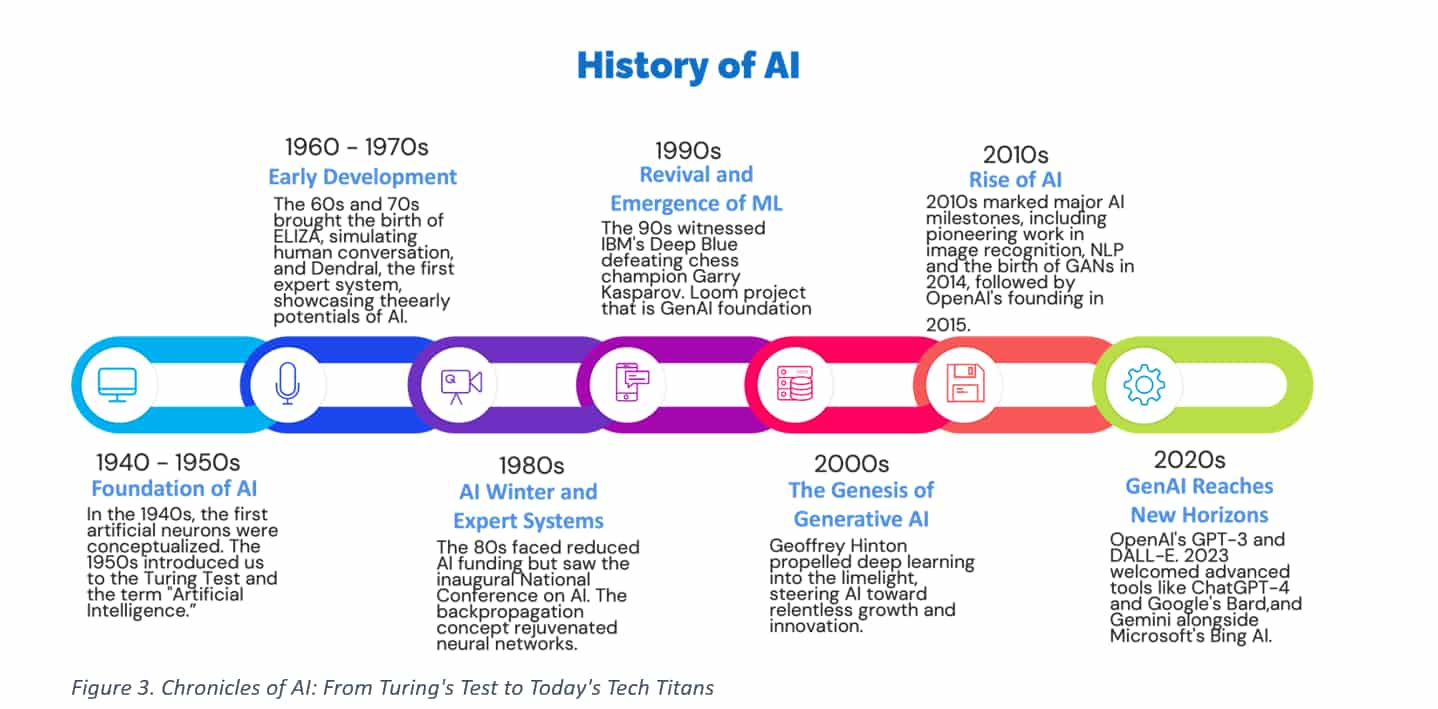
Early Foundations (1950s–1970s) The concept of AI dates back to ancient myths and philosophical debates about human-like machines. However, the formal field of AI emerged in the mid-20th century. In 1950, Alan Turing proposed the "Turing Test" as a criterion for machine intelligence, laying the groundwork for AI research. The term "Artificial Intelligence" was coined in 1956 during the Dartmouth Conference, where pioneers like John McCarthy, Marvin Minsky, and Herbert Simon discussed the potential of machines to simulate human cognition. Early AI systems, such as the Logic Theorist (1956) and ELIZA (1966), demonstrated basic problem-solving and language processing capabilities. However, limited computational power and funding constraints slowed progress during the 1970s, leading to the first "AI winter."
Revival and Expansion (1980s–2000s) The 1980s saw a resurgence in AI research with the development of expert systems—programs designed to mimic human expertise in specific domains. Systems like MYCIN (for medical diagnosis) and R1 (for computer configuration) showcased AI’s practical applications. Concurrently, advances in machine learning (ML) algorithms, such as neural networks, began to gain traction. The 1990s and early 2000s witnessed significant milestones, including IBM’s Deep Blue defeating world chess champion Garry Kasparov in 1997 and the rise of data-driven approaches like support vector machines (SVMs). The internet’s growth also provided vast datasets, fueling the development of more sophisticated AI models.
The Modern AI Revolution (2010s–Present) The 2010s marked a turning point for AI, driven by three key factors:
- Big Data: The explosion of digital data from social media, IoT devices, and enterprise systems enabled AI models to train on unprecedented volumes of information.
- Computational Power: Advances in graphics processing units (GPUs) and cloud computing accelerated the training of complex models.
- Algorithmic Innovations: Breakthroughs in deep learning, particularly convolutional neural networks (CNNs) and transformers, revolutionized fields like computer vision and NLP. Landmark achievements include:
- 2011: IBM Watson winning Jeopardy! against human champions.
- 2016: AlphaGo defeating Lee Sedol, a top Go player, using deep reinforcement learning.
- 2020s: The rise of generative AI models like DALL·E, MidJourney, and ChatGPT, capable of creating human-like text, images, and code. Today, AI is a multi-billion-dollar industry, with applications in autonomous vehicles, healthcare diagnostics, financial forecasting, and more.
#How It Works
Core Principles AI systems operate by processing data through algorithms designed to identify patterns, make predictions, or perform tasks autonomously. The two primary approaches are:
- Rule-Based AI: Uses predefined rules to make decisions (e.g., early expert systems).
- Learning-Based AI: Relies on data to train models, improving accuracy over time.
Key Techniques
- Machine Learning (ML)
- Supervised Learning: Models learn from labeled data (e.g., spam detection).
- Unsupervised Learning: Identifies patterns in unlabeled data (e.g., customer segmentation).
- Reinforcement Learning: Trains models through trial and error (e.g., robotics, game-playing AI).
- Deep Learning - A subset of ML that uses multi-layered neural networks (deep neural networks) to model complex data structures.
- Convolutional Neural Networks (CNNs): Excels in image and video recognition.
- Recurrent Neural Networks (RNNs): Processes sequential data (e.g., time-series analysis).
- Transformers: Powers modern NLP models (e.g., BERT, GPT) by capturing contextual relationships in text.
- Natural Language Processing (NLP) - Enables machines to understand, interpret, and generate human language. - Applications include chatbots, translation services, and sentiment analysis.
- Computer Vision - Allows AI to interpret and analyze visual data (e.g., facial recognition, medical imaging). - Uses techniques like object detection and image segmentation.
Data and Training AI models require vast datasets for training. The quality and diversity of data directly impact performance. Techniques like data augmentation and transfer learning help improve model robustness. Training involves:
- Feature Extraction: Identifying relevant data attributes.
- Model Selection: Choosing the appropriate algorithm (e.g., decision trees, neural networks).
- Hyperparameter Tuning: Optimizing model parameters for better accuracy.
- Evaluation: Assessing performance using metrics like precision, recall, and F1-score.
Deployment and Scalability Once trained, AI models are deployed in production environments, where they interact with real-world data. Cloud platforms (e.g., AWS, Google Cloud) and edge computing enable scalable AI solutions. Continuous monitoring and retraining ensure models adapt to evolving data patterns.
#Important Facts
- AI Market Growth: The global AI market is projected to reach $1.8 trillion by 2030 (Statista, 2023).
- Autonomous Vehicles: Companies like Tesla and Waymo are developing self-driving cars using AI-powered computer vision and sensor fusion.
- Healthcare Impact: AI assists in diagnosing diseases (e.g., detecting tumors in X-rays) and drug discovery (e.g., AlphaFold for protein folding).
- Ethical Concerns: Bias in AI algorithms, data privacy, and job displacement are major challenges.
- Generative AI: Models like DALL·E 3 and Stable Diffusion can generate realistic images from text prompts.
- AI in Finance: Used for fraud detection, algorithmic trading, and credit scoring.
- Quantum AI: Emerging field combining quantum computing with AI for solving complex optimization problems.
- AI in Education: Personalized learning platforms (e.g., Duolingo, Khan Academy) adapt content to individual needs.
#Timeline
- Foundational ideas
Core concepts and early methods shape Why AI Is the Future of Technology.
- Practical use
Tools, examples, and real-world deployments make the topic easier to evaluate.
- Responsible implementation
Current work focuses on reliability, governance, performance, and measurable impact.
#Related Terms
#FAQ
What does Why AI Is the Future of Technology cover?
Explains why ai is the future of technology, including key reasons, examples, benefits, trade-offs, and risks.
Why is Why AI Is the Future of Technology important?
It helps readers understand key concepts, compare practical use cases, and evaluate how AI Trends decisions affect outcomes, risks, and implementation choices.
What should readers verify before applying this topic?
Readers should compare benefits, limitations, data requirements, and related themes such as AI, Future, Technology before using the ideas in real projects.
#References
- Why AI Is the Future of Technology terminology and background research
- Why AI Is the Future of Technology use cases, implementation examples, and limitations
- AI Trends best practices, standards, and risk guidance
- AI case studies, benchmarks, and current industry analysis


Comments
No comments yet. Start the discussion with a useful note.