

#Short Answer
Artificial intelligence refers to the capability of computer systems to mimic human-like intelligence. Unlike traditional software, which follows explicit instructions, AI systems analyze data, identify patterns, and make decisions with minimal human intervention. The field is broadly categorized into two types: narrow AI, designed for specific tasks (e.g., facial recognition), and general AI, which aims to replicate human-level intelligence across all domains (still theoretical).
#Infobox
#Overview
Artificial intelligence refers to the capability of computer systems to mimic human-like intelligence. Unlike traditional software, which follows explicit instructions, AI systems analyze data, identify patterns, and make decisions with minimal human intervention. The field is broadly categorized into two types: narrow AI, designed for specific tasks (e.g., facial recognition), and general AI, which aims to replicate human-level intelligence across all domains (still theoretical).
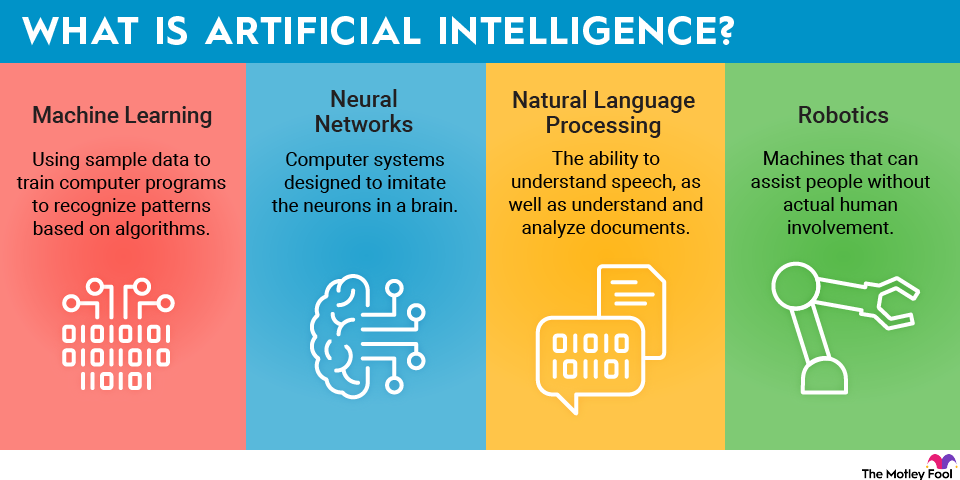
AI technologies leverage algorithms, statistical models, and large datasets to improve accuracy over time. Key components include:
- Machine Learning (ML): Enables systems to learn from data without explicit programming.
- Deep Learning: A subset of ML using neural networks with multiple layers to process complex data like images and speech.
- Natural Language Processing (NLP): Facilitates interaction between humans and machines through language.
- Computer Vision: Allows machines to interpret and analyze visual information.
#History / Background
The concept of artificial intelligence dates back to ancient myths and automatons, but modern AI began in the mid-20th century. In 1950, Alan Turing proposed the Turing Test as a criterion for machine intelligence. The term "artificial intelligence" was coined in 1956 by John McCarthy at the Dartmouth Conference, marking the official birth of the field.
Early AI research focused on symbolic reasoning and problem-solving, exemplified by programs like Logic Theorist (1956) and General Problem Solver (1957). The 1960s and 1970s saw progress in expert systems, such as DENDRAL (1965) for chemical analysis. However, funding cuts in the 1970s led to an "AI Winter," a period of reduced interest and investment.
The 1980s witnessed a resurgence with the development of expert systems like MYCIN (medical diagnosis) and the revival of neural networks. The 1990s and 2000s brought breakthroughs in machine learning, fueled by increased computational power and big data. Key milestones include IBM's Deep Blue defeating a chess champion in 1997 and the rise of deep learning in the 2010s, with systems like AlexNet (2012) revolutionizing image recognition.
#How It Works
AI systems operate through a combination of algorithms, data, and computational power. The process typically involves:
- Data Collection: Gathering relevant datasets (e.g., text, images, sensor data).
- Preprocessing: Cleaning and structuring data to remove noise and biases.
- Model Training: Using algorithms to learn patterns from the data. For example, a neural network adjusts its weights to minimize errors.
- Evaluation: Testing the model's performance on unseen data to ensure generalization.
- Deployment: Integrating the model into applications (e.g., chatbots, recommendation engines).
Key techniques include:
- Supervised Learning: Models learn from labeled data (e.g., spam detection).
- Unsupervised Learning: Identifies patterns in unlabeled data (e.g., customer segmentation).
- Reinforcement Learning: Systems learn by interacting with an environment to maximize rewards (e.g., game-playing AI).
#Important Facts
- AI is not sentient: Current AI lacks consciousness and operates based on programmed logic.
- Bias in AI: Algorithms can perpetuate biases present in training data, leading to unfair outcomes.
- Explainability: Many AI models (e.g., deep neural networks) are "black boxes," making their decisions hard to interpret.
- Energy Consumption: Training large AI models requires significant computational resources, raising environmental concerns.
- Ethical Concerns: Issues include job displacement, privacy violations, and autonomous weapons.
- AI in Healthcare: Used for drug discovery, diagnostic imaging, and personalized treatment plans.
- Regulation: Governments are increasingly implementing policies to govern AI development and deployment.
#Timeline
- Alan Turing proposes the
Alan Turing proposes the *Turing Test*.
- John McCarthy coins the
John McCarthy coins the term 'artificial intelligence' at Dartmouth Conference.
- ELIZA, an early NLP
ELIZA, an early NLP program, simulates conversation.
- IBM's *Deep Blue* defeats
IBM's *Deep Blue* defeats world chess champion Garry Kasparov.
- IBM's *Watson* wins *Jeopardy!
IBM's *Watson* wins *Jeopardy!* against human champions.
- *AlexNet* wins ImageNet compet
*AlexNet* wins ImageNet competition, sparking deep learning revolution.
- AlphaGo defeats a world
AlphaGo defeats a world champion Go player.
- OpenAI releases *GPT-3*, a
OpenAI releases *GPT-3*, a language model with 175 billion parameters.
- Stable Diffusion and DALL·E
Stable Diffusion and DALL·E 2 enable text-to-image generation.
#Related Terms
#FAQ
What does What Is Artificial Intelligence? cover?
Explains what artificial intelligence is, how it works, common examples, and why the concept matters for readers.
Why is What Is Artificial Intelligence? important?
It helps readers understand key concepts, compare practical use cases, and evaluate how Creative AI decisions affect outcomes, risks, and implementation choices.
What should readers verify before applying this topic?
Readers should compare the benefits, limitations, data requirements, and related themes such as Explainer, Artificial, Intelligence before using the ideas in real projects.
#References
- What Is Artificial Intelligence? terminology and background research
- What Is Artificial Intelligence? use cases, implementation examples, and limitations
- Creative AI best practices, standards, and risk guidance
- Explainer case studies, benchmarks, and current industry analysis




Comments
No comments yet. Start the discussion with a useful note.