

#Short Answer
Explains What Is a Chatbot, including the core definition, how it works, practical examples, and limitations.
#Infobox
#Overview
A chatbot is a software application that engages in dialogue with humans via text or voice, mimicking natural language to perform tasks such as answering queries, providing recommendations, or executing commands. These systems leverage Natural Language Processing (NLP) to interpret user input, Machine Learning (ML) to improve responses over time, and sometimes generative AI to produce human-like replies. Chatbots are categorized into three main types:
- Rule-based chatbots – Follow predefined scripts and respond based on specific keywords or decision trees.
- Retrieval-based chatbots – Select responses from a predefined database based on input similarity.
- Generative chatbots – Use deep learning models (e.g., transformers) to generate original responses dynamically. Their applications span industries, including e-commerce (product recommendations), healthcare (symptom checkers), banking (transaction assistance), and customer support (24/7 query resolution).
#History / Background
#Early Developments
(1960s–1990s)
The concept of chatbots dates back to 1966, when Joseph Weizenbaum created ELIZA, an early NLP program designed to simulate a Rogerian psychotherapist. ELIZA used pattern matching to respond to user inputs, though it lacked true understanding. In 1972, PARRY was developed by Kenneth Colby, simulating a paranoid schizophrenic to study human-computer interaction. Unlike ELIZA, PARRY attempted to model emotional responses. The 1990s saw the rise of smart assistants like SmaterChild (2001), an AI companion for AOL Instant Messenger, and ALICE (Artificial Linguistic Internet Computer Entity) in 1995, which used heuristic pattern matching.
#Modern Era
(2000s–Present)
The 2000s introduced voice-activated assistants like Apple’s Siri (2011), which integrated NLP with speech recognition. Google Assistant (2016) and Amazon Alexa (2014) followed, expanding chatbot capabilities to smart home devices. Advancements in deep learning (e.g., RNNs, LSTMs, Transformers) enabled more sophisticated models like Microsoft’s Xiaoice (2014) and OpenAI’s ChatGPT (2022), which generate contextually relevant and coherent responses. Today, chatbots are integral to business automation, healthcare diagnostics, and education, with continuous improvements in contextual understanding and multilingual support.
#How It Works
#Core Components
- Natural Language Processing (NLP)
- Tokenization: Breaking input text into words/phrases.
- Part-of-Speech (POS) Tagging: Identifying grammatical structure.
- Named Entity Recognition (NER): Extracting entities (e.g., names, dates).
- Sentiment Analysis: Detecting user emotions (positive/negative/neutral).
- Intent Recognition - Classifies user intent (e.g., "book a flight," "check balance") using machine learning models (e.g., BERT, RoBERTa).
- Response Generation
- Rule-based: Matches input to predefined responses.
- Retrieval-based: Selects the best response from a database.
- Generative: Uses transformer models (e.g., GPT-3, LaMDA) to create new text.
- Context Management - Maintains conversation history to ensure coherent follow-ups (e.g., remembering prior queries).
- Integration & APIs - Connects to databases, CRM systems, or third-party services (e.g., weather APIs, payment gateways).
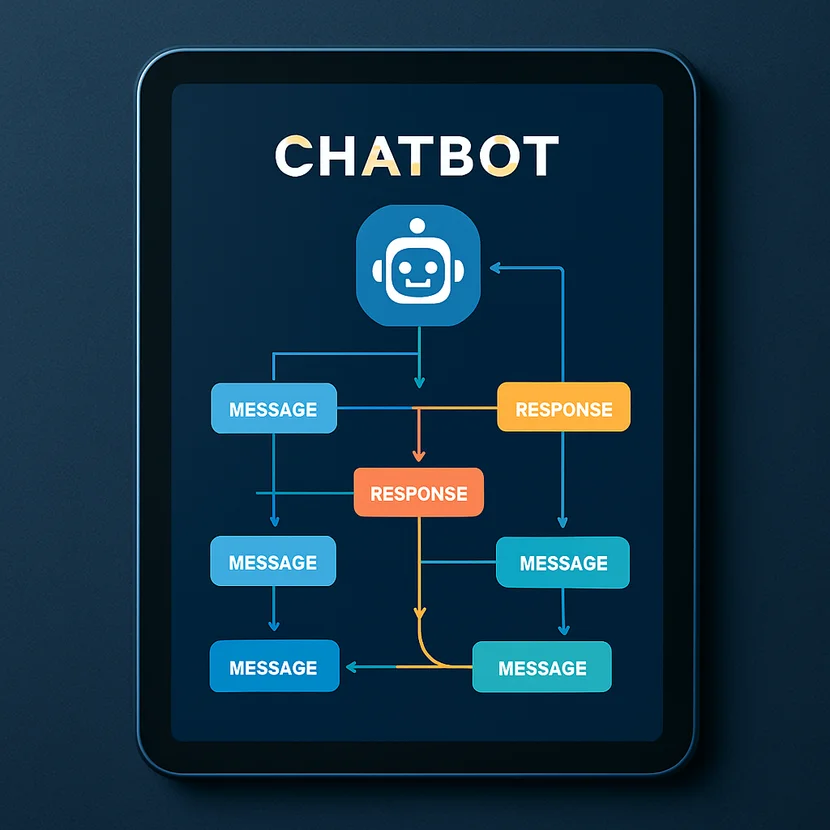
#Example Workflow 1. User inputs: "What’s the weather in New York?" 2. NLP processes the query, identifies intent (weather check). 3. System fetches data from a weather API. 4. Generates response: "The weather in New York is sunny with a high of 75°F."
#Important Facts
- Efficiency: Chatbots can handle thousands of queries simultaneously, reducing wait times in customer service.
- Cost Savings: Businesses save up to 30% on support costs by automating routine inquiries.
- 24/7 Availability: Unlike human agents, chatbots operate round-the-clock.
- Multilingual Support: Advanced models (e.g., Google’s Multilingual NLP) support over 100 languages.
- Ethical Concerns: Risks include misinformation spread, privacy violations, and bias in training data.
- Industry Adoption:
- E-commerce: 60% of shoppers prefer chatbots for quick answers.
- Healthcare: Used for mental health screening and appointment scheduling.
- Banking: 80% of financial institutions use chatbots for customer queries.
#Timeline
- Foundational ideas
Core concepts and early methods shape What Is a Chatbot?.
- Practical use
Tools, examples, and real-world deployments make the topic easier to evaluate.
- Responsible implementation
Current work focuses on reliability, governance, performance, and measurable impact.
#Related Terms
#FAQ
What does What Is a Chatbot? cover?
Explains What Is a Chatbot, including the core definition, how it works, practical examples, and limitations.
Why is What Is a Chatbot? important?
It helps readers understand key concepts, compare practical use cases, and evaluate how Language AI decisions affect outcomes, risks, and implementation choices.
What should readers verify before applying this topic?
Readers should compare benefits, limitations, data requirements, and related themes such as Chatbot, AI, Machine Learning before using the ideas in real projects.
#References
- What Is a Chatbot? terminology and background research
- What Is a Chatbot? use cases, implementation examples, and limitations
- Language AI best practices, standards, and risk guidance
- Chatbot case studies, benchmarks, and current industry analysis


Comments
No comments yet. Start the discussion with a useful note.