


#Short Answer
Covers step-by-step guide to creating a chatbot, including core concepts, practical examples, benefits, limitations, and risks in Language AI.
#Infobox
#Overview
Creating a chatbot involves designing an AI-powered system that can understand user inputs, process them, and generate appropriate responses. Chatbots are widely used in customer service, virtual assistants, e-commerce, and healthcare to automate interactions and improve efficiency. The process typically includes defining the chatbot’s purpose, selecting the right tools, designing conversation flows, training the AI model, and deploying the bot across platforms. Modern chatbots leverage natural language processing (NLP) to interpret user queries and machine learning (ML) to improve responses over time. They can be rule-based (following predefined scripts) or AI-driven (using neural networks to understand context). The choice of approach depends on the complexity of the use case and the desired level of automation.
#History / Background
The concept of chatbots dates back to the 1960s, with ELIZA, developed by Joseph Weizenbaum at MIT, being one of the earliest examples. ELIZA simulated a psychotherapist by using pattern matching and substitution methodology, though it lacked true understanding of language. In the 1970s, PARRY was created to simulate a person with paranoid schizophrenia, marking an early attempt to model human behavior in AI. The 1990s saw the rise of ALICE (Artificial Linguistic Internet Computer Entity), which used heuristic pattern matching and was one of the first chatbots to pass the Turing Test in a limited context. The 2010s brought significant advancements with the integration of machine learning and deep learning techniques. Companies like Google, Microsoft, and IBM developed sophisticated AI platforms such as Dialogflow, Microsoft Bot Framework, and Watson Assistant, enabling developers to build chatbots without extensive coding knowledge. The proliferation of messaging apps like Facebook Messenger, WhatsApp, and Slack further accelerated chatbot adoption, making them accessible to businesses of all sizes. Today, chatbots are integral to digital transformation strategies, with applications ranging from customer support automation to personalized marketing and healthcare diagnostics. The rise of large language models (LLMs) like GPT-3 and GPT-4 has further enhanced chatbot capabilities, enabling more natural and context-aware conversations.
#How It Works
#Core Components of a Chatbot
- Natural Language Processing (NLP)
- Tokenization: Breaking down user input into words or phrases (tokens).
- Part-of-Speech (POS) Tagging: Identifying grammatical components (e.g., nouns, verbs).
- Named Entity Recognition (NER): Extracting entities like names, dates, or locations.
- Sentiment Analysis: Determining the emotional tone of the user’s message.
- Intent Recognition: Classifying the user’s intent (e.g., "greeting," "booking a service").
- Dialog Management
- Rule-Based Systems: Follow predefined conversation flows (e.g., FAQ bots).
- Machine Learning Models: Use algorithms to predict responses based on training data.
- State Tracking: Maintain context across multiple turns in a conversation.
- Response Generation
- Template-Based: Predefined responses pulled from a database.
- Generative Models: AI models (e.g., transformers) generate dynamic responses.
- Hybrid Approach: Combines templates with AI-generated content for flexibility.
- Integration Layer - Connects the chatbot to databases, APIs, or third-party services (e.g., payment gateways, CRM systems). - Ensures real-time data retrieval and action execution (e.g., booking a flight, checking order status).
#Development Workflow
- Define Objectives - Identify the chatbot’s purpose (e.g., customer support, lead generation, internal FAQ). - Determine the target audience and preferred platforms (e.g., website, mobile app, Slack).
- Choose a Development Approach
- No-Code/Low-Code Platforms: Ideal for beginners (e.g., Dialogflow, ManyChat, Tars).
- Custom Development: Requires programming knowledge (e.g., Python with TensorFlow/PyTorch).
- Hybrid Solutions: Combine no-code tools with custom scripts for advanced features.
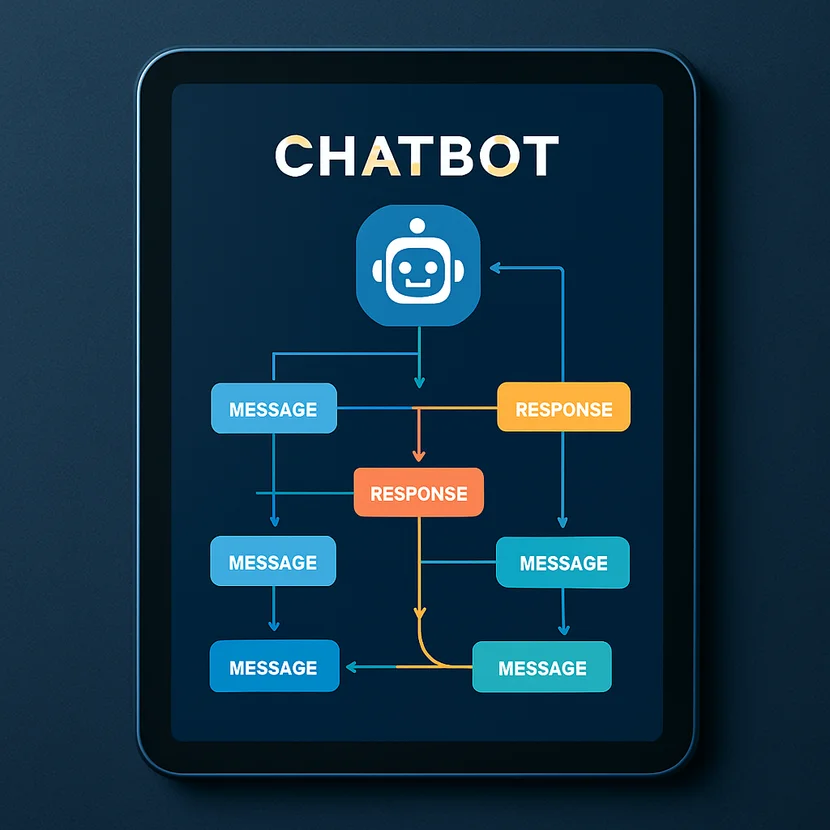
- Design Conversation Flows - Create user flows (e.g., onboarding, troubleshooting, payment processing). - Use flowcharts or state diagrams to visualize interactions. - Define fallback responses for unrecognized inputs.
- Train the Model
- Supervised Learning: Provide labeled datasets (e.g., question-answer pairs).
- Unsupervised Learning: Use clustering to group similar queries.
- Reinforcement Learning: Optimize responses based on user feedback.
- Develop and Test
- Prototype Testing: Validate basic functionality with a small user group.
- A/B Testing: Compare different response strategies.
- Performance Metrics: Track accuracy, response time, and user satisfaction.
- Deploy and Monitor - Deploy on chosen platforms (e.g., website chat widget, Slack bot). - Use analytics tools to monitor engagement, drop-off rates, and user queries. - Continuously update the model with new data to improve performance.
#Important Facts
- Efficiency: Chatbots can handle 70-90% of routine customer queries, reducing operational costs by up to 30%.
- User Expectations: 64% of users prefer chatbots for quick responses, while 55% expect them to provide 24/7 support.
- Industry Adoption: The global chatbot market is projected to reach $15.5 billion by 2028, growing at a CAGR of 23.3%.
- Multilingual Support: Advanced chatbots support over 100 languages, enabling global scalability.
- Security Risks: Poorly designed chatbots can expose sensitive data; encryption and access controls are critical.
- Ethical Considerations: Bias in training data can lead to discriminatory responses; regular audits are necessary.
- Integration Capabilities: Modern chatbots can connect to CRM systems (e.g., Salesforce), payment gateways (e.g., Stripe), and IoT devices.
#Timeline
- Foundational ideas
Core concepts and early methods shape Step-by-step Guide to Creating a Chatbot.
- Practical use
Tools, examples, and real-world deployments make the topic easier to evaluate.
- Responsible implementation
Current work focuses on reliability, governance, performance, and measurable impact.
#Related Terms
#FAQ
What does Step-by-step Guide to Creating a Chatbot cover?
Covers step-by-step guide to creating a chatbot, including core concepts, practical examples, benefits, limitations, and risks in Language AI.
Why is Step-by-step Guide to Creating a Chatbot important?
It helps readers understand key concepts, compare practical use cases, and evaluate how Language AI decisions affect outcomes, risks, and implementation choices.
What should readers verify before applying this topic?
Readers should compare benefits, limitations, data requirements, and related themes such as Creating, Chatbot, AI before using the ideas in real projects.
#References
- Step-by-step Guide to Creating a Chatbot terminology and background research
- Step-by-step Guide to Creating a Chatbot use cases, implementation examples, and limitations
- Language AI best practices, standards, and risk guidance
- Creating case studies, benchmarks, and current industry analysis


Comments
No comments yet. Start the discussion with a useful note.