


#Short Answer
Covers meaning of chatbots, including core concepts, practical examples, benefits, limitations, and risks in Language AI.
#Infobox
#Overview
Chatbots are software applications that enable human-computer interaction via natural language. They interpret user inputs, analyze context, and deliver contextually relevant responses, often mimicking human conversation patterns. Modern chatbots leverage advanced AI techniques, including NLP, to understand nuances in language, handle ambiguities, and improve over time through user interactions. The versatility of chatbots has led to their integration across diverse sectors. In customer service, they resolve queries 24/7, reducing operational costs. In healthcare, they assist in triaging symptoms or scheduling appointments. E-commerce platforms use chatbots for personalized product recommendations and order tracking. Additionally, chatbots serve as virtual assistants (e.g., Siri, Alexa) for tasks like setting reminders or providing weather updates.
#History / Background
#Early Developments
(1960s–1990s)
The concept of chatbots dates back to 1966, when ELIZA, developed by Joseph Weizenbaum at MIT, became one of the first programs to simulate human conversation. ELIZA used pattern matching to respond to user inputs, though its interactions were rudimentary and lacked true understanding. In 1972, PARRY, created by Kenneth Colby, simulated a person with paranoid schizophrenia, marking an early attempt to model complex human behaviors. The 1990s saw the rise of ALICE (Artificial Linguistic Internet Computer Entity), an NLP-based chatbot that won the Loebner Prize (a Turing Test competition) multiple times. ALICE introduced more sophisticated pattern recognition but still relied on predefined scripts.
#Modern Era
(2000s–Present)
The 2000s brought significant advancements with the integration of machine learning and statistical NLP. IBM’s Watson (2011) demonstrated the potential of AI-driven chatbots by winning Jeopardy!, showcasing deep learning’s ability to process unstructured data. The proliferation of messaging platforms (e.g., Facebook Messenger, WhatsApp) in the 2010s accelerated chatbot adoption. Companies like Google (Google Assistant), Amazon (Alexa), and Microsoft (Cortana) launched voice-enabled chatbots, expanding their reach beyond text-based interactions. Today, generative AI (e.g., OpenAI’s GPT models) has revolutionized chatbots by enabling them to produce human-like, context-aware responses without rigid scripting. This shift has blurred the line between automated and human-like interactions.
#How It Works
#Core Components
- Natural Language Processing (NLP)
- Tokenization: Breaks input text into meaningful units (words, phrases).
- Part-of-Speech (POS) Tagging: Identifies grammatical structures (e.g., nouns, verbs).
- Named Entity Recognition (NER): Detects entities like names, dates, or locations.
- Sentiment Analysis: Gauges user emotions (e.g., frustration, satisfaction) to tailor responses.
- Machine Learning & Deep Learning
- Supervised Learning: Trains models on labeled datasets (e.g., customer service transcripts).
- Reinforcement Learning: Optimizes responses based on user feedback (e.g., correcting misinterpretations).
- Neural Networks: Models like Transformers (e.g., BERT, GPT) enable contextual understanding and generative capabilities.
- Dialogue Management
- Rule-Based Systems: Follow predefined decision trees (e.g., FAQ bots).
- Contextual Models: Maintain conversation history to provide coherent, multi-turn responses.
- Hybrid Approaches: Combine rule-based logic with AI for flexibility.
- Response Generation
- Retrieval-Based: Selects pre-written responses from a database.
- Generative Models: Creates new responses dynamically (e.g., GPT-3).
- Hybrid Generation: Blends retrieved and generated content for accuracy.
#Workflow Example
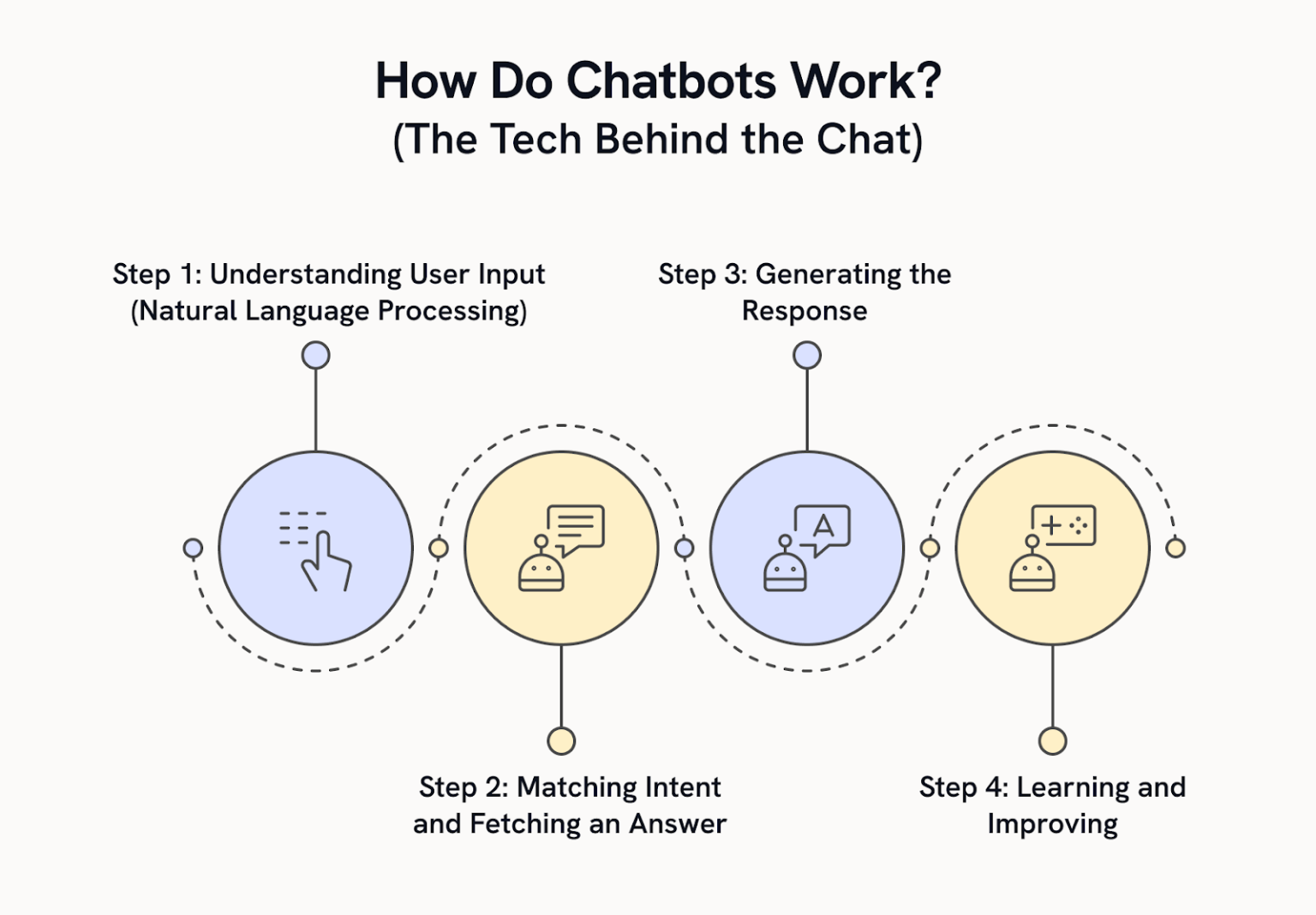
- User Input: "I need help resetting my password."
- NLP Processing: Tokenizes the sentence, identifies key entities ("password," "reset").
- Intent Recognition: Determines the user’s intent (e.g., "password recovery").
- Contextual Analysis: Checks user history (e.g., recent login attempts).
- Response Generation: "I can reset your password. Please verify your email address."
- User Feedback Loop: Logs the interaction to improve future responses.
#Important Facts
- Efficiency: Chatbots can handle millions of queries simultaneously, reducing wait times by up to 80% in customer service.
- Cost Savings: Businesses save 30–50% on support costs by automating routine inquiries.
- User Preference: 64% of users prefer chatbots for quick answers over human agents.
- Multilingual Support: Advanced chatbots support over 100 languages, breaking language barriers.
- Ethical Concerns: Risks include misinformation spread, privacy violations, and bias in training data.
- Industry Adoption:
- Banking: 80% of banks use chatbots for customer queries.
- Healthcare: Chatbots assist in mental health screening (e.g., Woebot).
- Retail: 24% of shoppers interact with chatbots before purchasing.
#Timeline
- Foundational ideas
Core concepts and early methods shape Meaning of Chatbots.
- Practical use
Tools, examples, and real-world deployments make the topic easier to evaluate.
- Responsible implementation
Current work focuses on reliability, governance, performance, and measurable impact.
#Related Terms
#FAQ
What does Meaning of Chatbots cover?
Covers meaning of chatbots, including core concepts, practical examples, benefits, limitations, and risks in Language AI.
Why is Meaning of Chatbots important?
It helps readers understand key concepts, compare practical use cases, and evaluate how Language AI decisions affect outcomes, risks, and implementation choices.
What should readers verify before applying this topic?
Readers should compare benefits, limitations, data requirements, and related themes such as Meaning, Chatbots, AI before using the ideas in real projects.
#References
- Meaning of Chatbots terminology and background research
- Meaning of Chatbots use cases, implementation examples, and limitations
- Language AI best practices, standards, and risk guidance
- Meaning case studies, benchmarks, and current industry analysis


Comments
No comments yet. Start the discussion with a useful note.