


#Short Answer
Traces timeline of chatbots, highlighting major milestones, context, examples, and future implications.
#Infobox
#Overview
Chatbots represent a paradigm shift in human-computer interaction, enabling machines to simulate human-like conversations. Initially confined to rigid, scripted responses, modern chatbots leverage natural language processing (NLP), machine learning (ML), and generative AI to deliver context-aware, dynamic interactions. The evolution of chatbots reflects broader advancements in artificial intelligence, from symbolic AI to deep learning and transformer architectures. This timeline categorizes chatbot development into distinct eras:
- Foundational Era (1950–1990): Theoretical groundwork and early experiments.
- Rule-Based Era (1990–2010): Scripted dialogue systems and early commercialization.
- Machine Learning Era (2010–2017): Integration of statistical models and neural networks.
- Generative AI Era (2017–present): Large language models (LLMs) and multimodal capabilities.
#History / Background
#Early Concepts (1950–1965)
The conceptual foundation for chatbots was laid by Alan Turing in 1950 with his Imitation Game (later called the Turing Test), which proposed that a machine could be considered intelligent if it could converse indistinguishably from a human. This idea catalyzed research into natural language understanding.
#The Birth of ELIZA (1966) ELIZA, developed by Joseph Weizenbaum at MIT, is widely regarded as the first chatbot. It mimicked a Rogerian psychotherapist using pattern-matching and substitution techniques. ELIZA’s simplicity—relying on keyword spotting and pre-programmed responses—demonstrated the potential of text-based interaction, though it lacked true comprehension.
#PARRY and the 1970s In 1972, PARRY (created by Kenneth Colby) simulated a person with paranoid schizophrenia. Unlike ELIZA, PARRY incorporated a more complex internal state model, though it remained rule-based. These early systems were constrained by computational limitations and the absence of large datasets.
#Commercialization and ALICE (1990s)
The 1990s saw the rise of chatterbots designed for entertainment and customer service. ALICE (Artificial Linguistic Internet Computer Entity), created by Richard Wallace in 1995, used an XML-based pattern-matching system (AIML) to generate responses. ALICE won the Loebner Prize (a Turing Test competition) three times (2000, 2001, 2004), showcasing the limitations of rule-based systems in handling open-ended conversations.
#SmarterChild and Mobile Chatbots (2000s)
The early 2000s introduced SmarterChild, a chatbot integrated into AOL Instant Messenger (AIM). It provided real-time information (weather, news) and entertainment, marking one of the first mass-market chatbots. Concurrently, Microsoft’s Clippy (1997–2001) became iconic, though criticized for its intrusiveness.
#IBM Watson and the Rise of AI (2010–2014)
IBM’s Watson, unveiled in 2011, demonstrated the power of deep learning and unstructured data processing. Though primarily a question-answering system, Watson’s NLP capabilities influenced chatbot development. Meanwhile, Xiaoice (Microsoft, 2014) became a cultural phenomenon in China, engaging millions in empathetic conversations and setting benchmarks for emotional AI.
#The Deep Learning Revolution (2015–2017)
Advances in neural networks and word embeddings (e.g., Word2Vec, GloVe) enabled chatbots to understand context better. Google’s Duplex (2018) showcased near-human interaction by making reservations via phone calls, highlighting the potential of real-time speech synthesis.
#How It Works
#Core Technologies
- Rule-Based Systems: - Use if-then logic and predefined scripts (e.g., ALICE’s AIML).
- Pros: Predictable, easy to deploy.
- Cons: Inflexible, unable to handle novel queries.
- Machine Learning Models:
- Sequence-to-sequence (Seq2Seq): Encoder-decoder architectures (e.g., early Google Assistant).
- Transformer Models: Introduced in 2017 with Vaswani et al.’s paper, enabling parallel processing and attention mechanisms.
- Fine-Tuning: Pre-trained models (e.g., BERT, T5) adapted for specific tasks.
- Generative AI:
- Large Language Models (LLMs): Trained on vast corpora (e.g., GPT-3, LLaMA, Mistral).
- Multimodal Capabilities: Integration with images, audio (e.g., voice assistants).
- Reinforcement Learning from Human Feedback (RLHF): Aligns responses with user preferences (e.g., ChatGPT).
#Key Components
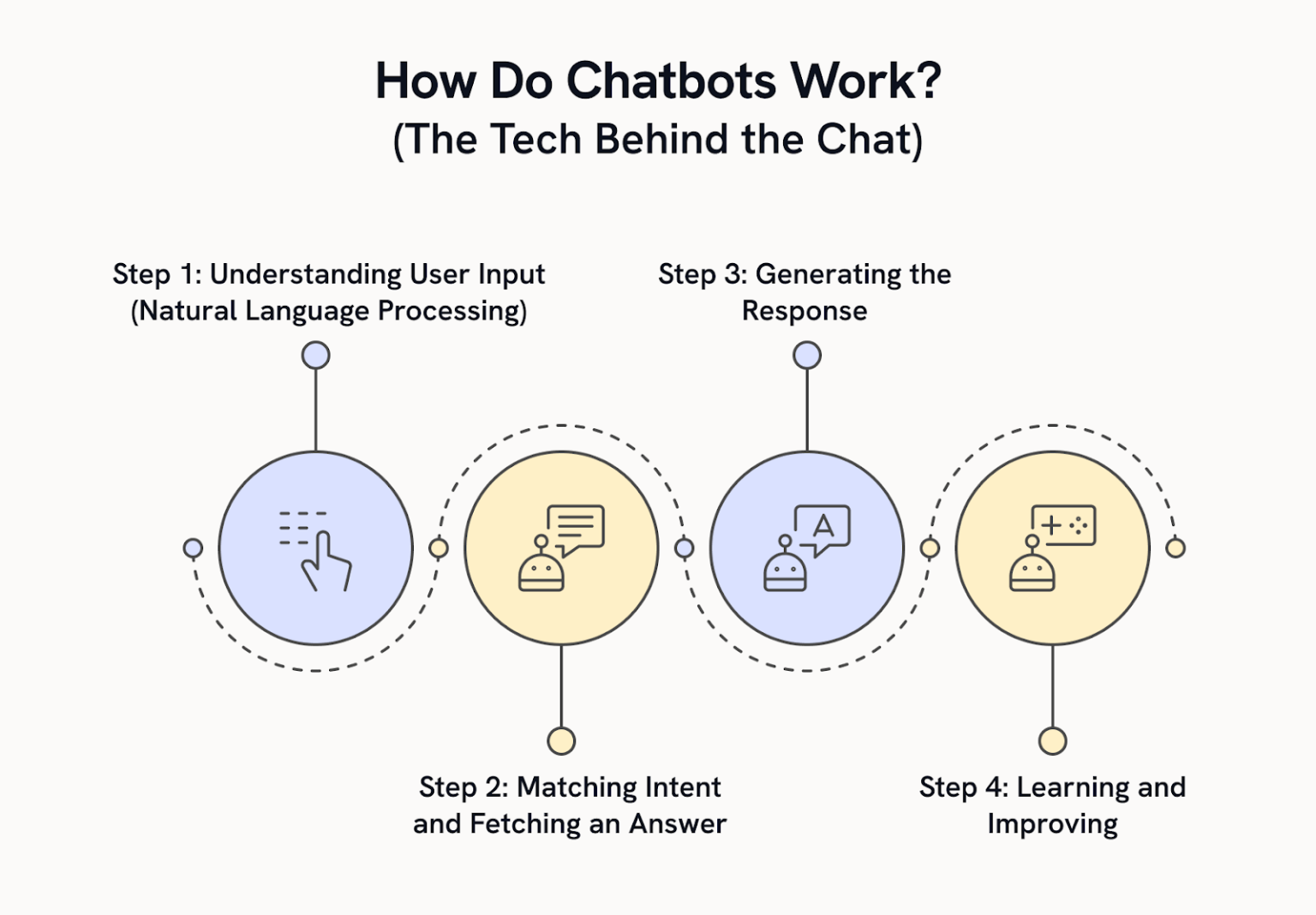
- Natural Language Understanding (NLU): Parses user intent (e.g., intent classification, entity recognition).
- Natural Language Generation (NLG): Crafts responses (e.g., template-based, neural generation).
- Dialogue Management: Tracks conversation history to maintain context.
- Knowledge Base: Retrieves factual information (e.g., Wikipedia integration).
#Challenges
- Contextual Understanding: Maintaining coherence over long conversations.
- Bias and Safety: Mitigating harmful outputs (e.g., Microsoft’s Tay incident).
- Scalability: Balancing computational costs with performance.
#Important Facts
- First Turing Test Winner: Eugene Goostman (2014), a chatbot simulating a 13-year-old Ukrainian boy, fooled 33% of judges.
- Most Advanced Chatbot: ChatGPT (OpenAI) reached 100 million users in 2 months (2023), setting a record for fastest-growing consumer app.
- Industry Adoption: 80% of businesses plan to deploy chatbots by 2025 (Gartner).
- Healthcare Impact: Chatbots like Woebot (2017) provide mental health support, reducing therapy costs by up to 30%.
- Multilingual Capabilities: Modern chatbots support 100+ languages (e.g., Google’s Bard, Meta’s LLaMA).
- Ethical Concerns: Deepfake chatbots (e.g., impersonating deceased loved ones) raise privacy and consent issues.
#Timeline
- Foundational ideas
Core concepts and early methods shape Timeline of Chatbots.
- Practical use
Tools, examples, and real-world deployments make the topic easier to evaluate.
- Responsible implementation
Current work focuses on reliability, governance, performance, and measurable impact.
#Related Terms
#FAQ
What does Timeline of Chatbots cover?
Traces timeline of chatbots, highlighting major milestones, context, examples, and future implications.
Why is Timeline of Chatbots important?
It helps readers understand key concepts, compare practical use cases, and evaluate how Language AI decisions affect outcomes, risks, and implementation choices.
What should readers verify before applying this topic?
Readers should compare benefits, limitations, data requirements, and related themes such as Timeline, Chatbots, AI before using the ideas in real projects.
#References
- Timeline of Chatbots terminology and background research
- Timeline of Chatbots use cases, implementation examples, and limitations
- Language AI best practices, standards, and risk guidance
- Timeline case studies, benchmarks, and current industry analysis


Comments
No comments yet. Start the discussion with a useful note.