

#Short Answer
Traces timeline of ai in retail, highlighting major milestones, context, examples, and future implications.
#Infobox
#Overview
Artificial intelligence (AI) has become a cornerstone of innovation in the retail industry, reshaping how businesses interact with customers, manage supply chains, and optimize operations. AI in retail encompasses a wide range of technologies, including machine learning (ML), natural language processing (NLP), computer vision, and robotics, all of which enhance decision-making, automate repetitive tasks, and deliver hyper-personalized shopping experiences. The integration of AI in retail began with basic automation in the late 20th century and has since evolved into sophisticated systems capable of predicting consumer behavior, managing dynamic pricing, and even enabling cashier-less stores. Retailers leverage AI to analyze vast datasets, identify trends, and automate processes, leading to increased sales, reduced waste, and improved customer satisfaction. Key areas where AI has made a significant impact include:
- Customer Experience: AI-powered chatbots, virtual assistants, and personalized recommendations enhance engagement and loyalty.
- Inventory Management: Predictive analytics optimize stock levels, reducing overstocking and stockouts.
- Pricing Strategies: Dynamic pricing algorithms adjust prices in real-time based on demand, competition, and other factors.
- Fraud Detection: AI systems identify suspicious transactions and prevent losses.
- Supply Chain Optimization: AI-driven logistics improve delivery times and reduce operational costs. As AI continues to advance, its role in retail is expected to expand further, with emerging technologies like generative AI and autonomous delivery systems poised to redefine the industry.
#History / Background
#Early Foundations (1980s–1990s)
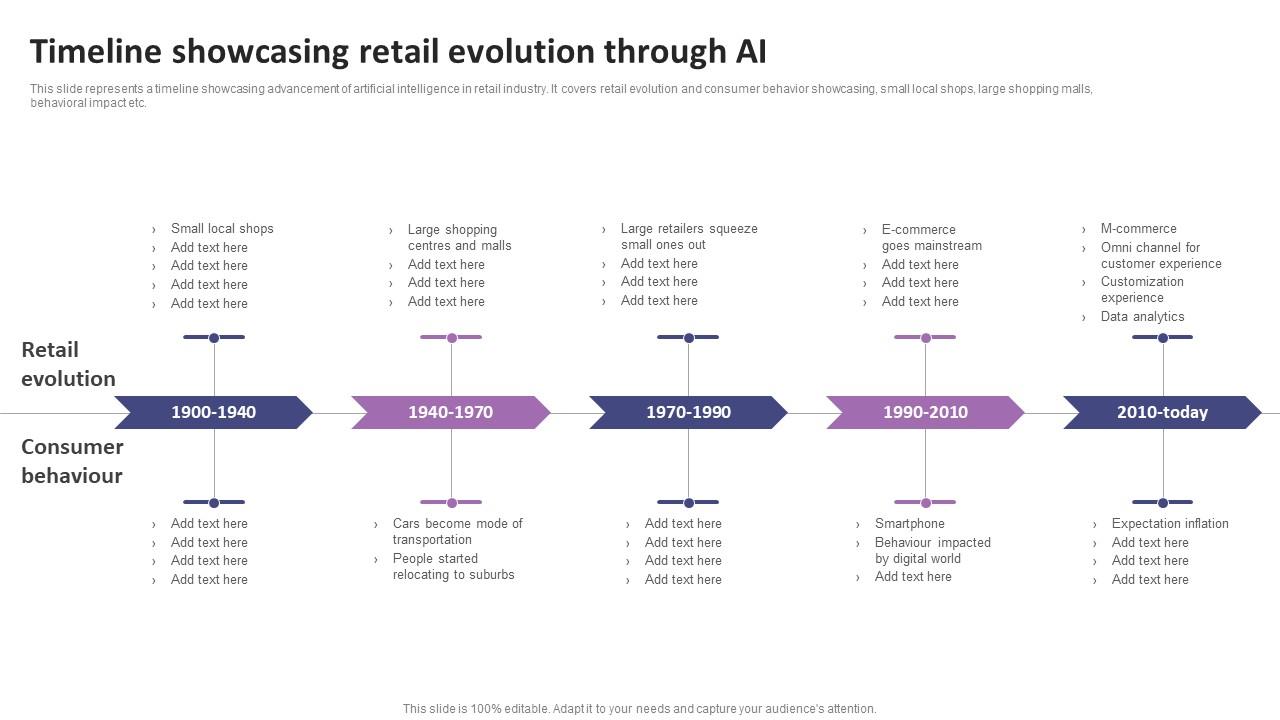
The roots of AI in retail can be traced back to the 1980s, when businesses began adopting basic automation tools to streamline inventory management and point-of-sale (POS) systems. Early AI applications were rule-based and lacked the sophistication of modern machine learning models. Retailers used simple algorithms to track sales data and generate basic reports, but these systems were limited in their ability to adapt or learn from new data.
#The Rise of E-Commerce (2000s)
The advent of e-commerce in the late 1990s and early 2000s accelerated AI adoption in retail. Companies like Amazon and eBay pioneered AI-driven recommendation engines, which analyzed user behavior to suggest products. These systems used collaborative filtering and basic machine learning techniques to improve personalization, laying the groundwork for more advanced AI applications.
#The Big Data Revolution (2010s)
The proliferation of big data in the 2010s enabled retailers to harness vast amounts of customer and operational data. AI technologies such as deep learning and natural language processing (NLP) became more accessible, allowing retailers to implement:
- Chatbots and Virtual Assistants: AI-powered customer service tools reduced response times and improved user experience.
- Computer Vision: Used in cashier-less stores (e.g., Amazon Go) to track purchases without traditional checkout processes.
- Predictive Analytics: Helped retailers forecast demand, optimize pricing, and manage inventory more efficiently.
#Modern Innovations (2020s)
In the 2020s, AI in retail has reached new heights with the integration of generative AI, autonomous delivery systems, and hyper-personalization. Retailers are now using AI to:
- Create Dynamic Content: Generative AI generates product descriptions, marketing copy, and even personalized emails.
- Enable Autonomous Stores: Fully automated retail environments, such as Amazon Go, use AI to track customer movements and process transactions without human intervention.
- Enhance Visual Search: AI-powered image recognition allows customers to search for products using photos, improving discovery and reducing friction in the shopping journey. The COVID-19 pandemic further accelerated AI adoption, as retailers sought contactless solutions and digital-first strategies to adapt to changing consumer behaviors.
#How It Works
AI in retail operates through a combination of advanced algorithms, data processing, and real-time decision-making. The process can be broken down into several key components:
#1. Data Collection and Processing Retailers gather data from multiple sources, including:
- Customer Interactions: Purchase history, browsing behavior, and feedback.
- Operational Data: Inventory levels, sales trends, and supply chain metrics.
- External Data: Market trends, competitor pricing, and economic indicators. This data is processed and analyzed using AI models to extract actionable insights.
#2. Machine Learning and Predictive Analytics Machine learning algorithms, particularly supervised and unsupervised learning models, are trained on historical data to identify patterns and predict future outcomes. For example:
- Demand Forecasting: AI models analyze past sales data, seasonality, and external factors to predict future demand, helping retailers optimize inventory levels.
- Customer Segmentation: Clustering algorithms group customers based on behavior, preferences, and demographics, enabling targeted marketing campaigns.
- Price Optimization: Reinforcement learning algorithms adjust prices dynamically based on demand, competition, and customer sensitivity.
#3. Natural Language Processing (NLP) for Customer Interaction NLP enables AI systems to understand and generate human-like text, powering:
- Chatbots and Virtual Assistants: These tools handle customer inquiries, provide product recommendations, and assist with purchases in real-time.
- Sentiment Analysis: AI analyzes customer reviews and social media posts to gauge sentiment and identify areas for improvement.
#4. Computer Vision for Visual Applications Computer vision technology processes and interprets visual data, used in:
- Cashier-less Stores: Cameras and sensors track customer movements and items selected, automatically charging customers upon exit.
- Visual Search: Customers upload images to find similar products, improving product discovery.
- Quality Control: AI inspects products for defects or inconsistencies in manufacturing and logistics.
#5. Robotics and Automation AI-driven robotics automate tasks such as:
- Warehouse Management: Robots sort, pick, and pack orders with high precision and speed.
- Delivery Drones and Autonomous Vehicles: AI-powered systems optimize delivery routes and reduce transit times.
#6. Personalization and Recommendation Engines AI algorithms analyze individual customer behavior to deliver personalized experiences, such as:
- Product Recommendations: "Customers who bought this also bought..." suggestions based on collaborative filtering and deep learning.
- Dynamic Content: AI generates tailored emails, ads, and website content to increase engagement and conversion rates.
#Important Facts
- AI in Retail Market Size: The global AI in retail market was valued at approximately $5.7 billion in 2022 and is projected to grow at a compound annual growth rate (CAGR) of 30.4% from 2023 to 2030.
- Customer Expectations: 73% of consumers expect personalized experiences from retailers, and AI plays a crucial role in delivering this.
- Efficiency Gains: AI-powered inventory management can reduce stockouts by up to 50% and overstocking by 30%.
- Fraud Prevention: AI systems detect fraudulent transactions with 95% accuracy, significantly reducing financial losses.
- Adoption Rates: As of 2023, 60% of retailers have implemented AI in at least one area of their operations, with chatbots and recommendation engines being the most common applications.
- Cost Savings: AI-driven automation can reduce operational costs by up to 20% by minimizing human error and streamlining processes.
- Sustainability Impact: AI helps retailers optimize supply chains, reducing waste and carbon footprints by 15–20% through better demand forecasting.
#Timeline
- Foundational ideas
Core concepts and early methods shape Timeline of AI in Retail.
- Practical use
Tools, examples, and real-world deployments make the topic easier to evaluate.
- Responsible implementation
Current work focuses on reliability, governance, performance, and measurable impact.
#Related Terms
#FAQ
What does Timeline of AI in Retail cover?
Traces timeline of ai in retail, highlighting major milestones, context, examples, and future implications.
Why is Timeline of AI in Retail important?
It helps readers understand key concepts, compare practical use cases, and evaluate how Business & Marketing decisions affect outcomes, risks, and implementation choices.
What should readers verify before applying this topic?
Readers should compare benefits, limitations, data requirements, and related themes such as Timeline, AI, Retail before using the ideas in real projects.
#References
- Timeline of AI in Retail terminology and background research
- Timeline of AI in Retail use cases, implementation examples, and limitations
- Business & Marketing best practices, standards, and risk guidance
- Timeline case studies, benchmarks, and current industry analysis
Comments
No comments yet. Start the discussion with a useful note.