

#Short Answer
Traces timeline of ai in finance, highlighting major milestones, context, examples, and future implications.
#Infobox
#History / Background
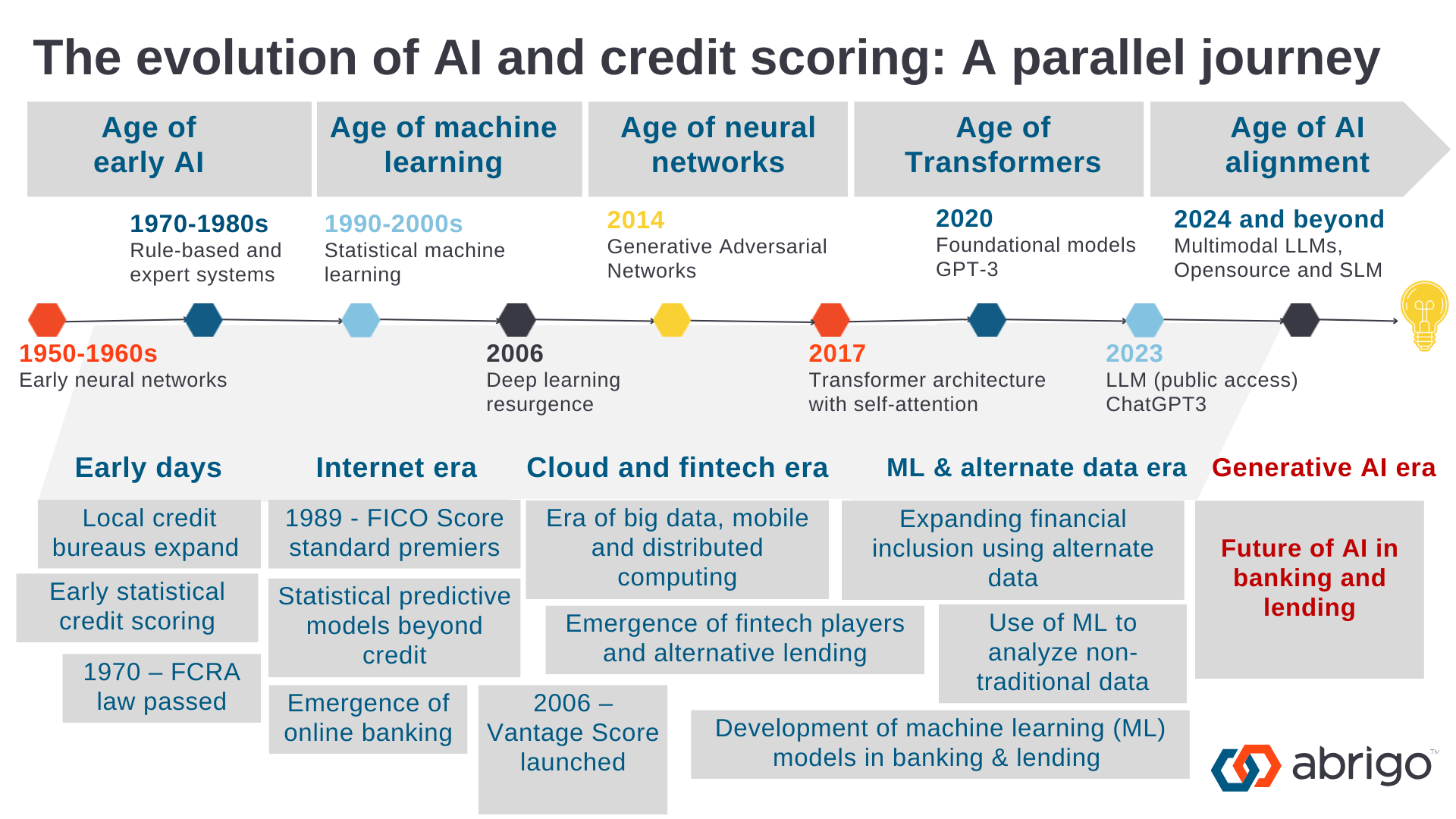
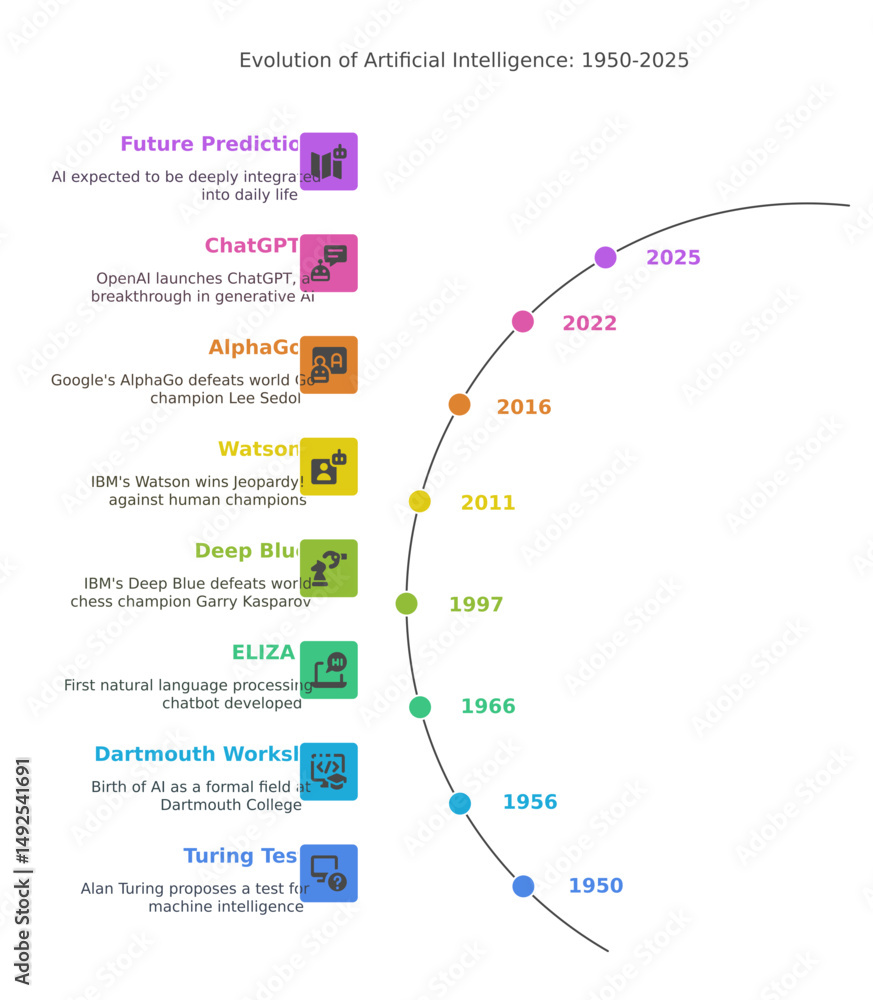
Early Foundations (1950s–1970s) The concept of AI dates back to the 1950s, with early research focused on symbolic reasoning and problem-solving. In finance, the first applications were rudimentary, such as automated bookkeeping systems and basic statistical models for risk assessment. The 1960s and 1970s saw the development of expert systems—AI programs designed to mimic human decision-making in specialized domains. These systems laid the groundwork for later financial AI applications, though their capabilities were limited by computational constraints.
The Rise of Machine Learning (1980s–1990s) The 1980s marked a turning point with the advent of machine learning (ML), which enabled systems to learn from data without explicit programming. Financial institutions began experimenting with ML for credit scoring, using statistical models to evaluate borrower risk. The 1990s saw the proliferation of neural networks, which improved pattern recognition in financial markets. However, computational power and data availability remained significant barriers to widespread adoption.
The Digital Revolution (2000s–2010s) The 2000s brought exponential growth in data volume and computational power, accelerating AI adoption in finance. Key developments included:
- Algorithmic Trading: Firms like Renaissance Technologies and Two Sigma leveraged AI to execute high-frequency trades, analyzing market data in real-time.
- Credit Scoring: Companies like FICO refined AI-driven models to assess creditworthiness, reducing reliance on traditional metrics.
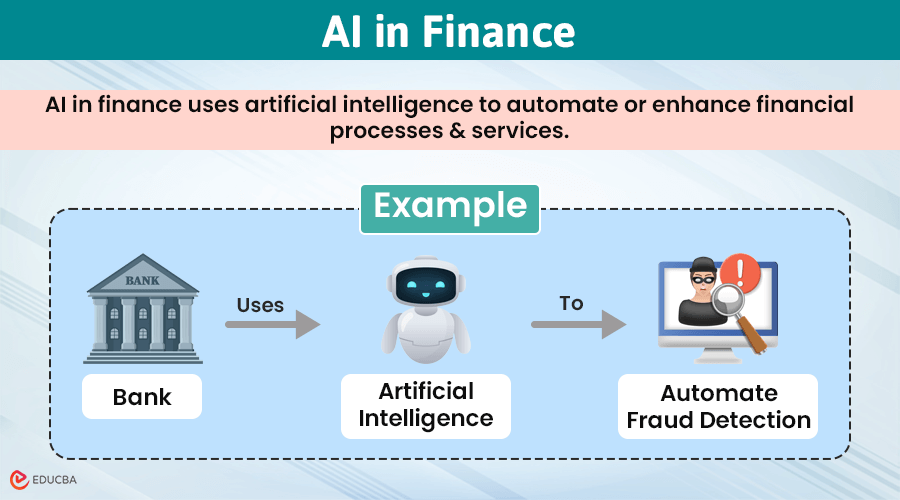
- Fraud Detection: Banks implemented AI systems to detect anomalous transactions, improving security and compliance.
- Robo-Advisors: Platforms like Betterment and Wealthfront emerged, using AI to provide automated, personalized investment advice. The 2010s saw the rise of deep learning, a subset of ML that uses neural networks with multiple layers to process complex data. This technology enabled breakthroughs in natural language processing (NLP), allowing AI to analyze financial news, earnings reports, and social media sentiment for trading signals.
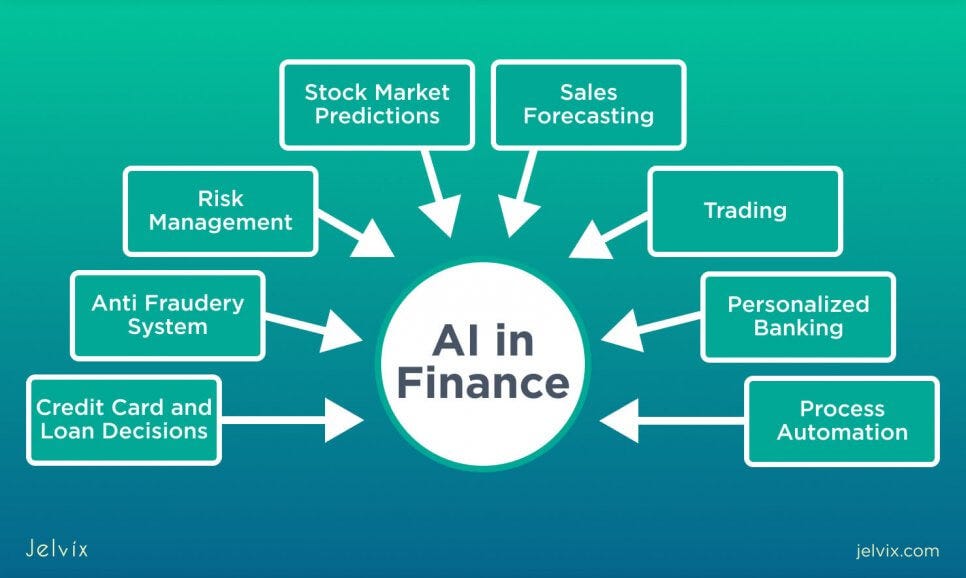
The Modern Era (2020s–Present) Today, AI is deeply embedded in finance, with applications spanning:
- Predictive Analytics: AI models forecast market trends, economic indicators, and asset prices with increasing accuracy.
- Chatbots and Virtual Assistants: Financial institutions deploy AI-powered chatbots to handle customer inquiries, reducing operational costs.
- Blockchain and AI: The integration of AI with blockchain technology enhances smart contract execution and fraud prevention.
- Regulatory Compliance: AI automates compliance monitoring, ensuring adherence to evolving financial regulations.
#How It Works
Core AI Technologies in Finance
- Machine Learning (ML)
- Supervised Learning: Models are trained on labeled data to predict outcomes (e.g., credit default risk).
- Unsupervised Learning: Identifies hidden patterns in data (e.g., clustering customers for targeted marketing).
- Reinforcement Learning: Optimizes decision-making through trial and error (e.g., algorithmic trading strategies).
- Natural Language Processing (NLP) - Analyzes textual data from news articles, earnings calls, and social media to gauge market sentiment. - Powers chatbots and virtual assistants for customer service.
- Computer Vision - Processes visual data, such as receipts or invoices, for automated accounting and fraud detection.
- Deep Learning - Uses neural networks to model complex financial relationships, enabling high-accuracy predictions.
Key AI Applications
- Algorithmic Trading: AI systems execute trades at speeds and frequencies impossible for humans, exploiting market inefficiencies.
- Credit Scoring: AI models evaluate borrower risk by analyzing alternative data sources (e.g., utility payments, social media activity).
- Fraud Detection: Machine learning algorithms identify suspicious transactions by detecting anomalies in spending patterns.
- Portfolio Management: Robo-advisors use AI to create and rebalance investment portfolios based on user risk profiles.
- Risk Management: AI assesses market, credit, and operational risks by simulating various scenarios.
#Important Facts
- Efficiency Gains: AI-driven automation reduces operational costs by up to 30% in financial services.
- Accuracy Improvements: AI models outperform traditional statistical methods in predicting market movements and credit defaults.
- Regulatory Challenges: AI adoption is constrained by data privacy laws (e.g., GDPR) and ethical concerns about algorithmic bias.
- Market Impact: AI-powered trading accounts for over 60% of U.S. equity trading volume.
- Customer Experience: AI chatbots resolve up to 80% of routine customer queries without human intervention.
#Timeline
- Foundational ideas
Core concepts and early methods shape Timeline of AI in Finance.
- Practical use
Tools, examples, and real-world deployments make the topic easier to evaluate.
- Responsible implementation
Current work focuses on reliability, governance, performance, and measurable impact.
#Related Terms
#FAQ
What does Timeline of AI in Finance cover?
Traces timeline of ai in finance, highlighting major milestones, context, examples, and future implications.
Why is Timeline of AI in Finance important?
It helps readers understand key concepts, compare practical use cases, and evaluate how Business & Marketing decisions affect outcomes, risks, and implementation choices.
What should readers verify before applying this topic?
Readers should compare benefits, limitations, data requirements, and related themes such as Timeline, AI, Finance before using the ideas in real projects.
#References
- Timeline of AI in Finance terminology and background research
- Timeline of AI in Finance use cases, implementation examples, and limitations
- Business & Marketing best practices, standards, and risk guidance
- Timeline case studies, benchmarks, and current industry analysis
Comments
No comments yet. Start the discussion with a useful note.