

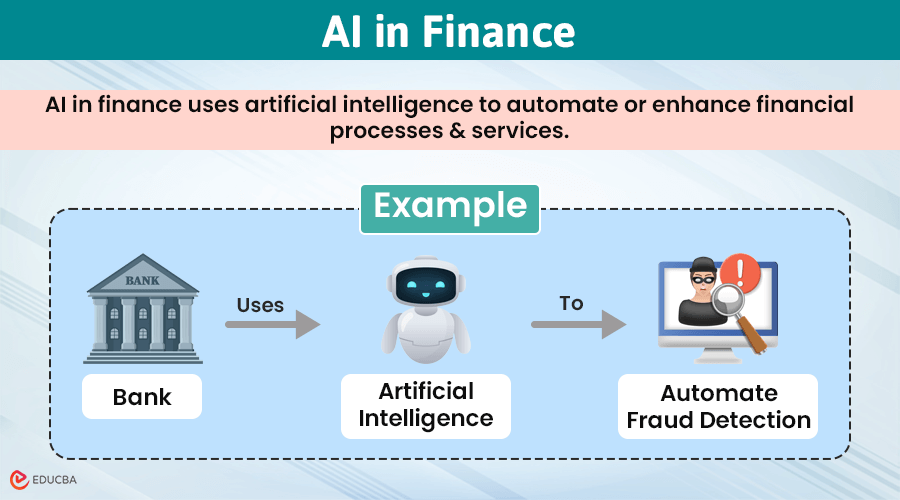
#Short Answer
Covers meaning of ai in finance, including core concepts, practical examples, benefits, limitations, and risks in Business & Marketing.
#Infobox
#Overview
Artificial Intelligence (AI) has revolutionized the financial sector by introducing automation, predictive capabilities, and data-driven decision-making. Unlike traditional financial systems that rely on manual processes and static models, AI leverages advanced algorithms to analyze real-time data, identify trends, and execute tasks with minimal human intervention. This transformation spans across banking, investment management, insurance, and fintech, enabling institutions to enhance customer experiences, optimize operations, and mitigate risks. AI in finance encompasses a broad spectrum of technologies, including machine learning (ML), natural language processing (NLP), computer vision, and robotics process automation (RPA). These tools are deployed to automate repetitive tasks, such as transaction processing and customer service, while also enabling sophisticated applications like fraud detection, algorithmic trading, and personalized financial advice. The integration of AI has led to the emergence of fintech startups and the evolution of traditional financial institutions into data-centric enterprises. The adoption of AI in finance is driven by the exponential growth of big data, advancements in computational power, and the need for real-time analytics. Financial institutions are increasingly investing in AI to gain a competitive edge, reduce operational costs, and comply with stringent regulatory requirements. However, the implementation of AI also raises concerns about data privacy, algorithmic bias, and cybersecurity threats, necessitating robust governance frameworks.
#History / Background
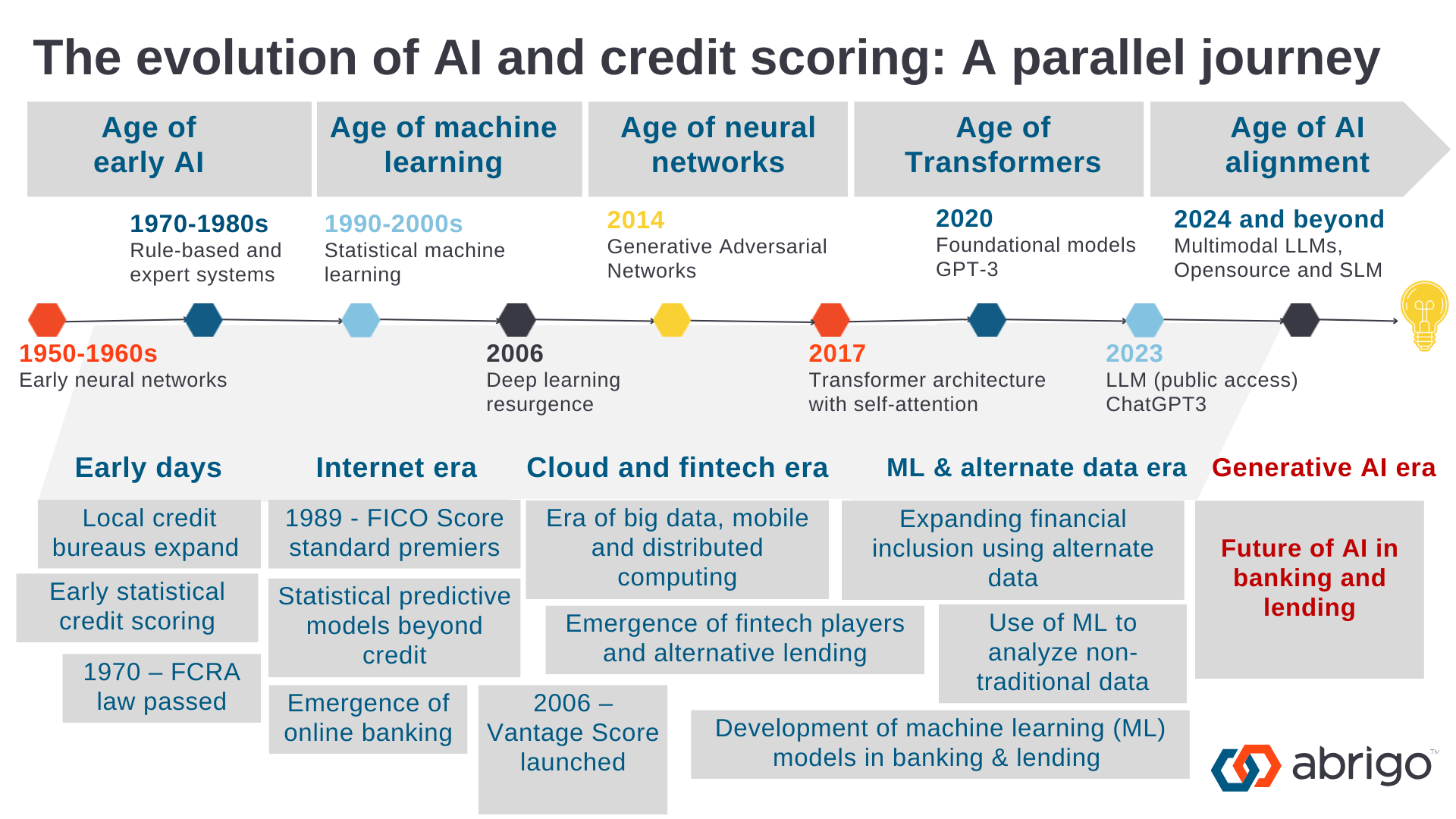
The integration of AI into finance traces its roots to the 1950s and 1960s, when early computer systems were first used to automate financial calculations and record-keeping. The development of quantitative finance in the 1970s, fueled by the Black-Scholes model for option pricing, laid the groundwork for algorithmic trading. However, the true potential of AI in finance began to unfold in the 1980s and 1990s with the advent of expert systems and neural networks. One of the earliest applications of AI in finance was credit scoring, where statistical models were used to assess borrower risk. The Fair Isaac Corporation (FICO), founded in 1956, pioneered credit scoring models that later incorporated AI techniques. In the 1990s, financial institutions started using genetic algorithms and fuzzy logic to optimize trading strategies and portfolio management. The 2000s marked a significant turning point with the rise of machine learning and the proliferation of big data. The 2008 financial crisis highlighted the need for better risk management tools, accelerating the adoption of AI-driven predictive models. During this period, hedge funds and asset management firms began deploying AI to analyze market trends and execute high-frequency trades. The 2010s witnessed a surge in fintech innovation, with startups leveraging AI to disrupt traditional banking and payment systems. Companies like Stripe, Square, and Revolut integrated AI into their platforms to enhance fraud detection, personalize financial products, and streamline customer onboarding. Meanwhile, central banks and regulatory bodies started exploring AI for supervisory purposes, using it to monitor market stability and detect fraudulent activities. Today, AI in finance is a multi-billion-dollar industry, with applications ranging from chatbots and virtual assistants to autonomous trading systems and AI-powered robo-advisors. The COVID-19 pandemic further accelerated digital transformation, as financial institutions sought AI solutions to handle remote transactions, customer inquiries, and risk assessments.
#How It Works
AI in finance operates through a combination of data collection, model training, and decision execution. The process typically involves the following steps:
#
- Data Collection and Preprocessing Financial institutions gather vast amounts of data from multiple sources, including:
- Transaction records (credit card swipes, bank transfers)
- Market data (stock prices, commodity rates, forex fluctuations)
- Customer data (demographics, spending habits, credit history)
- Unstructured data (news articles, social media posts, earnings call transcripts) This data is cleaned, normalized, and structured to remove noise and inconsistencies. Techniques like feature engineering are used to extract meaningful variables that can be fed into AI models.
#
- Model Selection and Training Different AI techniques are applied based on the financial task:
- Supervised Learning: Used for credit scoring, fraud detection, and price prediction. Models like logistic regression, random forests, and support vector machines (SVM) are trained on labeled datasets to classify or predict outcomes.
- Unsupervised Learning: Applied in customer segmentation, anomaly detection, and portfolio diversification. Algorithms like k-means clustering and principal component analysis (PCA) identify hidden patterns in unlabeled data.
- Reinforcement Learning: Utilized in algorithmic trading and dynamic pricing. Models learn optimal strategies by interacting with the market and receiving feedback in the form of rewards or penalties.
- Natural Language Processing (NLP): Powers sentiment analysis, chatbots, and earnings report analysis. Techniques like transformers and word embeddings extract insights from textual data.
- Computer Vision: Used in check processing, document verification, and fraud detection by analyzing images and videos.
#
- Deployment and Real-Time Processing Once trained, AI models are deployed into production environments where they:
- Automate workflows (e.g., loan approvals, trade executions)
- Generate insights (e.g., market trends, customer behavior)
- Interact with users (e.g., virtual assistants, chatbots)
- Monitor risks (e.g., credit defaults, market crashes) For real-time applications, edge computing and cloud-based AI platforms ensure low-latency processing. Financial institutions often use hybrid models, combining AI with traditional statistical methods to improve accuracy.
#
- Feedback and Continuous Learning AI systems in finance are designed to adapt and improve over time. Techniques like online learning and transfer learning allow models to update their parameters based on new data. Reinforcement learning agents, for example, refine their trading strategies by learning from market feedback.
#Key AI Applications in Finance:
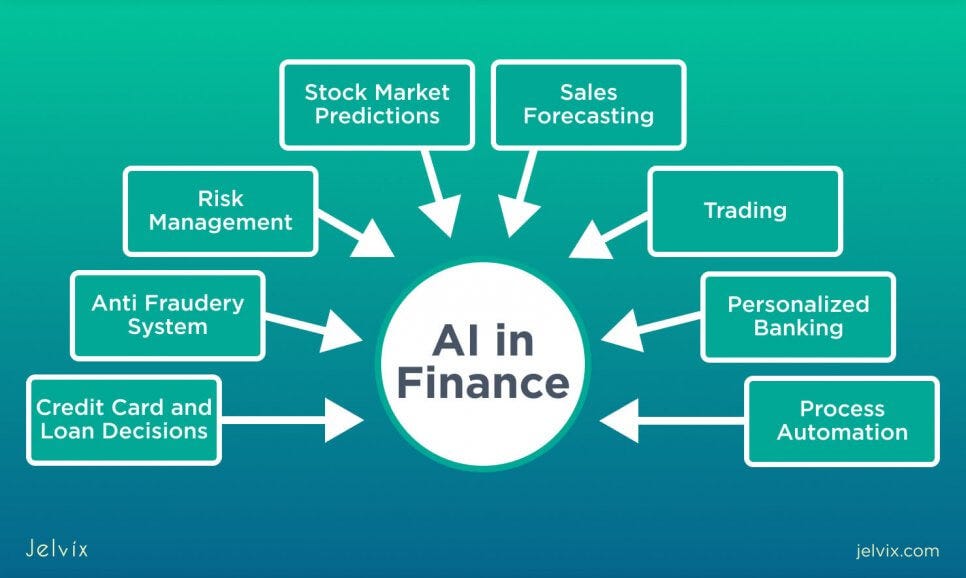
| Application | AI Technique | Example | |--------------------------|--------------------------------|--------------------------------------| | Fraud Detection | Supervised Learning, NLP | Identifying suspicious transactions | | Algorithmic Trading | Reinforcement Learning, NLP | Executing trades based on market signals | | Credit Scoring | Supervised Learning | Assessing loan applicant risk | | Chatbots & Virtual Assistants | NLP, Deep Learning | Handling customer queries 24/7 | | Portfolio Management | Unsupervised Learning, RL | Optimizing asset allocation | | Risk Assessment | Predictive Analytics | Forecasting credit defaults | | Anti-Money Laundering (AML) | Supervised Learning, Graph Theory | Detecting suspicious transaction patterns |
#Important Facts
- Market Growth: The global AI in finance market is projected to reach $26.67 billion by 2026, growing at a CAGR of 23.6% from 2021 to 2026.
- Fraud Prevention: AI-powered fraud detection systems reduce false positives by up to 50% compared to traditional rule-based systems.
- Algorithmic Trading: Over 70% of stock trades in the U.S. are executed by algorithms, with AI-driven high-frequency trading (HFT) accounting for a significant portion.
- Customer Personalization: AI enables financial institutions to offer hyper-personalized products, with 80% of consumers more likely to do business with companies that personalize experiences.
- Cost Savings: Banks using AI for customer service report up to 30% reduction in operational costs by automating routine inquiries.
- Regulatory Compliance: AI helps financial institutions comply with regulations like GDPR, AML, and KYC by automating data collection and reporting.
- Bias in AI: Studies show that AI models can inherit biases from historical data, leading to discriminatory outcomes in lending and hiring decisions.
- Explainability: The "black box" nature of some AI models (e.g., deep neural networks) poses challenges in regulatory compliance and stakeholder trust.
- Quantum Computing: Emerging quantum AI techniques promise to revolutionize portfolio optimization and risk modeling by solving complex calculations exponentially faster.
- Job Displacement: While AI automates repetitive tasks, it also creates new roles in AI ethics, model governance, and data science.
#Timeline
- Foundational ideas
Core concepts and early methods shape Meaning of AI in Finance.
- Practical use
Tools, examples, and real-world deployments make the topic easier to evaluate.
- Responsible implementation
Current work focuses on reliability, governance, performance, and measurable impact.
#Related Terms
#FAQ
What does Meaning of AI in Finance cover?
Covers meaning of ai in finance, including core concepts, practical examples, benefits, limitations, and risks in Business & Marketing.
Why is Meaning of AI in Finance important?
It helps readers understand key concepts, compare practical use cases, and evaluate how Business & Marketing decisions affect outcomes, risks, and implementation choices.
What should readers verify before applying this topic?
Readers should compare benefits, limitations, data requirements, and related themes such as Meaning, AI, Finance before using the ideas in real projects.
#References
- Meaning of AI in Finance terminology and background research
- Meaning of AI in Finance use cases, implementation examples, and limitations
- Business & Marketing best practices, standards, and risk guidance
- Meaning case studies, benchmarks, and current industry analysis

Comments
No comments yet. Start the discussion with a useful note.