

#Short Answer
Traces the rise of ai: a historical perspective, highlighting major milestones, context, examples, and future implications.
#Infobox
#Overview
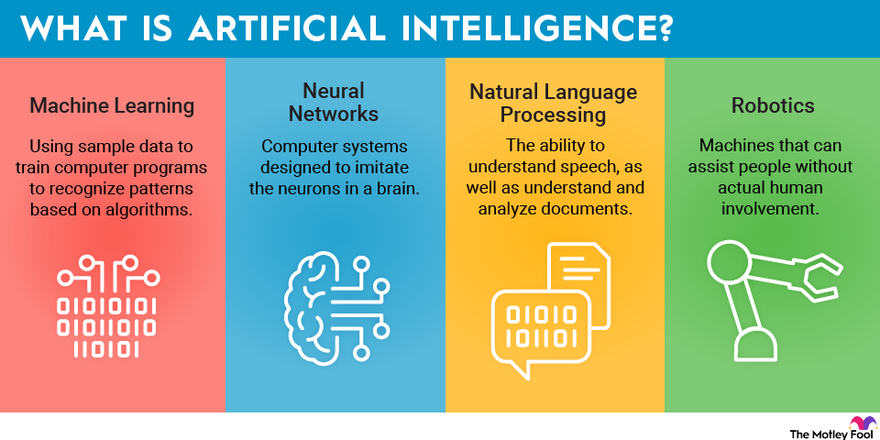
Artificial Intelligence (AI) refers to the simulation of human intelligence in machines, enabling them to perform tasks such as learning, reasoning, problem-solving, and decision-making. The rise of AI represents one of the most significant technological revolutions in human history, reshaping industries, economies, and daily life. From its early theoretical underpinnings to today’s advanced systems, AI has evolved through waves of innovation, each building upon the last to create increasingly sophisticated capabilities. The field of AI encompasses a broad spectrum of subfields, including machine learning, natural language processing (NLP), computer vision, robotics, and expert systems. These technologies are not only automating routine tasks but also enabling breakthroughs in fields such as medicine, finance, and climate science. As AI continues to advance, it poses both unprecedented opportunities and ethical challenges, prompting global discussions on governance, bias, and the future of work.
#History / Background
#Early Foundations (Pre-1950s)
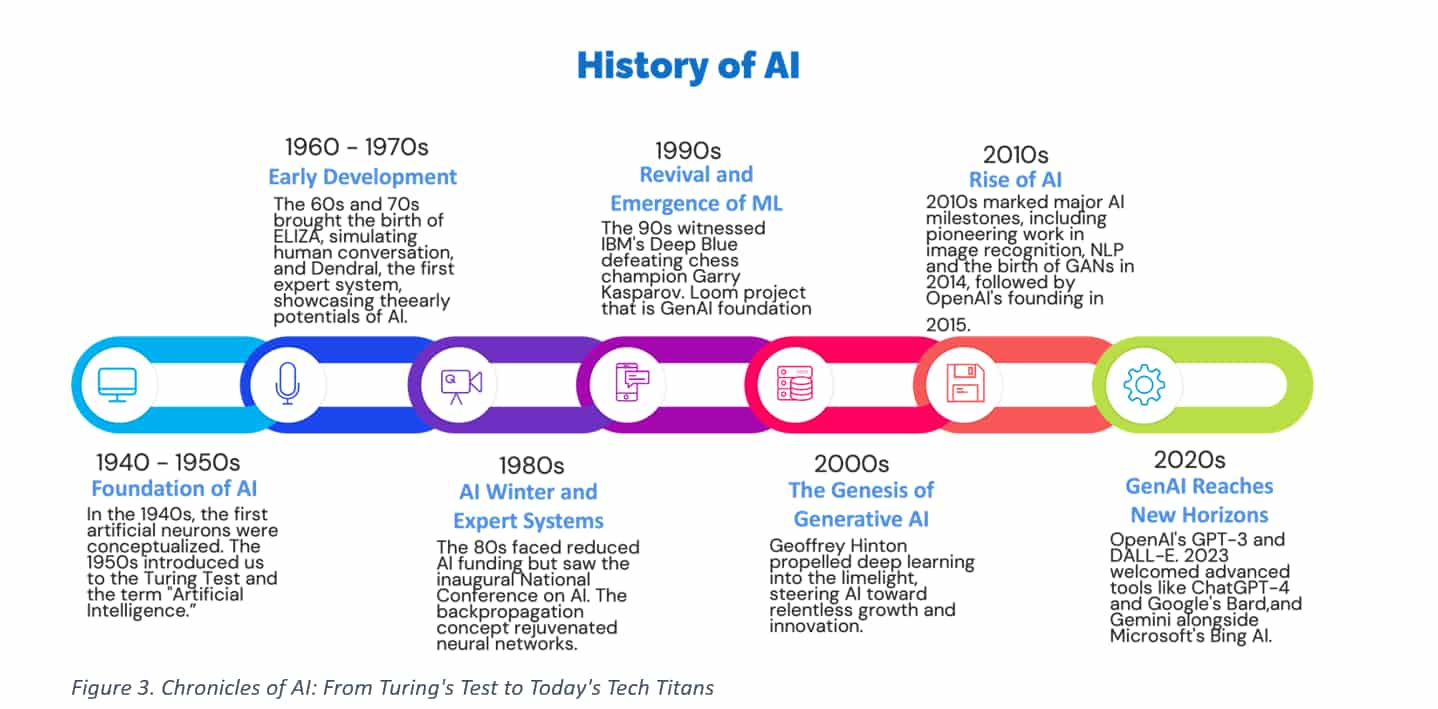
The conceptual roots of AI can be traced back to ancient myths and philosophical inquiries about human cognition and the possibility of creating artificial beings. However, the formal study of AI began in the mid-20th century, driven by advancements in mathematics, logic, and computing.
- 1943: Warren McCulloch and Walter Pitts published a paper on artificial neurons, laying the groundwork for neural networks.
- 1950: Alan Turing proposed the "Turing Test" as a criterion for machine intelligence, challenging the notion of whether machines could exhibit human-like thought.
- 1951: The first AI program, written by Christopher Strachey for checkers, and Dietrich Prinz’s chess-playing program, demonstrated early computational problem-solving.
#The Birth of AI (1956–1970s)
The term "Artificial Intelligence" was coined in 1956 during the Dartmouth Conference, organized by John McCarthy, Marvin Minsky, Nathaniel Rochester, and Claude Shannon. This event is widely regarded as the official birth of AI as a distinct field of study.
- 1956: The Logic Theorist, developed by Allen Newell and Herbert Simon, solved mathematical problems by mimicking human reasoning.
- 1958: John McCarthy invented LISP, a programming language that became fundamental to AI research.
- 1966: ELIZA, an early natural language processing program created by Joseph Weizenbaum, simulated human conversation, marking a milestone in NLP.
- 1969: Shakey the Robot, developed at Stanford Research Institute, became the first general-purpose mobile robot to reason about its actions.
#The AI Winter (1970s–1980s)
Despite early enthusiasm, AI research faced significant setbacks due to overpromising and underdelivering on expectations. Limited computational power and the complexity of real-world problems led to reduced funding and interest, a period known as the "AI Winter."
- 1973: The Lighthill Report in the UK criticized AI research, leading to reduced government funding.
- 1980s: Expert systems, such as MYCIN for medical diagnosis, gained traction by applying rule-based logic to specific domains. However, these systems were brittle and struggled with scalability.
#The Revival (1990s–2000s)
The resurgence of AI in the 1990s and 2000s was fueled by advances in computing power, data availability, and algorithmic innovations.
- 1997: IBM’s Deep Blue defeated world chess champion Garry Kasparov, demonstrating the potential of AI in complex strategic games.
- 2006: Geoffrey Hinton’s work on deep learning reignited interest in neural networks, leading to breakthroughs in image and speech recognition.
- 2011: IBM Watson won Jeopardy!, showcasing AI’s ability to understand and process natural language at a human level.
#The Modern Era (2010s–Present)
The 2010s marked the dawn of the deep learning revolution, driven by big data, cloud computing, and improved hardware like GPUs.
- 2012: AlexNet, a deep convolutional neural network, achieved unprecedented accuracy in the ImageNet competition, sparking widespread adoption of deep learning.
- 2016: AlphaGo, developed by DeepMind, defeated Lee Sedol in the ancient board game Go, a feat previously thought to be decades away.
- 2020s: AI systems like DALL·E, Stable Diffusion, and large language models (e.g., GPT-3, GPT-4) have demonstrated remarkable capabilities in generating human-like text, images, and even music.
#How It Works
#Core Concepts AI systems operate through a combination of algorithms, data, and computational power. The primary approaches include:
- Rule-Based Systems: Early AI relied on predefined rules to make decisions. For example, expert systems used if-then logic to diagnose diseases or troubleshoot equipment.
- Machine Learning (ML): A subset of AI where models learn patterns from data without explicit programming. ML includes:
- Supervised Learning: Models are trained on labeled data (e.g., spam detection).
- Unsupervised Learning: Models identify patterns in unlabeled data (e.g., customer segmentation).
- Reinforcement Learning: Models learn by interacting with an environment and receiving rewards (e.g., AlphaGo).
- Deep Learning: A specialized form of ML that uses neural networks with multiple layers (deep neural networks) to model complex data structures. Convolutional Neural Networks (CNNs) excel in image recognition, while Recurrent Neural Networks (RNNs) and Transformers are used for sequential data like text.
#Key Technologies
- Neural Networks: Inspired by the human brain, these networks consist of interconnected nodes (neurons) that process information in layers. Deep learning architectures, such as CNNs and Transformers, have driven recent advancements.
- Natural Language Processing (NLP): Enables machines to understand, interpret, and generate human language. Techniques include tokenization, sentiment analysis, and language modeling (e.g., BERT, GPT).
- Computer Vision: Allows machines to interpret and analyze visual data. Applications include facial recognition, autonomous vehicles, and medical imaging.
- Robotics: Combines AI with mechanical systems to perform physical tasks, from manufacturing to surgery.
#Data and Computation AI’s progress is heavily dependent on data and computational resources. Large datasets (e.g., ImageNet, Common Crawl) are essential for training models, while high-performance computing (HPC) and cloud infrastructure enable scalable processing. Graphics Processing Units (GPUs) and Tensor Processing Units (TPUs) have accelerated training times for deep learning models.
#Important Facts
- AI is Ubiquitous: AI technologies are embedded in everyday devices, from smartphones (voice assistants like Siri and Alexa) to smart home systems and recommendation algorithms (e.g., Netflix, Amazon).
- Economic Impact: The global AI market is projected to reach over $1.8 trillion by 2030, with applications in healthcare alone expected to save $150 billion annually by 2030.
- Ethical Concerns: AI raises ethical issues such as algorithmic bias, privacy violations, and job displacement. Initiatives like AI ethics guidelines and regulatory frameworks (e.g., the EU AI Act) aim to address these challenges.
- Human-AI Collaboration: AI augments human capabilities rather than replacing them entirely. For example, AI assists doctors in diagnosing diseases and engineers in designing complex systems.
- Explainability: Many AI models, particularly deep learning systems, operate as "black boxes," making it difficult to interpret their decisions. Research in explainable AI (XAI) seeks to improve transparency.
#Timeline
- Foundational ideas
Core concepts and early methods shape The Rise of AI: a Historical Perspective.
- Practical use
Tools, examples, and real-world deployments make the topic easier to evaluate.
- Responsible implementation
Current work focuses on reliability, governance, performance, and measurable impact.
#Related Terms
#FAQ
What does The Rise of AI: a Historical Perspective cover?
Traces the rise of ai: a historical perspective, highlighting major milestones, context, examples, and future implications.
Why is The Rise of AI: a Historical Perspective important?
It helps readers understand key concepts, compare practical use cases, and evaluate how Artificial Intelligence decisions affect outcomes, risks, and implementation choices.
What should readers verify before applying this topic?
Readers should compare benefits, limitations, data requirements, and related themes such as Rise, AI, Historical before using the ideas in real projects.
#References
- The Rise of AI: a Historical Perspective terminology and background research
- The Rise of AI: a Historical Perspective use cases, implementation examples, and limitations
- Artificial Intelligence best practices, standards, and risk guidance
- Rise case studies, benchmarks, and current industry analysis


Comments
No comments yet. Start the discussion with a useful note.