

#Short Answer
Covers meaning of artificial intelligence, including core concepts, practical examples, benefits, limitations, and risks in Artificial Intelligence.
#Infobox
#Overview
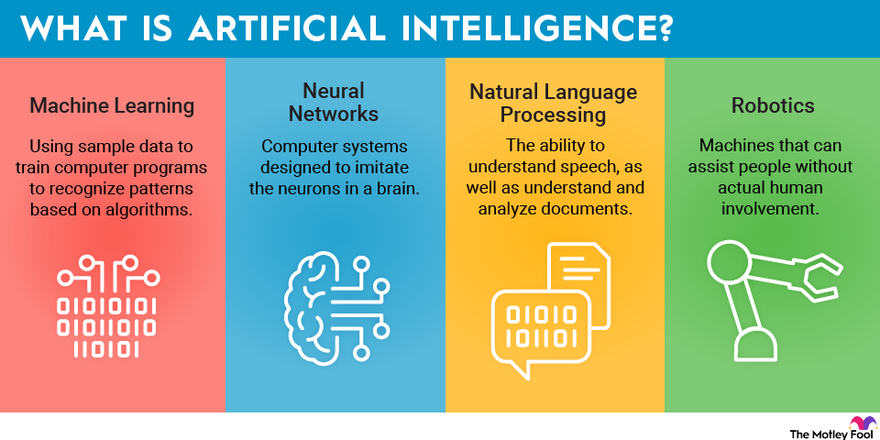
Artificial Intelligence (AI) is a branch of computer science focused on creating systems capable of performing tasks that typically require human intelligence. These tasks include learning, reasoning, problem-solving, perception, and language comprehension. AI systems are designed to analyze vast amounts of data, identify patterns, and make decisions with minimal human intervention. The field of AI is broadly categorized into Narrow AI (designed for specific tasks) and General AI (hypothetical systems with human-like cognitive abilities). While Narrow AI is already prevalent in everyday applications—such as virtual assistants, recommendation algorithms, and autonomous vehicles—General AI remains a theoretical goal. AI technologies are powered by algorithms, statistical models, and computational power. Machine Learning (ML), a subset of AI, enables systems to improve their performance over time by learning from data without explicit programming. Deep Learning, a further specialization, uses neural networks with multiple layers to model complex patterns, driving advancements in fields like image recognition and natural language processing.
#History / Background
#Early Foundations (1940s–1950s)
The concept of AI emerged from early work in cybernetics and formal logic. In 1943, Warren McCulloch and Walter Pitts proposed a mathematical model of artificial neurons, laying the groundwork for neural networks. Alan Turing’s 1950 paper "Computing Machinery and Intelligence" introduced the Turing Test, a criterion for determining a machine’s ability to exhibit intelligent behavior equivalent to, or indistinguishable from, that of a human. The term "Artificial Intelligence" was coined in 1956 during the Dartmouth Conference, organized by John McCarthy, Marvin Minsky, Nathaniel Rochester, and Claude Shannon. This event is widely regarded as the birth of AI as a formal discipline.
#The Golden Years (1956–1974)
This period saw rapid progress in AI research. Programs like Logic Theorist (1956) and General Problem Solver (1957) demonstrated early capabilities in symbolic reasoning. In 1958, John McCarthy developed LISP, a programming language that became fundamental to AI development. The ELIZA chatbot (1966), created by Joseph Weizenbaum, simulated human conversation and sparked interest in natural language processing. However, limitations in computational power and data availability constrained further advancements.
#The AI Winter (1974–1980)
Funding cuts and unmet expectations led to a decline in AI research, known as the AI Winter. Critics argued that AI systems were overly ambitious and lacked practical applications. During this time, expert systems—rule-based programs designed to mimic human expertise—gained traction, particularly in medical and industrial domains.
#Revival and Expansion (1980–2000)
The 1980s saw a resurgence in AI interest, fueled by advancements in expert systems and the Japanese Fifth Generation Computer Systems project. Companies like IBM and Xerox invested in AI research, leading to breakthroughs in speech recognition and machine translation. In 1997, IBM’s Deep Blue defeated world chess champion Garry Kasparov, marking a significant milestone in AI’s ability to compete with humans in complex strategic games. The late 1990s also saw the rise of data mining and predictive analytics, leveraging AI to extract insights from large datasets.
#The Modern Era (2000–Present)
The 21st century has witnessed an explosion in AI capabilities, driven by exponential growth in computational power, the availability of big data, and advances in algorithms. Key developments include:
- 2011: IBM Watson defeated human champions on the quiz show Jeopardy!, showcasing AI’s prowess in natural language understanding.
- 2012: The ImageNet competition demonstrated the superiority of deep learning models in image classification.
- 2016: Google’s AlphaGo defeated Lee Sedol, a top Go player, using deep reinforcement learning.
- 2020s: The proliferation of generative AI models, such as DALL·E and ChatGPT, has democratized AI, enabling creative and conversational applications. Today, AI is integrated into nearly every industry, from healthcare (diagnostic imaging, drug discovery) to finance (fraud detection, algorithmic trading) and transportation (self-driving cars).
#How It Works
#Core Principles AI systems operate by processing data, identifying patterns, and making decisions based on learned models. The process typically involves:
- Data Collection: Gathering relevant datasets from sources such as sensors, databases, or user interactions.
- Data Preprocessing: Cleaning, normalizing, and transforming raw data into a format suitable for analysis.
- Model Training: Using algorithms to train models on the preprocessed data. This step may involve supervised learning (labeled data), unsupervised learning (unlabeled data), or reinforcement learning (reward-based feedback).
- Inference: Applying the trained model to new data to generate predictions or decisions.
- Evaluation: Assessing the model’s performance using metrics like accuracy, precision, recall, or F1-score.
#Key Techniques
- Machine Learning (ML): Algorithms that improve automatically through experience. Subfields include:
- Supervised Learning: Models learn from labeled data (e.g., classification, regression).
- Unsupervised Learning: Models identify patterns in unlabeled data (e.g., clustering, dimensionality reduction).
- Reinforcement Learning: Models learn by interacting with an environment and receiving rewards or penalties (e.g., robotics, game-playing AI).
- Deep Learning: A subset of ML that uses neural networks with multiple layers (deep neural networks) to model complex patterns. Applications include:
- Convolutional Neural Networks (CNNs): Used for image and video recognition.
- Recurrent Neural Networks (RNNs): Used for sequential data, such as time-series analysis or natural language processing.
- Transformers: A architecture introduced in 2017 that revolutionized NLP, enabling models like BERT and GPT.
- Natural Language Processing (NLP): Enables machines to understand, interpret, and generate human language. Techniques include:
- Tokenization: Breaking text into words or phrases.
- Sentiment Analysis: Determining the emotional tone of a text.
- Machine Translation: Automatically translating text between languages.
- Computer Vision: Enables machines to interpret and analyze visual information from the world. Applications include:
- Object Detection: Identifying and locating objects in images.
- Facial Recognition: Analyzing and identifying human faces.
- Medical Imaging: Assisting in diagnosing diseases from X-rays or MRIs.
#AI Architecture Modern AI systems often rely on neural networks, which are inspired by the structure of the human brain. A neural network consists of:
- Input Layer: Receives raw data.
- Hidden Layers: Perform computations and extract features.
- Output Layer: Produces the final prediction or decision. The backpropagation algorithm is used to train neural networks by adjusting weights based on the error of the output. Optimization techniques like gradient descent help minimize this error.
#Important Facts
- AI vs. Human Intelligence: While AI excels at specific tasks (e.g., playing chess, recognizing faces), it lacks general intelligence and consciousness. Current AI systems are narrow in scope and cannot perform tasks outside their training.
- Bias in AI: AI models can perpetuate biases present in their training data, leading to unfair or discriminatory outcomes. Addressing bias is a critical challenge in AI ethics.
- Explainability: Many AI models, particularly deep learning systems, operate as "black boxes," making it difficult to understand how they arrive at decisions. Explainable AI (XAI) aims to address this issue.
- Energy Consumption: Training large AI models requires significant computational resources, contributing to high energy consumption. Efforts are underway to develop more energy-efficient algorithms.
- Regulation: Governments worldwide are implementing regulations to govern AI development and deployment, focusing on ethics, transparency, and accountability. Examples include the EU AI Act and the Algorithmic Accountability Act in the U.S.
- Job Displacement: AI automation is expected to disrupt certain job markets, particularly in routine-based roles. However, it is also creating new opportunities in AI development, data science, and related fields.
- Singularity Hypothesis: Some theorists, like Ray Kurzweil, predict that AI could eventually surpass human intelligence, leading to a technological singularity where machines continuously improve themselves beyond human control.
#Timeline
- Foundational ideas
Core concepts and early methods shape Meaning of Artificial Intelligence.
- Practical use
Tools, examples, and real-world deployments make the topic easier to evaluate.
- Responsible implementation
Current work focuses on reliability, governance, performance, and measurable impact.
#Related Terms
#FAQ
What does Meaning of Artificial Intelligence cover?
Covers meaning of artificial intelligence, including core concepts, practical examples, benefits, limitations, and risks in Artificial Intelligence.
Why is Meaning of Artificial Intelligence important?
It helps readers understand key concepts, compare practical use cases, and evaluate how Artificial Intelligence decisions affect outcomes, risks, and implementation choices.
What should readers verify before applying this topic?
Readers should compare benefits, limitations, data requirements, and related themes such as Meaning, Artificial, Intelligence before using the ideas in real projects.
#References
- Meaning of Artificial Intelligence terminology and background research
- Meaning of Artificial Intelligence use cases, implementation examples, and limitations
- Artificial Intelligence best practices, standards, and risk guidance
- Meaning case studies, benchmarks, and current industry analysis

Comments
No comments yet. Start the discussion with a useful note.