

#Short Answer
Compares TensorFlow vs PyTorch: Which Is Better, covering key differences, advantages, limitations, and selection criteria.
#Infobox
#Overview
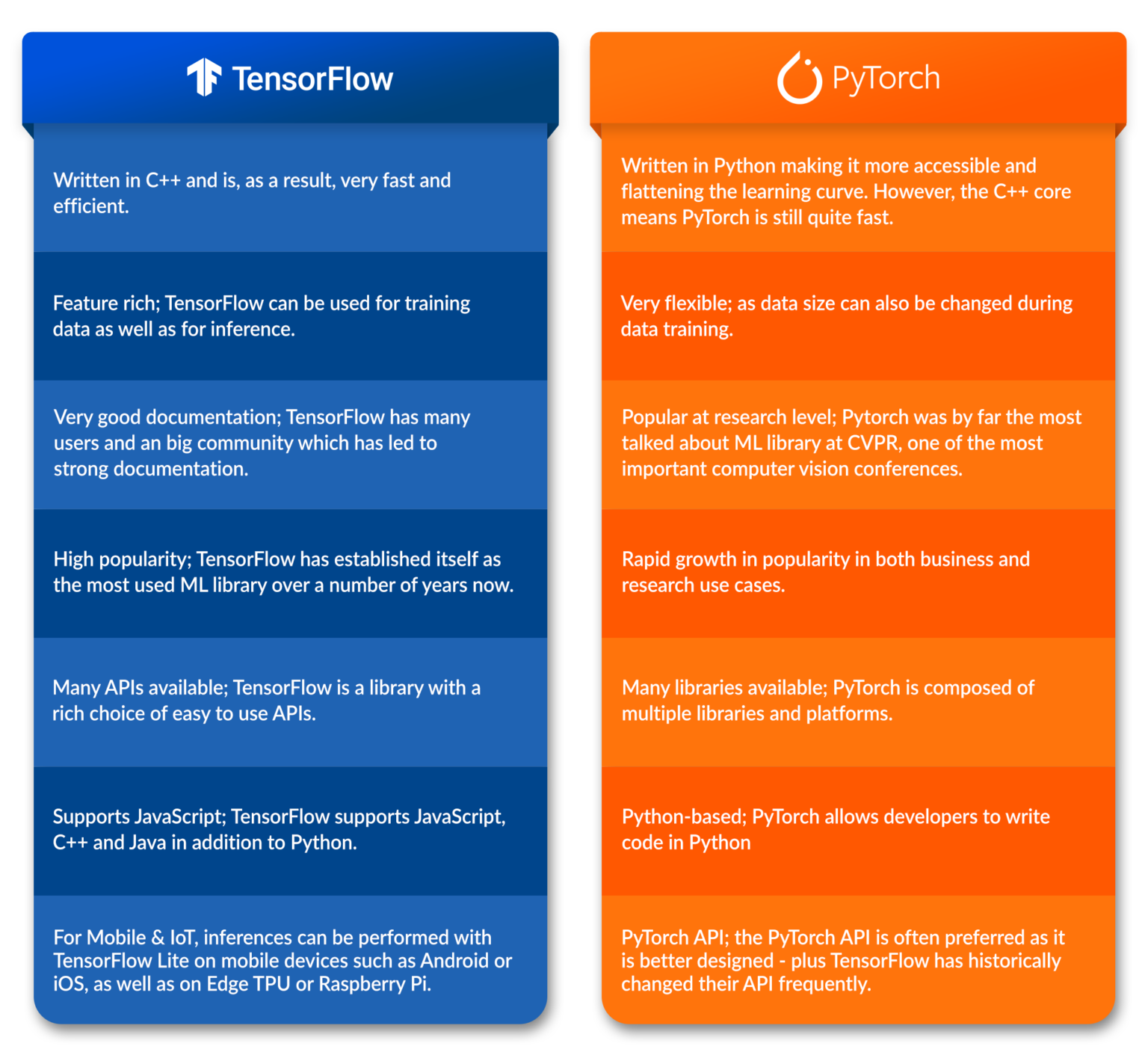
TensorFlow and PyTorch are the two dominant open-source frameworks in deep learning, each powering a vast array of applications from computer vision to natural language processing. Developed by Google and Meta (formerly Facebook), respectively, these frameworks have reshaped how researchers and engineers approach machine learning (ML) tasks. While TensorFlow emphasizes scalability and deployment in production environments, PyTorch prioritizes intuitive design and dynamic computation, making it a favorite in academic and exploratory research. The rivalry between TensorFlow and PyTorch has driven rapid innovation in the ML ecosystem, with both frameworks continuously evolving to incorporate cutting-edge techniques like distributed training, auto-differentiation, and hardware acceleration. Their competition has also led to improved interoperability, with tools like ONNX (Open Neural Network Exchange) enabling cross-framework model sharing.
#History / Background
#TensorFlow TensorFlow originated from Google Brain’s internal project, DistBelief, a proprietary deep learning framework used for large-scale ML tasks. In 2015, Google open-sourced TensorFlow under the Apache License 2.0, aiming to democratize AI development. The framework’s first public release (TensorFlow 1.0) in November 2015 introduced a static computation graph, which, while efficient for deployment, posed challenges for dynamic research workflows. Key milestones in TensorFlow’s evolution include:
- 2017: Introduction of Keras as TensorFlow’s high-level API, simplifying model building.
- 2019: Release of TensorFlow 2.0, which adopted eager execution by default, aligning with PyTorch’s dynamic approach.
- 2020: Launch of TensorFlow Extended (TFX), a production-ready ML pipeline toolkit.
- 2021: Introduction of TensorFlow Lite for mobile and edge devices.
#PyTorch PyTorch emerged from Torch, a scientific computing framework based on the Lua programming language. In 2016, Facebook’s AI Research (FAIR) team, led by Soumith Chintala, released PyTorch as a Python-first alternative with a dynamic computation graph. Its design closely mirrored NumPy’s syntax, making it accessible to Python developers. Key milestones in PyTorch’s evolution include:
- 2017: PyTorch 0.2 introduced TorchScript, enabling model serialization and deployment.
- 2018: Integration with Caffe2, enhancing scalability for production use.
- 2019: Release of TorchVision, a library for computer vision tasks.
- 2020: PyTorch 1.6 introduced TorchElastic, supporting distributed training across clusters.
- 2022: PyTorch 2.0 introduced TorchDynamo, optimizing dynamic graphs for performance.
#How It Works
#TensorFlow TensorFlow operates on a dataflow graph paradigm, where computations are represented as nodes (operations) and edges (tensors). Initially, TensorFlow used a static graph (TensorFlow 1.x), where the entire computation graph was defined before execution. This approach enabled optimizations like XLA (Accelerated Linear Algebra) compilation but required cumbersome session management. In TensorFlow 2.x, eager execution became the default, allowing immediate evaluation of operations like standard Python code. Key components include:
- Tensors: Multi-dimensional arrays representing data.
- Operations (Ops): Mathematical computations (e.g., matrix multiplication, activation functions).
- Variables: Stateful tensors that can be updated during training.
- Graphs: Static representations of computation for optimization and deployment. TensorFlow’s ecosystem includes:
- Keras: A high-level API for rapid prototyping.
- TFX: Tools for data validation, model training, and serving.
- TensorFlow Lite: Lightweight framework for mobile and embedded devices.
#PyTorch PyTorch employs a define-by-run paradigm, where the computation graph is constructed dynamically during execution. This approach mirrors Python’s flexibility, allowing developers to use conditional statements and loops in their models without pre-defining the graph. Key components of PyTorch include:
- Tensors: Similar to NumPy arrays but with GPU acceleration.
- Autograd: Automatic differentiation engine for gradient computation.
- Modules: Neural network layers (e.g.,
nn.Linear,nn.Conv2d). - Optimizers: Algorithms for updating model parameters (e.g., Adam, SGD). PyTorch’s ecosystem includes:
- TorchVision: Pre-trained models and datasets for computer vision.
- TorchText: Tools for NLP tasks.
- TorchAudio: Audio processing libraries.
- TorchScript: Serialization format for deploying models in non-Python environments.
#Important Facts
#Performance
- Training Speed: PyTorch’s dynamic graph can introduce overhead in some cases, but optimizations like TorchDynamo (PyTorch 2.0) and XLA (TensorFlow) narrow the gap.
- Inference: TensorFlow’s static graph often outperforms PyTorch in production due to optimizations like graph pruning and quantization.
- GPU Utilization: Both frameworks support CUDA, but TensorFlow’s integration with TensorRT (NVIDIA’s inference optimizer) gives it an edge in deployment.
#Community and Adoption
- GitHub Stars: PyTorch surpassed TensorFlow in GitHub stars in 2018 and continues to lead (~60% vs. ~40% of ML projects in 2023).
- Research Papers: PyTorch is the framework of choice for ~70% of recent ML research papers (as of 2023), according to Papers With Code.
- Industry Use: TensorFlow dominates in enterprise environments (e.g., Google Cloud, AWS SageMaker), while PyTorch is prevalent in academia and startups.
#Learning Curve
- TensorFlow: Steeper initial learning curve due to its static graph legacy and complex APIs (e.g.,
tf.function,tf.GradientTape). - PyTorch: More intuitive for Python developers, with a syntax closely resembling NumPy and PyTorch’s eager execution model.
#Timeline
- Foundational ideas
Core concepts and early methods shape TensorFlow vs PyTorch: Which Is Better?.
- Practical use
Tools, examples, and real-world deployments make the topic easier to evaluate.
- Responsible implementation
Current work focuses on reliability, governance, performance, and measurable impact.
#Related Terms
#FAQ
What does TensorFlow vs PyTorch: Which Is Better? cover?
Compares TensorFlow vs PyTorch: Which Is Better, covering key differences, advantages, limitations, and selection criteria.
Why is TensorFlow vs PyTorch: Which Is Better? important?
It helps readers understand key concepts, compare practical use cases, and evaluate how Machine Learning decisions affect outcomes, risks, and implementation choices.
What should readers verify before applying this topic?
Readers should compare benefits, limitations, data requirements, and related themes such as TensorFlow, PyTorch, Which before using the ideas in real projects.
#References
- TensorFlow vs PyTorch: Which Is Better? terminology and background research
- TensorFlow vs PyTorch: Which Is Better? use cases, implementation examples, and limitations
- Machine Learning best practices, standards, and risk guidance
- TensorFlow case studies, benchmarks, and current industry analysis


Comments
No comments yet. Start the discussion with a useful note.