

#Short Answer
Compares Python vs R for AI: Which to Choose, covering key differences, advantages, limitations, and selection criteria.
#Infobox
#Overview
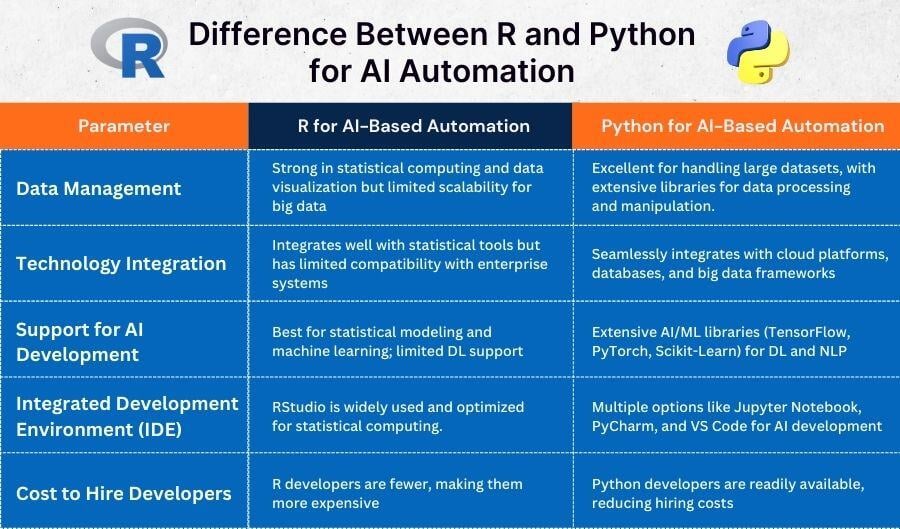
The debate between Python and R for AI development centers on their distinct strengths and use cases. Python, a general-purpose language, has become the de facto standard for machine learning (ML), deep learning, and AI automation due to its readability, scalability, and rich ecosystem of libraries. R, on the other hand, is a statistical programming language designed for data analysis, visualization, and research, making it ideal for tasks requiring advanced statistical modeling. While both languages can perform similar tasks, their design philosophies differ significantly. Python prioritizes simplicity and flexibility, enabling developers to build complex AI systems with minimal overhead. R, conversely, excels in statistical rigor and reproducibility, making it a favorite among researchers and statisticians. The choice between the two often hinges on the specific requirements of the project, the user’s background, and the desired outcomes.
#History / Background
#Python Python was created in 1991 by Guido van Rossum as a successor to the ABC language. Initially designed as a general-purpose, high-level programming language, Python’s emphasis on readability and clean syntax quickly garnered attention in the scientific and academic communities. By the early 2000s, Python had become a popular choice for data science and AI development, thanks to libraries like NumPy (2006) and SciPy (2001). The rise of deep learning in the 2010s further cemented Python’s dominance in AI. Frameworks such as TensorFlow (2015) and PyTorch (2016) provided developers with powerful tools for building neural networks, accelerating Python’s adoption in both industry and academia. Today, Python is the most widely used language for AI automation, powering applications in computer vision, natural language processing (NLP), and reinforcement learning.
#R R was developed in 1993 by Ross Ihaka and Robert Gentleman at the University of Auckland as an implementation of the S language, which was itself inspired by Lisp and Scheme. Unlike Python, R was explicitly designed for statistical computing and data analysis, making it a staple in academic research, particularly in fields like biostatistics, econometrics, and epidemiology. The language’s vectorized operations and built-in statistical functions made it an attractive choice for researchers who needed to perform complex analyses without extensive programming. Over time, R evolved to include powerful data visualization tools like ggplot2 (2005), which became a standard for creating publication-quality graphs. While R’s growth in AI has been slower than Python’s, it remains a dominant force in statistical modeling, hypothesis testing, and reproducible research.
#How It Works
#Python in AI Python’s role in AI is primarily driven by its ecosystem of libraries and frameworks, which simplify the development of complex models. Key components include:
- Machine Learning Libraries:
- Scikit-learn: Provides tools for supervised and unsupervised learning, including classification, regression, and clustering.
- TensorFlow and PyTorch: Deep learning frameworks that enable the creation of neural networks, transformers, and generative models.
- Keras: A high-level API for building neural networks, often used in conjunction with TensorFlow.
- Data Processing:
- Pandas: A library for data manipulation and analysis, offering data structures like DataFrames.
- NumPy: Provides support for numerical computing, including multi-dimensional arrays and linear algebra operations.
- Automation and Deployment:
- FastAPI and Flask: Frameworks for building AI-powered web applications.
- Docker and Kubernetes: Tools for deploying AI models in production environments. Python’s interpreted nature and dynamic typing allow for rapid prototyping, while its extensive documentation and community support make it accessible to both beginners and experts.
#R in AI R’s strengths in AI lie in its statistical capabilities and data visualization tools. Key components include:
- Statistical Modeling:
- Base R: Includes functions for linear regression, ANOVA, and time-series analysis.
- caret: A package for machine learning, providing a unified interface for training models.
- lme4: Used for mixed-effects modeling, common in biological and social sciences.
- Data Visualization:
- ggplot2: A grammar of graphics-based system for creating customizable plots.
- plotly: Enables interactive visualizations, useful for exploring high-dimensional data.
- Reproducible Research:
- R Markdown: Allows users to combine code, text, and visualizations in a single document.
- Shiny: A framework for building interactive web applications directly from R. R’s functional programming paradigm and focus on statistics make it ideal for tasks requiring precision and reproducibility. However, its steeper learning curve and slower performance on large datasets can be limiting for some AI applications.
#Important Facts
- Python is the most popular language for AI, according to surveys like the Stack Overflow Developer Survey and Kaggle’s State of Data Science Report.
- R is the second most used language in data science, trailing only Python, but it dominates in academic research and statistical publications.
- Python’s PyPI (Python Package Index) hosts over 400,000 packages, including many specialized for AI, while R’s CRAN (Comprehensive R Archive Network) contains over 18,000 packages, primarily focused on statistics and data analysis.
- Performance: Python is generally faster for large-scale AI tasks due to its optimized libraries (e.g., TensorFlow, PyTorch), while R can be slower when processing big datasets.
- Job Market: Python is more in demand for AI roles in industry, particularly in tech companies, whereas R is more common in research institutions and financial sectors.
- Integration: Python can easily integrate with C++, Java, and other languages, making it versatile for enterprise AI solutions. R, while less flexible, excels in statistical computing and data wrangling.
- Community: Python’s community is larger and more diverse, with active contributions from Google, Microsoft, and Facebook. R’s community is smaller but highly specialized, with strong ties to academia.
#Timeline
- Foundational ideas
Core concepts and early methods shape Python vs R for AI: Which to Choose?.
- Practical use
Tools, examples, and real-world deployments make the topic easier to evaluate.
- Responsible implementation
Current work focuses on reliability, governance, performance, and measurable impact.
#Related Terms
#FAQ
What does Python vs R for AI: Which to Choose? cover?
Compares Python vs R for AI: Which to Choose, covering key differences, advantages, limitations, and selection criteria.
Why is Python vs R for AI: Which to Choose? important?
It helps readers understand key concepts, compare practical use cases, and evaluate how Artificial Intelligence decisions affect outcomes, risks, and implementation choices.
What should readers verify before applying this topic?
Readers should compare benefits, limitations, data requirements, and related themes such as Python, AI, Which before using the ideas in real projects.
#References
- Python vs R for AI: Which to Choose? terminology and background research
- Python vs R for AI: Which to Choose? use cases, implementation examples, and limitations
- Artificial Intelligence best practices, standards, and risk guidance
- Python case studies, benchmarks, and current industry analysis



Comments
No comments yet. Start the discussion with a useful note.