

#Short Answer
Compares Open-source vs Proprietary AI: Which to Use, covering key differences, advantages, limitations, and selection criteria.
#Infobox
#Overview
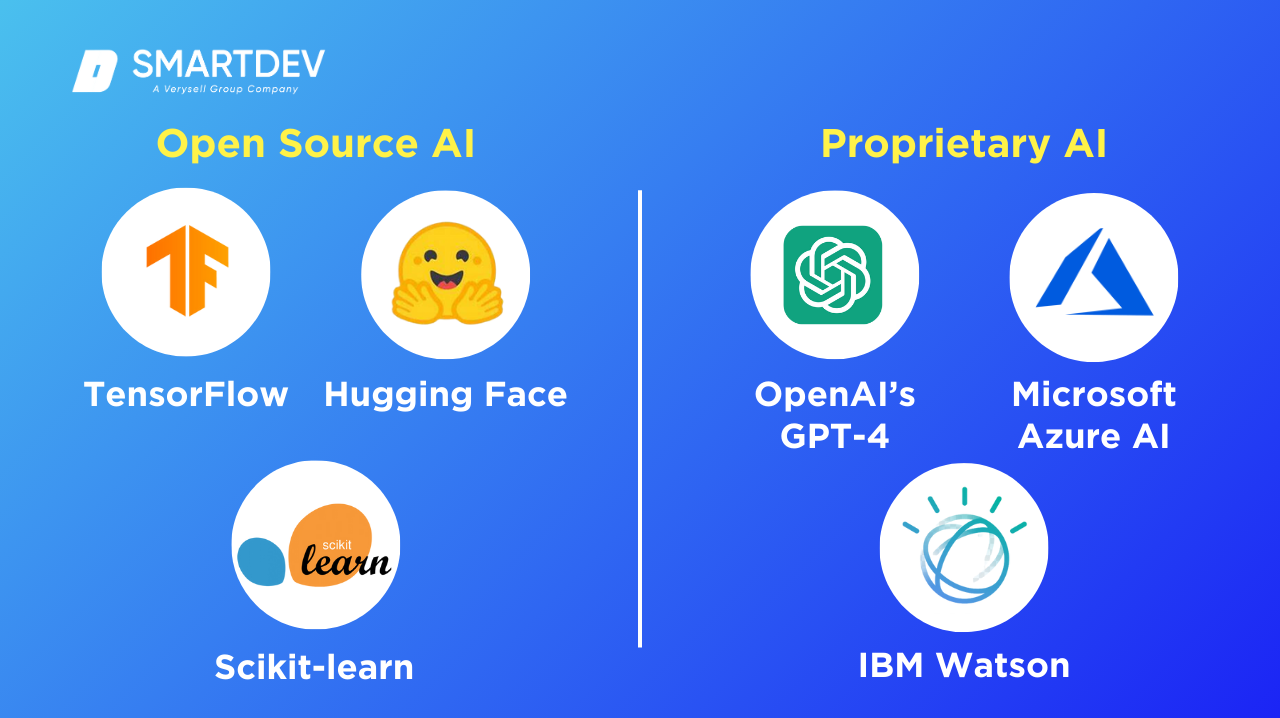
The debate between open-source AI and proprietary AI has intensified as artificial intelligence becomes integral to industries ranging from healthcare to finance. Open-source AI refers to AI models, frameworks, and tools whose source code is publicly available, allowing users to modify, distribute, and enhance them. In contrast, proprietary AI consists of closed-source solutions developed by corporations, often delivered as cloud-based services or licensed software. The choice between the two hinges on cost efficiency, flexibility, and scalability. Open-source AI is favored by developers, startups, and researchers who require customization and control, while proprietary AI appeals to enterprises and institutions seeking plug-and-play solutions with minimal technical overhead. However, both models have evolved to address different needs, with some organizations adopting hybrid approaches that combine the strengths of each.
#History / Background
#Early Developments
in AI (1950s–1990s)
The origins of AI trace back to the mid-20th century, with early research focused on symbolic AI and rule-based systems. During this period, AI development was largely academic and open, with institutions like MIT and Stanford sharing research freely. However, proprietary interests began to emerge as AI applications expanded into commercial sectors.
#Rise of Proprietary AI (1990s–2010s)
The late 20th century saw the rise of corporate AI research, with companies like IBM, Microsoft, and Google investing in closed-source AI systems. Proprietary AI gained traction due to its scalability, ease of integration, and vendor support. The 2010s marked a turning point with the advent of deep learning, which required significant computational resources—often only accessible to large corporations.
#Open-Source AI Revolution (2015–Present)
The open-source AI movement gained momentum with the release of frameworks like TensorFlow (2015) and PyTorch (2016), both developed by tech giants but released under open licenses. The Hugging Face Transformers library (2018) further democratized AI by providing pre-trained models for natural language processing (NLP). This shift enabled smaller organizations and individuals to build and deploy AI models without prohibitive costs.
#Regulatory and Ethical Considerations As AI adoption grew, so did concerns about bias, privacy, and accountability. Open-source AI advocates argue that transparency reduces risks, while proprietary AI proponents highlight vendor-managed compliance as a safeguard. Regulations like the EU AI Act (2024) have further influenced the landscape, pushing organizations to weigh risk management against innovation speed.
#How It Works
#Open-Source AI: Architecture and Workflow Open-source AI systems are built on modular frameworks that allow users to:
- Download and modify pre-trained models (e.g., Stable Diffusion for image generation).
- Fine-tune models using custom datasets (e.g., adapting BERT for domain-specific NLP tasks).
- Collaborate via platforms like GitHub, where developers contribute improvements. Key components include:
- Model Weights: Pre-trained parameters (e.g., weights for LLMs like Llama).
- Frameworks: Tools like PyTorch or JAX for building and training models.
- APIs: Libraries such as Hugging Face’s
transformersfor easy integration. Advantages: - Cost: No licensing fees; only infrastructure costs (e.g., cloud GPUs).
- Flexibility: Users can tweak architectures, add features, or optimize for specific hardware.
- Community Support: Bug fixes and updates are crowd-sourced. Challenges:
- Maintenance: Requires in-house expertise for updates and security patches.
- Fragmentation: Multiple forks of a project can lead to compatibility issues.
#Proprietary AI: Architecture and Workflow Proprietary AI solutions are typically cloud-based or on-premise software delivered as:
- SaaS (Software-as-a-Service): APIs for tasks like sentiment analysis (e.g., AWS Comprehend).
- Licensed Software: On-premise deployment (e.g., IBM Watson Discovery).
- Managed Services: End-to-end solutions with vendor support (e.g., Google Vertex AI). Key components include:
- Black-Box Models: Users interact via APIs without access to underlying code.
- Vendor-Owned Data: Training data and model improvements are proprietary.
- Compliance Tools: Built-in features for GDPR, HIPAA, or SOC 2 compliance. Advantages:
- Ease of Use: No need for deep technical knowledge; ready-to-deploy solutions.
- Support: Dedicated customer service and SLAs (Service Level Agreements).
- Scalability: Handles large-scale deployments with minimal setup. Challenges:
- Cost: Subscription fees, usage-based pricing, or enterprise licensing can be high.
- Vendor Lock-in: Difficult to migrate to alternative solutions.
- Limited Customization: Restricted to the vendor’s predefined features.
#Important Facts
- Cost Efficiency: - Open-source AI can reduce costs by up to 70% compared to proprietary alternatives, especially for long-term projects. - Proprietary AI may offer free tiers (e.g., AWS Free Tier) but often incurs costs at scale.
- Performance: - Open-source models like Llama 3 or Stable Diffusion XL can match or exceed proprietary models (e.g., MidJourney) in specific tasks. - Proprietary models (e.g., GPT-4) often lead in general-purpose benchmarks due to larger training datasets.
- Security Risks: - Open-source AI is vulnerable to supply-chain attacks (e.g., malicious code in dependencies). - Proprietary AI may have hidden vulnerabilities but benefits from vendor-controlled security updates.
- Ethical Considerations: - Open-source AI enables auditability, reducing risks of biased or harmful outputs. - Proprietary AI providers may restrict usage (e.g., prohibiting military applications) to align with ethical guidelines.
- Adoption Trends:
- Open-source AI dominates in academia, startups, and research labs (e.g., 60% of AI papers use PyTorch).
- Proprietary AI leads in enterprise adoption, with 78% of Fortune 500 companies using cloud-based AI services.
#Timeline
- Foundational ideas
Core concepts and early methods shape Open-source vs Proprietary AI: Which to Use?.
- Practical use
Tools, examples, and real-world deployments make the topic easier to evaluate.
- Responsible implementation
Current work focuses on reliability, governance, performance, and measurable impact.
#Related Terms
#FAQ
What does Open-source vs Proprietary AI: Which to Use? cover?
Compares Open-source vs Proprietary AI: Which to Use, covering key differences, advantages, limitations, and selection criteria.
Why is Open-source vs Proprietary AI: Which to Use? important?
It helps readers understand key concepts, compare practical use cases, and evaluate how Artificial Intelligence decisions affect outcomes, risks, and implementation choices.
What should readers verify before applying this topic?
Readers should compare benefits, limitations, data requirements, and related themes such as Open, Source, Proprietary before using the ideas in real projects.
#References
- Open-source vs Proprietary AI: Which to Use? terminology and background research
- Open-source vs Proprietary AI: Which to Use? use cases, implementation examples, and limitations
- Artificial Intelligence best practices, standards, and risk guidance
- Open case studies, benchmarks, and current industry analysis


Comments
No comments yet. Start the discussion with a useful note.