


#Short Answer
Covers meaning of deep learning, including core concepts, practical examples, benefits, limitations, and risks in Machine Learning.
#Infobox
#History / Background
Early Foundations The conceptual roots of deep learning trace back to the 1940s with the introduction of the first artificial neuron model by Warren McCulloch and Walter Pitts. Their work laid the groundwork for neural networks by proposing a simplified computational model of biological neurons. In 1958, Frank Rosenblatt developed the Perceptron, an early form of a neural network capable of learning from data. However, the Perceptron was limited to linear problems, and its capabilities were constrained by the computational resources of the time.
The AI Winter and Revival The 1970s and 1980s saw a decline in neural network research due to the limitations of single-layer models and the rise of symbolic AI approaches. This period, known as the "AI winter," lasted until the mid-1980s when Geoffrey Hinton, David Rumelhart, and Ronald Williams reintroduced the backpropagation algorithm. This algorithm enabled multi-layer neural networks to learn from errors by adjusting weights through gradient descent, reigniting interest in neural networks.
Breakthroughs in Deep Learning The term "deep learning" gained prominence in the 2000s, thanks to advancements in computational power and the availability of large datasets. In 2006, Hinton and his colleagues demonstrated that deep belief networks (DBNs) could be trained efficiently using a greedy layer-wise approach, overcoming the vanishing gradient problem that plagued earlier deep networks. This breakthrough paved the way for the development of modern deep learning architectures. A pivotal moment came in 2012 when a deep convolutional neural network (CNN) called AlexNet won the ImageNet Large Scale Visual Recognition Challenge (ILSVRC), significantly outperforming traditional methods. This victory showcased the potential of deep learning in computer vision and spurred widespread adoption across industries.
Modern Era Since then, deep learning has evolved rapidly, with innovations such as:
- Recurrent Neural Networks (RNNs): Designed for sequential data, enabling applications in natural language processing (NLP) and time-series analysis.
- Transformers: Introduced in 2017, these models revolutionized NLP by using self-attention mechanisms to process sequences in parallel, leading to the development of large language models like BERT and GPT.
- Generative Adversarial Networks (GANs): Introduced by Ian Goodfellow in 2014, GANs consist of two competing networks—a generator and a discriminator—that work together to produce realistic synthetic data. Today, deep learning continues to push the boundaries of AI, with ongoing research focused on improving efficiency, interpretability, and generalization.
#How It Works
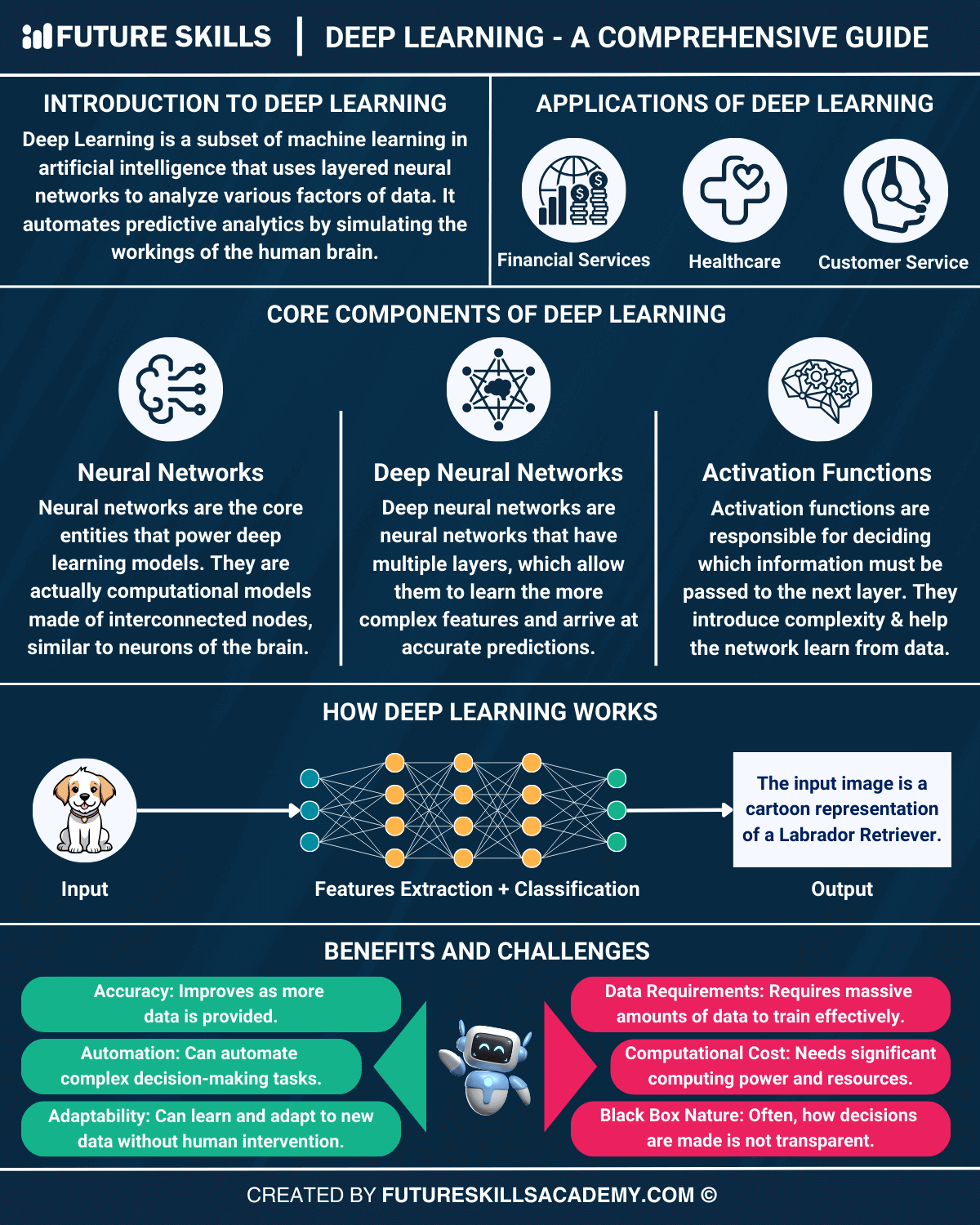
Neural Network Architecture Deep learning models are built on artificial neural networks, which consist of interconnected layers of neurons. The architecture typically includes:
- Input Layer: Receives the raw data (e.g., pixels in an image or words in a sentence).
- Hidden Layers: Intermediate layers that transform the input data through weighted connections and activation functions. The depth of these layers defines the "deep" in deep learning.
- Output Layer: Produces the final prediction or classification.
Key Components
- Neurons: Basic units of computation that apply an activation function (e.g., ReLU, sigmoid) to weighted inputs.
- Weights and Biases: Parameters that the model learns during training to minimize prediction errors.
- Activation Functions: Introduce non-linearity, enabling the network to learn complex patterns. Common functions include ReLU (Rectified Linear Unit), sigmoid, and tanh.
- Loss Function: Measures the difference between the predicted output and the actual target, guiding the optimization process.
- Optimization Algorithms: Such as stochastic gradient descent (SGD) or Adam, which adjust the weights to minimize the loss function.
Training Process
- Forward Propagation: The input data is passed through the network, layer by layer, to generate a prediction.
- Loss Calculation: The prediction is compared to the actual target using a loss function (e.g., mean squared error for regression or cross-entropy for classification).
- Backpropagation: The error is propagated backward through the network, and the weights are updated using gradient descent to reduce the loss.
- Iteration: The process repeats over multiple epochs (iterations) until the model achieves satisfactory performance.
Types of Deep Learning Models
- Feedforward Neural Networks (FNNs): The simplest form, where data flows in one direction from input to output.
- Convolutional Neural Networks (CNNs): Specialized for grid-like data (e.g., images), using convolutional layers to detect spatial hierarchies.
- Recurrent Neural Networks (RNNs): Designed for sequential data (e.g., time series or text), with loops that allow information to persist across steps.
- Long Short-Term Memory (LSTM) Networks: A type of RNN that addresses the vanishing gradient problem, making it suitable for long sequences.
- Transformers: Use self-attention mechanisms to weigh the importance of different parts of the input, enabling parallel processing of sequences.
- Autoencoders: Unsupervised models that learn to compress and reconstruct data, useful for dimensionality reduction and anomaly detection.
- Generative Adversarial Networks (GANs): Consist of a generator and discriminator that compete to produce and evaluate synthetic data.
#Important Facts
Advantages of Deep Learning
- Automatic Feature Extraction: Eliminates the need for manual feature engineering, as the model learns relevant features directly from raw data.
- Scalability: Performs exceptionally well with large datasets and complex patterns.
- Versatility: Applicable to a wide range of tasks, including image recognition, speech synthesis, and drug discovery.
- State-of-the-Art Performance: Consistently achieves top results in benchmarks across various domains.
Challenges and Limitations
- Computational Cost: Training deep learning models requires significant computational resources, often necessitating GPUs or TPUs.
- Data Hunger: Deep learning models thrive on large datasets; performance degrades with insufficient or biased data.
- Interpretability: The complexity of deep models often makes them "black boxes," challenging to interpret and explain.
- Overfitting: Models may memorize training data instead of generalizing, leading to poor performance on unseen data.
- Ethical Concerns: Issues such as bias in training data, privacy violations, and misuse in deepfake generation pose significant challenges.
Key Innovations
- Batch Normalization: Normalizes the inputs to each layer, stabilizing and accelerating training.
- Dropout: Randomly deactivates neurons during training to prevent overfitting.
- Transfer Learning: Leverages pre-trained models on new tasks, reducing the need for extensive training data.
- Attention Mechanisms: Enhances model performance by focusing on relevant parts of the input data.
#Timeline
- Foundational ideas
Core concepts and early methods shape Meaning of Deep Learning.
- Practical use
Tools, examples, and real-world deployments make the topic easier to evaluate.
- Responsible implementation
Current work focuses on reliability, governance, performance, and measurable impact.
#Related Terms
#FAQ
What does Meaning of Deep Learning cover?
Covers meaning of deep learning, including core concepts, practical examples, benefits, limitations, and risks in Machine Learning.
Why is Meaning of Deep Learning important?
It helps readers understand key concepts, compare practical use cases, and evaluate how Machine Learning decisions affect outcomes, risks, and implementation choices.
What should readers verify before applying this topic?
Readers should compare benefits, limitations, data requirements, and related themes such as Meaning, Deep, Learning before using the ideas in real projects.
#References
- Meaning of Deep Learning terminology and background research
- Meaning of Deep Learning use cases, implementation examples, and limitations
- Machine Learning best practices, standards, and risk guidance
- Meaning case studies, benchmarks, and current industry analysis
Comments
No comments yet. Start the discussion with a useful note.