


#Short Answer
Explains how to use ai for data analysis, including the main process, tools, examples, risks, and practical implementation steps.
#Infobox
#Overview
AI for data analysis refers to the application of artificial intelligence techniques to collect, process, analyze, and interpret large volumes of data with minimal human intervention. Unlike traditional statistical methods, AI-driven analysis leverages algorithms capable of learning from data, adapting to new inputs, and improving over time. This approach enables organizations to extract meaningful insights, predict trends, and automate decision-making processes. The integration of AI into data analysis has transformed industries by enabling faster, more accurate, and scalable insights. From detecting anomalies in financial transactions to personalizing customer experiences in e-commerce, AI-powered analytics has become a cornerstone of modern data-driven strategies. As data continues to grow in volume and complexity, AI provides the tools necessary to harness its full potential.
#History / Background
The evolution of AI in data analysis is closely tied to advancements in computing power, data storage, and algorithmic innovation.
- 1950s–1960s: Early AI research focused on symbolic reasoning and rule-based systems. The term "artificial intelligence" was coined in 1956 at Dartmouth College, laying the groundwork for computational problem-solving.
- 1980s–1990s: The rise of machine learning introduced algorithms like decision trees and neural networks. Expert systems gained traction in business and healthcare, though limitations in scalability and data availability persisted.
- 2000s: The explosion of digital data and improvements in computing infrastructure enabled the training of more complex models. The availability of large datasets and the rise of cloud computing made AI-driven analysis more accessible.
- 2010s–Present: Deep learning revolutionized AI by achieving breakthroughs in image recognition, natural language understanding, and predictive modeling. Frameworks like TensorFlow and PyTorch democratized AI development, while AI ethics and governance became central concerns. The convergence of big data, cloud computing, and AI has accelerated the adoption of intelligent analytics across sectors, making AI an indispensable tool in data science.
#How It Works
AI for data analysis operates through a multi-stage pipeline that transforms raw data into actionable insights.
#
- Data Collection and Ingestion Data is gathered from various sources—databases, APIs, IoT devices, logs, and user interactions. AI systems often use web scraping, ETL (Extract, Transform, Load) pipelines, and real-time streaming to ensure continuous data flow.
#
- Data Preprocessing Raw data is cleaned, normalized, and transformed to remove noise, handle missing values, and standardize formats. Techniques such as imputation, outlier detection, and feature scaling are applied. AI models may use autoencoders or generative adversarial networks (GANs) for synthetic data generation or augmentation.
#
- Feature Engineering Relevant features are extracted or engineered to improve model performance. This may involve dimensionality reduction (e.g., PCA), text vectorization (e.g., TF-IDF, word embeddings), or image feature extraction using convolutional neural networks (CNNs).
#
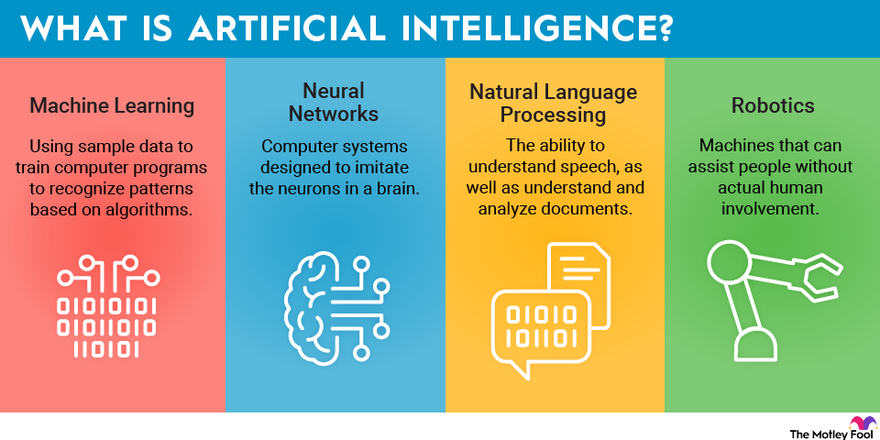
- Model Selection and Training AI models are selected based on the problem type:
- Supervised Learning: Used for classification or regression tasks (e.g., spam detection, sales forecasting).
- Unsupervised Learning: Identifies patterns in unlabeled data (e.g., clustering, anomaly detection).
- Reinforcement Learning: Optimizes decision-making through trial and error (e.g., dynamic pricing, robotics).
- Deep Learning: Handles complex data like images, audio, and text (e.g., object recognition, sentiment analysis). Models are trained using labeled datasets, with performance evaluated using metrics such as accuracy, precision, recall, F1-score, or AUC-ROC.
#
- Model Deployment and Monitoring Once trained, models are deployed into production environments where they process new data in real time or batch mode. Continuous monitoring tracks performance drift, data drift, and model decay. Feedback loops allow for retraining and model updates.
#
- Insight Generation and Visualization AI systems generate insights through dashboards, reports, and automated alerts. Natural language generation (NLG) tools can produce human-readable summaries from data, while visualization platforms like Tableau or Power BI enhance interpretability.
#Important Facts
- Speed and Scale: AI can analyze millions of data points in seconds, far exceeding human capacity.
- Pattern Recognition: AI excels at detecting subtle patterns and correlations that may elude traditional statistical methods.
- Automation: Routine analysis tasks—such as report generation or anomaly detection—can be fully automated.
- Predictive Capabilities: AI models can forecast future trends based on historical data, enabling proactive decision-making.
- Bias and Fairness: AI models can perpetuate or amplify biases present in training data, requiring careful validation and mitigation.
- Explainability: Black-box models (e.g., deep neural networks) often lack transparency, leading to the development of explainable AI (XAI) techniques.
- Energy Consumption: Training large AI models consumes significant computational resources, raising sustainability concerns.
#Timeline
- Foundational ideas
Core concepts and early methods shape How to Use AI for Data Analysis.
- Practical use
Tools, examples, and real-world deployments make the topic easier to evaluate.
- Responsible implementation
Current work focuses on reliability, governance, performance, and measurable impact.
#Related Terms
#FAQ
What does How to Use AI for Data Analysis cover?
Explains how to use ai for data analysis, including the main process, tools, examples, risks, and practical implementation steps.
Why is How to Use AI for Data Analysis important?
It helps readers understand key concepts, compare practical use cases, and evaluate how Artificial Intelligence decisions affect outcomes, risks, and implementation choices.
What should readers verify before applying this topic?
Readers should compare benefits, limitations, data requirements, and related themes such as Use, AI, Data before using the ideas in real projects.
#References
- How to Use AI for Data Analysis terminology and background research
- How to Use AI for Data Analysis use cases, implementation examples, and limitations
- Artificial Intelligence best practices, standards, and risk guidance
- Use case studies, benchmarks, and current industry analysis



Comments
No comments yet. Start the discussion with a useful note.